ENTERPRISE RISK MANAGEMENT

Enterprise Risk Management Software

Identify, assess, treat, monitor, and review enterprise risks through structured workflows, risk ownership, treatment planning, and executive visibility.


Risk Management Workflow
Risk Identification
Risk Assessment
Approval
Treatment
Residual Risk
Review
Closure
Risk Registers Risk Assessment Risk Treatment Planning Risk Ownership KRI Monitoring Executive Risk Reporting
WHY ASPIA

Traditional Risk Registers Document Risks.
ASPIA Drives Risk Treatment.

Most risk management platforms help organizations identify and report risks. ASPIA helps organizations execute treatment plans, assign ownership, track actions, review progress, and reduce risk exposure.

Traditional Approach

Risk documentation focus

Static Risk Registers
Point-in-Time Heat Maps
Risk Reports
Disconnected Spreadsheets
ASPIA Connected Workflows

Operational execution platform

Treatment Plans
Clear Ownership
Action Tracking
Review Cycles
Closure
Live Risk Treatment Workflow
Cyber Risk Critical
In Progress
Owner: IT Security Head
Due: 15 Days
Operational Risk Medium
Actions In Progress
Owner: Operations Lead
Due: 30 Days
Compliance Risk Low
Closed
Owner: Compliance Head
Validated & Approved
ASPIA operationalizes risk treatment from identification through closure
THE CHALLENGE

Common Risk Management Challenges.

Risk registers and heat maps provide visibility.

The challenge begins when organizations need to assign ownership, execute treatment plans, monitor progress, and reduce risk exposure. ASPIA transforms risks into accountable treatment workflows with ownership, action tracking, reviews, and executive reporting.

Risk Registers Without Action

Risk registers exist but treatment plans are not operationalized.

Risk Ownership Gaps

Accountability for treatment execution remains unclear.

Delayed Treatment Plans

Action plans remain incomplete without structured tracking.

Limited Executive Visibility

Leadership cannot track risk treatment progress effectively.

2(1)
1
1(1)
fed
2
ASPIA infotech Bharti AXA
Grant
Tenable Logo - ASPIA
nangia-and-co-squareLogo-1689750943683
ENTERPRISE RISK LIFECYCLE

Execute The Complete Risk Management Lifecycle

Identify, assess, treat, monitor, and report on enterprise risks through structured governance workflows.

Identify

Risk Identification

Assess

Risk Assessment

Inherent Risk

Inherent Risk Exposure

Control Assessment

Control Evaluation

Residual Risk

Residual Exposure

Treatment

Treatment Planning

Actions

Action Tracking

Review

Periodic Review

Closure

Risk Closure

Inherent to Residual Risk Flow
Inherent Risk
Control Assessment
Residual Risk
RISK ASSESSMENT WORKFLOW

Inherent Risk To Residual Risk Management

Evaluate control effectiveness, understand residual exposure, and make informed treatment decisions using structured risk assessment workflows.

Evaluate inherent risk exposure
Assess control effectiveness
Calculate residual risk exposure
Make informed treatment decisions
Track residual risk over time
RISK ASSESSMENT METHODOLOGIES

Assess Risk Using Flexible Methodologies

Configure risk assessment approaches that align with your organization's risk framework and regulatory requirements.

Classic Assessment

Likelihood × Impact

Advanced Assessment

Custom Risk Formulas & Scoring Models

Risk Categorization
Strategic
Operational
Financial
Cyber
Compliance
Third-Party
Risk Treatment & Mitigation Workflow
Risk
Identified risk requiring treatment
Treatment Plan
Define mitigation strategy
Mitigation Owner
Assign accountability
Action Tracking
Monitor mitigation progress
Residual Risk
Calculate remaining exposure
Approval
Multi-level review & sign-off
Closure
Final validation & close
RISK TREATMENT & MITIGATION

Risk Treatment & Mitigation Workflows

Transform risks into accountable mitigation workflows with clear ownership, action tracking, residual risk calculation, and multi-level approval.

Treatment Planning

Define structured mitigation strategies

Mitigation Ownership

Assign clear accountability

Action Tracking

Monitor mitigation progress

Residual Risk Calculation

Calculate remaining exposure

Approval Workflows

Multi-level review & sign-off

Closure Validation

Verify treatment completion

RISK RESPONSE MANAGEMENT

Risk Response Management

Define and execute risk response strategies based on organizational risk appetite and business context.

Mitigate

Reduce risk exposure through corrective actions.

Accept

Formally accept residual risk within appetite.

Transfer

Transfer risk through contracts or insurance.

Avoid

Eliminate activities creating unacceptable risk.
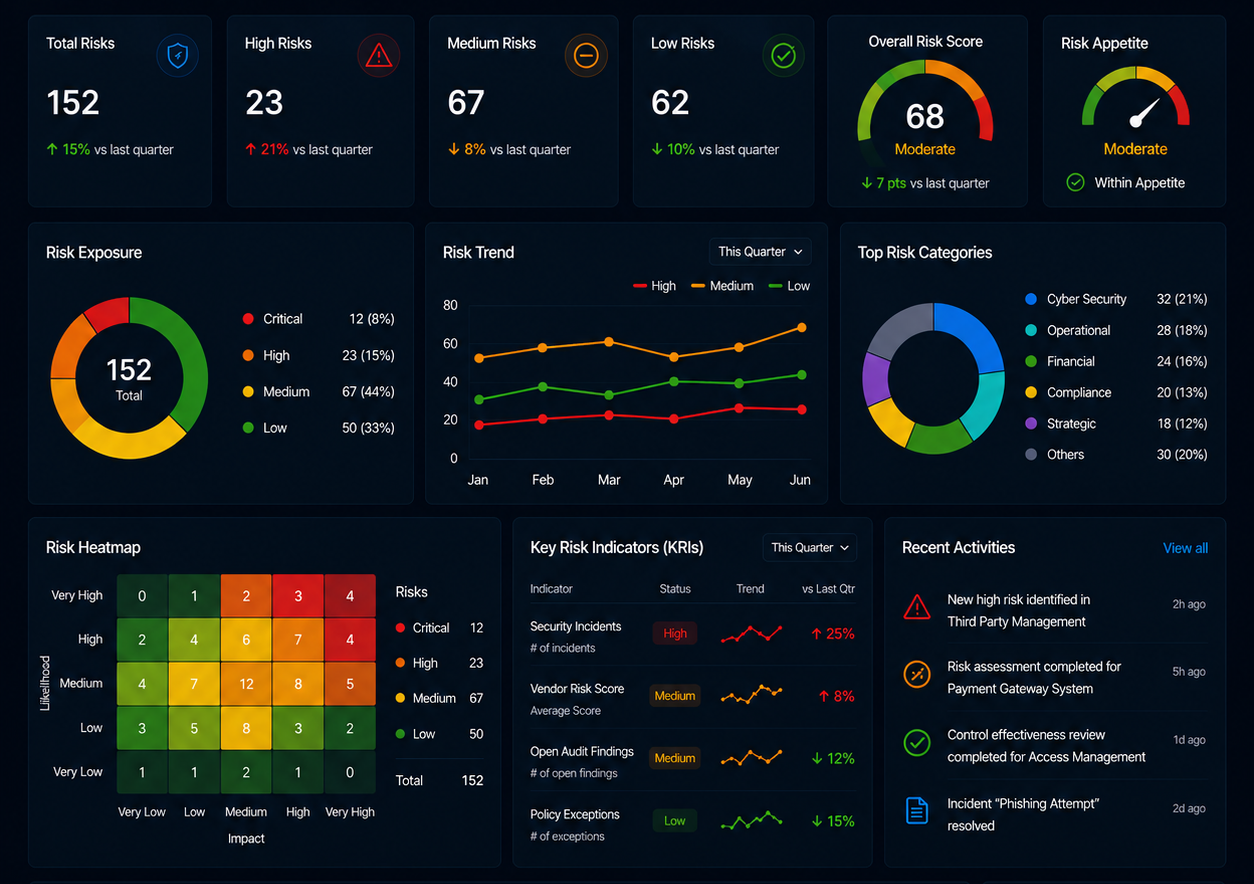
Enterprise Risk Dashboard
ASPIA Enterprise Risk Management Dashboard
ENTERPRISE RISK VISIBILITY

Enterprise Risk Visibility

Gain executive visibility into risk exposure, treatment progress, and enterprise risk posture.

Risk Heat Maps
Top Risks
Risk Trends
Risk Categories
Treatment Status
Business Unit Risk Exposure
Executive Dashboards
WHY RISK TEAMS CHOOSE ASPIA

Risk Governance & Accountability

Organizations across regulated industries trust ASPIA to operationalize risk governance, approvals, and accountability programs.

Multi-Level Approvals

Configurable approval chains for risk decisions

Risk Acceptance Governance

Formal risk acceptance with oversight

Treatment Ownership

Clear accountability for risk treatment

Automated Notifications

Reminders, escalations, and SLA tracking

Executive Visibility

Dashboards, reporting, and leadership insights

Complete Audit Trails

Full history of risk decisions and changes

CONNECTED RISK MANAGEMENT

Connect Enterprise Risks Across Governance Programs

Link enterprise risks with audit observations, vendor findings, vulnerabilities, compliance issues, incidents, and remediation activities.

Connected Governance Structure
Enterprise Risk
Audit Findings 8 linked
Vendor Findings 12 linked
Vulnerabilities 24 linked
Incidents 5 linked
Compliance Issues 15 linked
UNIFIED GOVERNANCE VISIBILITY

Connect enterprise risks across audit, vendor, compliance, and security programs

Maintain complete visibility into risk exposure across governance, risk, compliance, and security operations programs.

Link enterprise risks with audit observations, vendor findings, vulnerabilities, compliance issues, incidents, and remediation activities.

Connect audit findings to enterprise risks
Link vendor risks to risk registers
Map vulnerabilities to risk exposure
Connect compliance issues to risk treatment
Link incidents to risk registers
Track remediation across all risk sources
RELATED CAPABILITIES

Extend Enterprise Risk Management

Connect enterprise risk management with related governance capabilities to strengthen risk monitoring, exception governance, and enterprise risk visibility.

"`

Key Risk Indicator Management

Monitor enterprise risks through measurable indicators, threshold monitoring, breach detection, escalation workflows, trend analysis, and executive reporting.

Explore KRI Management

Exception Management

Govern risk acceptance, policy exceptions, approvals, compensating controls, review cycles, and exception expiry through structured workflows.

Explore Exception Management

Risk Register Management

Maintain centralized risk registers with ownership, categorization, assessments, treatment plans, review cycles, and governance oversight.

Explore Risk Register Management
"`
Frequently Asked Questions

Enterprise Risk Management Software FAQs

Learn how ASPIA helps organizations identify, assess, treat, monitor, and report on enterprise risks through connected risk management workflows.

Enterprise Risk Management (ERM) software helps organizations identify, assess, monitor, treat, and govern risks across business functions. ASPIA enables organizations to manage the complete risk lifecycle through risk assessments, treatment planning, ownership tracking, review workflows, and executive reporting.

ASPIA helps organizations operationalize enterprise risk management by providing structured workflows for risk identification, risk assessment, treatment planning, action tracking, risk reviews, and closure management. This helps improve accountability and visibility across risk programs.

Yes. ASPIA supports multiple risk categories including operational risk, information security risk, compliance risk, third-party risk, strategic risk, financial risk, and project risk within a centralized risk management framework.

Yes. ASPIA enables organizations to assess inherent risk, evaluate control effectiveness, calculate residual risk, and maintain visibility into risk exposure throughout the risk management lifecycle.

Yes. ASPIA supports common risk response strategies including risk mitigation, risk acceptance, risk transfer, and risk avoidance. Organizations can document decisions, approvals, treatment actions, and supporting evidence within the platform.

Yes. ASPIA supports operational risk management programs including risk identification, control assessments, risk event tracking, treatment planning, and operational risk reporting within a structured governance framework.

Yes. ASPIA enables organizations to create risk treatment plans, assign owners, track action items, monitor due dates, review progress, and maintain accountability through structured workflows.

Yes. Risks can be assigned to business owners, process owners, risk owners, department heads, and other responsible stakeholders. ASPIA helps organizations maintain clear accountability for risk treatment and risk governance activities.

Yes. ASPIA provides executive dashboards, risk heat maps, risk trend analysis, treatment status reporting, category-based risk reporting, business unit risk visibility, and enterprise-wide risk reporting.

Traditional risk register tools primarily document risks and generate reports. ASPIA goes beyond risk documentation by enabling organizations to execute risk treatment plans, assign ownership, track actions, manage reviews, and maintain accountability throughout the complete risk management lifecycle.

REQUEST A DEMO

See How ASPIA Operationalizes Enterprise Risk Management

Identify, assess, treat, monitor, and govern enterprise risks through structured workflows, ownership, approvals, and executive visibility.

Request Demo