
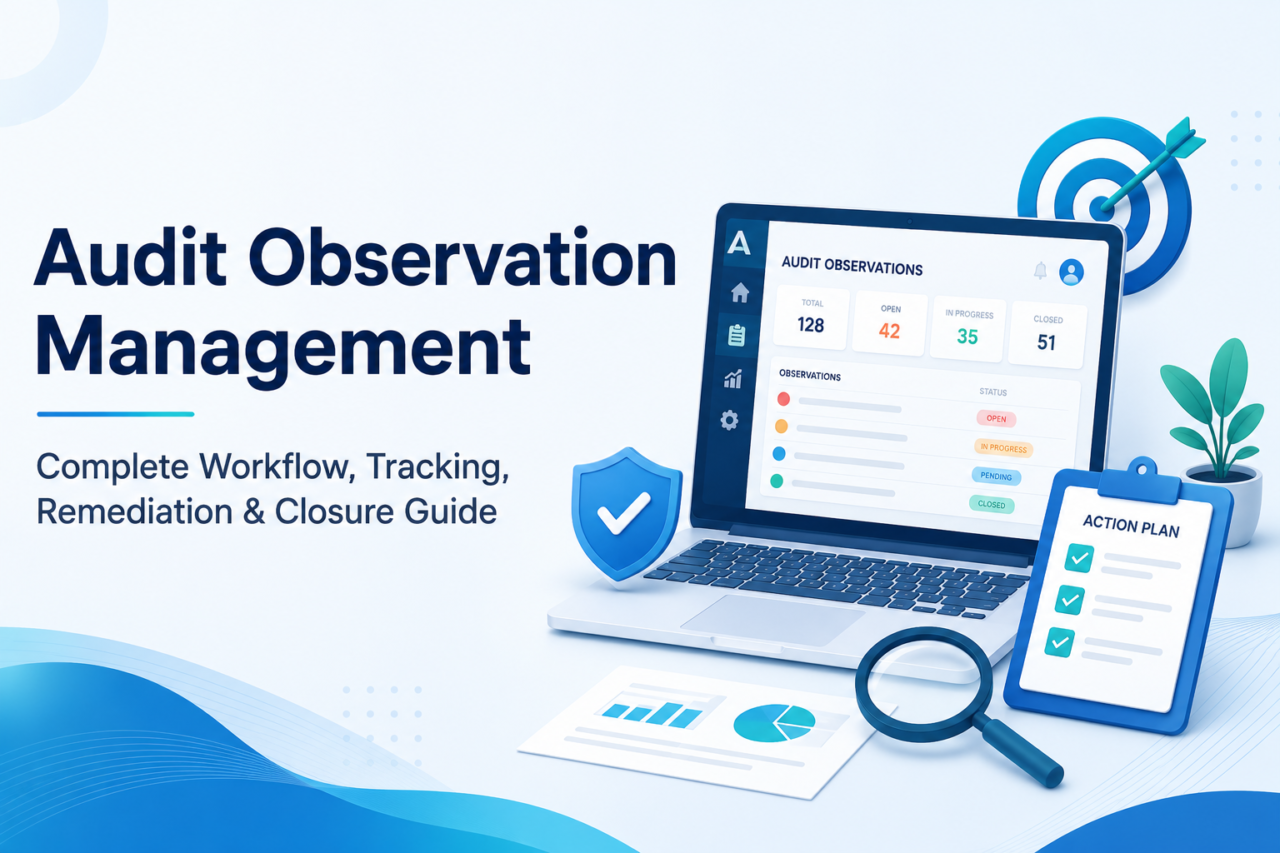
Audit Observation Management: Workflow, Remediation & Closure Guide 2026
Master the complete audit observation lifecycle from raising findings to final closure. Learn best practices, avoid common mistakes, and move beyond spreadsheets to drive real accountability.
In the high-stakes world of enterprise governance, the true measure of an internal audit function’s maturity isn’t just the number of reports it produces—it’s the speed and efficacy with which it drives management to remediate risks and close findings. For too long, the “Audit Observation” has been the unsung hero of the risk management cycle; identified, documented, and then… lost.
This guide serves as your definitive playbook. We will dissect the complete audit observation lifecycle, explore the nuances between findings and actions, and demonstrate how a modern platform like ASPIA can transform this traditionally chaotic process into a streamlined engine of governance excellence.
Key Takeaway:
Audit observations are governance commitments, not checklist items. Closing an observation should reduce risk, not simply complete a task.
1. What is Audit Observation Management?
At its core, Audit Observation Management is the end-to-end process of tracking, managing, and resolving issues identified during an internal audit engagement. It begins the moment an auditor identifies a deviation from a policy, standard, or regulation—the “Observation”—and continues through to the submission of evidence, management validation, and final closure.
Featured Snippet — What is Audit Observation Management?
Audit Observation Management is the systematic process of tracking, remediating, and closing findings identified during an internal audit. It is a structured workflow that ensures every audit issue is assigned a clear owner, a root cause is identified, a corrective action plan is created, and remedial evidence is submitted and validated by a deadline, ultimately closing the loop on audit risks.
Effective management is less about simply tracking a “finding” and more about managing the risk that the finding represents. It ensures that the audit is not just a snapshot in time but a catalyst for continuous improvement and risk mitigation.
2. Why Audit Observation Management Matters
Ignoring the observation management process is a fast track to governance failure. Here’s why getting it right is non-negotiable.
Common Pitfall:
Assigning ownership to a department rather than an individual. This diffusion of responsibility often leads to the observation languishing with no one accountable. Always assign a specific, named individual.
The Pitfalls of Manual Tracking
- Version Control Nightmares: Which version of the “Audit Action Plan” is the current one?
- Lack of Real-Time Visibility: CAEs and Risk Officers are forced to ask for status updates.
- Missed Due Dates: Without automated notifications, deadlines fly by.
- Audit Fatigue: The constant fire-drill of email follow-ups burns out teams.
Expert Insight:
In over 15 years of audit consulting, I have rarely seen a spreadsheet with more than 50 observations that was truly accurate. The data entry errors, the missed updates, and the sheer administrative burden of maintaining it make it an unreliable source of truth.
Best Practice:
Treat every audit observation as a potential regulatory issue. If you can’t easily produce a complete audit trail for a single observation, how will you defend your entire audit process during a regulator’s inspection?
3. Audit Observation vs. Audit Finding: A Critical Distinction
While often used interchangeably, “Audit Observation” and “Audit Finding” serve different purposes. Clarifying this distinction is crucial for clear communication and effective remediation.
4. The Complete Audit Observation Lifecycle
A mature Audit Observation Management process follows a structured lifecycle that ensures every observation progresses from identification to validated closure through clearly defined governance stages.
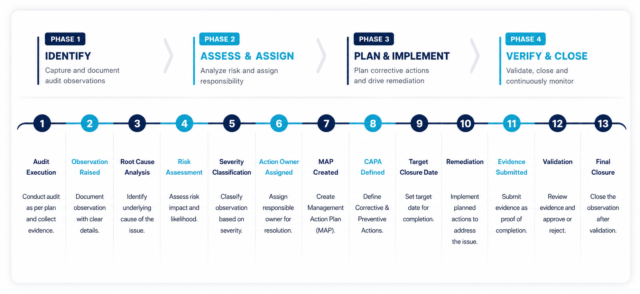
Audit Planning & Execution → Observation Raised → Root Cause Analysis → Risk Assessment → Severity Classification → Action Owner Assignment → Management Action Plan (MAP) → Corrective & Preventive Action (CAPA) → Target Closure Date → Remediation → Evidence Submission → Validation → Final Closure → Executive Dashboard & Continuous Monitoring.
5. Root Cause Analysis: Getting to the “Why”
Patience is a virtue, but if you fix a symptom without understanding the disease, the problem will return. Root Cause Analysis (RCA) is the most critical step in ensuring you’re not just “putting a band-aid on a bullet wound.”
Expert Insight:
In banking audits, the most common RCA failure is stopping at “human error.” When auditors dig deeper, the “human error” is almost always the result of a systemic process failure or a lack of adequate training.
Common RCA Methods
- The 5 Whys: Drill down to the fundamental issue by asking “Why?” repeatedly.
- Fishbone (Ishikawa) Diagram: Categorize causes into Methods, Machines, Materials, Manpower, Measurement, and Environment.
- Process Gap Analysis: Compare “as-is” vs. “should-be” process.
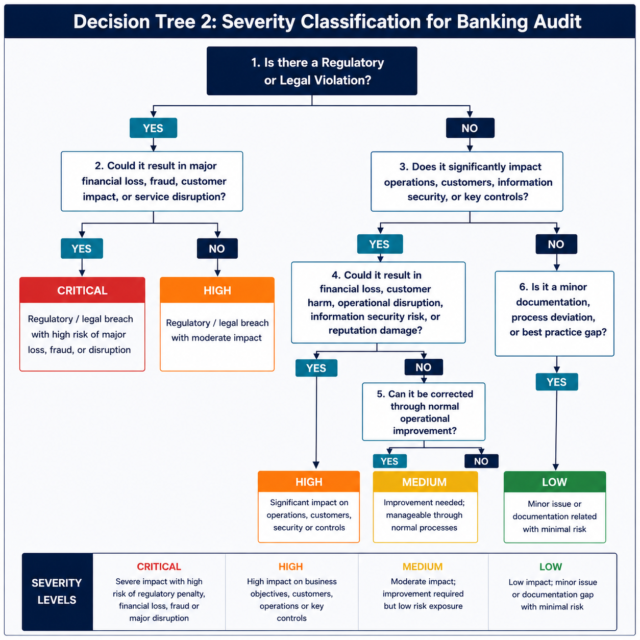
6. Severity Classification: Prioritizing Risk
Not all audit observations are created equal. A standard 4-point scale is common across enterprises.
7. The Management Action Plan (MAP): The Promise to Fix
Once an observation is raised, the management of the audited unit must respond. This is formalized in the Management Action Plan (MAP). It is a commitment to address the issue.
The MAP requires the Action Owner to provide concrete details:
- Owner: A specific, named individual responsible for execution.
- Due Date: The date by which the plan will be complete.
- Budget (if applicable): Is there a financial cost associated with the fix?
- Milestones: Breaking the plan into smaller, checkable steps.
- Dependencies: Does the plan rely on other teams?
- Success Criteria: How will we know this has been fixed?
Best Practice:
The MAP should be documented and agreed upon before the audit report is finalized. This creates a shared understanding and commitment, reducing the risk of management disputing the findings later.
8. Corrective and Preventive Action (CAPA): The Difference is Key
CAPA is a structured approach to problem-solving. It distinguishes between immediate fixes and long-term prevention.
- Correction: An immediate action to fix a specific, isolated problem. (e.g., replacing a broken light bulb).
- Corrective Action: Action taken to eliminate the cause of the detected problem. (e.g., implementing a scheduled preventative maintenance program).
- Preventive Action: Action taken to eliminate the potential cause of a future problem. (e.g., scheduling a tune-up based on data analytics).
9. Roles and Responsibilities in Audit Observation Management
10. The Governance Framework: The Three Lines Model
The Three Lines of Defense is a globally recognized framework for effective governance and risk management.
11. The Essential Audit Observation Dashboard: KPIs for Success
You can’t manage what you don’t measure. Here are the essential KPIs you should be tracking.
12. Maturity Model: From Excel to Predictive Audit
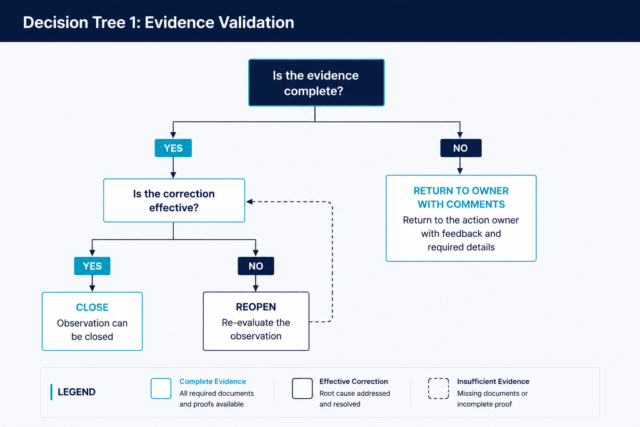
13. Decision Trees for Effective Observation Management
Decision trees provide a clear, visual guide for auditors and action owners, standardizing decision-making and reducing ambiguity.
14. Best Practices for Auditors and Management
- Write Clear, Actionable Observations: Avoid vague language.
- Agree on the Root Cause: Don’t let management propose a fix until you both agree.
- Set Realistic Deadlines: Unrealistic deadlines encourage artificial closure.
- Use Automated Notifications: Reduce “audit fatigue”.
- Evidence is King: Demand concrete evidence.
- Maintain an Audit Trail: Every comment, email, approval is crucial.
- Track Repeat Findings: Flag for deeper investigation.
15. Common Mistakes (And How to Avoid Them)
- Treating All Observations Equally: Use Severity Classification rigorously.
- Letting Management “Close” their own findings: Enforce segregation of duties.
- Using Email as a Workflow: Implement a centralized tracker.
- Ignoring Repeat Findings: Track and flag for deep-dive reviews.
- “Scope Creep” in Remediation: Stick to the MAP.
- Not Testing the Fix: Always require evidence of re-testing.
16. Understanding RBI’s Expectations for Internal Audit
For banks, NBFCs, and financial institutions in India, the Audit Observation Management process is not a matter of choice—it’s a regulatory mandate.
- Board and Audit Committee Oversight: Active oversight over internal audit function.
- Risk-Based Internal Audit (RBIA): Prioritize audits based on risk profile.
- Management Response and Accountability: Formal, documented management response.
- Follow-up and Timely Closure: Structured process to ensure issues are resolved.
- Escalation of Overdue Actions: Escalate overdue actions to Board.
- Documentation and Evidence: “Paper trail” is crucial.
17. Connecting Audit Observations to Enterprise GRC
Audit observations do not exist in a silo. Integration points:
- Risk Register Management: Link observations to enterprise risks.
- Risk and Control Self-Assessment (RCSA): Update RCSA with audit findings.
- Key Risk Indicators (KRIs): Link observations to KRIs.
- Risk and Control Matrix (RCM): Audit observations are test results.
- Compliance Management: Link to regulatory requirements.
- Vendor Risk Management: Track third-party observations.
- ITGC Audit: Link to technology risk profile.
18. How ASPIA Improves Audit Observation Management
ASPIA Infotech is purpose-built to transform the chaotic, spreadsheet-driven audit observation management process into a streamlined, automated, and transparent governance operation.
- Risk-Based Internal Audit Planning: Build Audit Universe dynamically.
- Streamlined Audit Programs: Link checklist items to observations.
- Centralized Audit Evidence Collection: Single secure repository.
- Observations as a Data Object: Structured with metadata.
- Embedded Root Cause Analysis: Guided RCA process.
- Dynamic Owner Assignment: Automatic notifications.
- Automated Notifications: Reminders, escalation alerts.
- Validation Workflow: Enforces segregation of duties.
- Executive Dashboards & Reports: Real-time KPIs.
- Immutable Audit Trails: Complete chain of evidence.
- Connected Governance: Links to Risk Register, RCSA, operational risk.
19. Traditional Tracking vs. ASPIA: A Comparative Analysis
20. Real Enterprise Examples: Banking Scenarios
21. Frequently Asked Questions (FAQs)
22. Conclusion
Audit Observation Management is the backbone of an effective internal audit function. It is the mechanism through which governance, risk, and compliance (GRC) cease to be abstract concepts and become tangible, actionable realities. As we navigate the complexities of 2026, the cost of manual, fragmented tracking is simply too high.
The modern CAE, CRO, or CISO needs more than just a checklist; they need a strategic partner to manage the entire lifecycle of risk mitigation. They need a platform that fosters accountability, provides real-time visibility, and connects audit observations to the broader risk landscape.
By adopting a systematic, automated approach—as facilitated by platforms like ASPIA—organizations can transform the audit observation process from a necessary burden into a strategic asset. It empowers audit teams to move beyond compliance policing and become trusted advisors, helping the business navigate risk with confidence and agility.
Ready to move beyond spreadsheets and automate your Audit Observation Management?
ASPIA Infotech helps enterprises manage the entire lifecycle of their audit observations in one unified platform. From raising and tracking to closure and reporting, gain full visibility and control over your audit portfolio.

