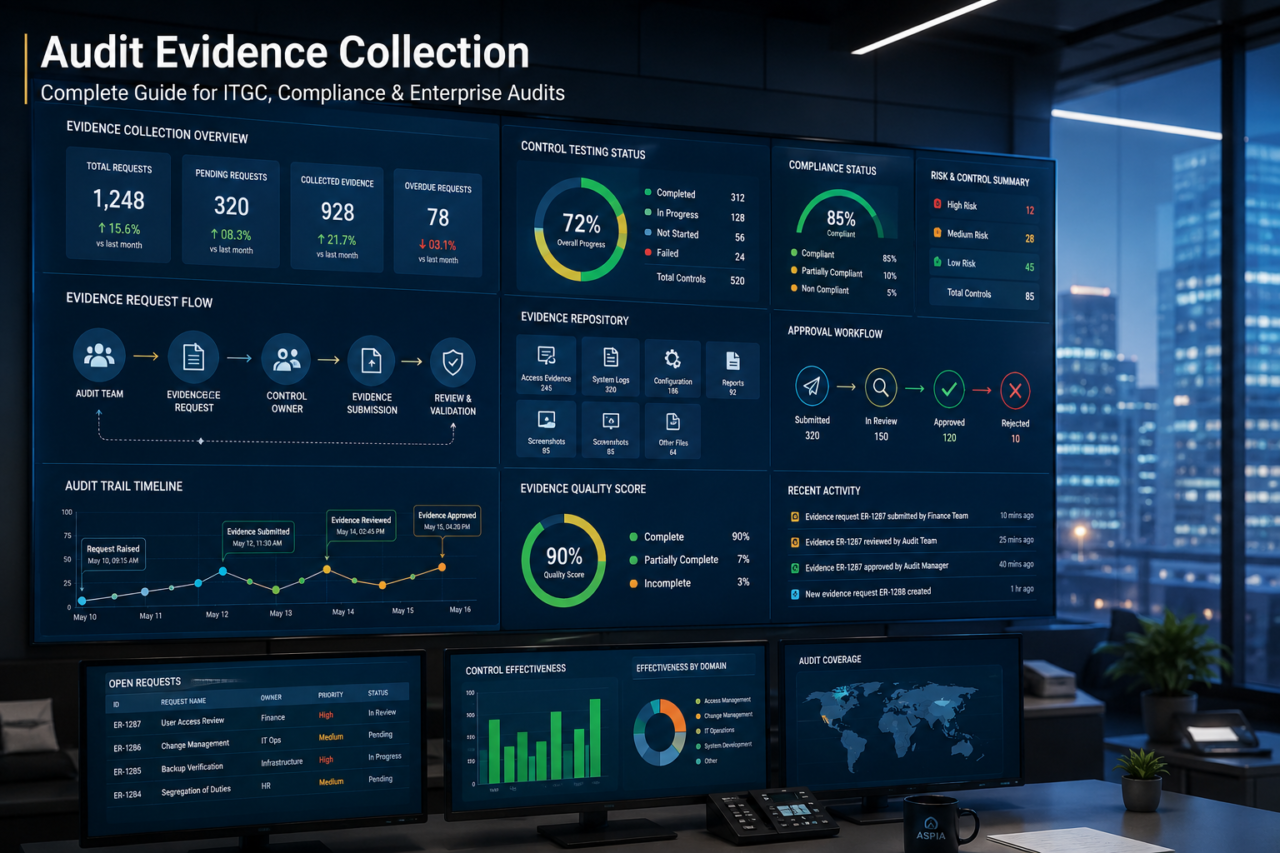
Audit evidence collection is the process of gathering, validating, organizing, and maintaining records that demonstrate whether security controls, compliance requirements, policies, and operational processes are functioning effectively. In modern enterprise environments, audit evidence is critical for ITGC audits, ISO 27001 audits, SOC 2 assessments, RBI compliance reviews, internal audits, vendor risk assessments, cybersecurity assessments, and regulatory inspections.
Organizations today operate across cloud environments, SaaS platforms, DevOps pipelines, multi-vendor ecosystems, and hybrid infrastructure. As environments become more distributed, collecting audit-ready evidence manually through spreadsheets, screenshots, emails, and shared folders becomes increasingly difficult.
This guide explains the complete audit evidence collection process, including evidence types, collection methods, common challenges, automation strategies, compliance requirements, and best practices.
1. What is Audit Evidence?
Audit evidence refers to records, logs, documents, screenshots, configurations, reports, or system-generated artifacts used to verify whether controls and processes are operating effectively.
Auditors use evidence to validate security controls, compliance requirements, access management, change management, operational processes, incident handling, backup activities, monitoring controls, and regulatory obligations.
Strong evidence collection improves audit readiness, compliance visibility, governance maturity, risk management, and operational transparency.
2. Why Audit Evidence Collection Is Important
Organizations frequently fail audits not because controls are missing, but because they cannot produce sufficient evidence demonstrating that controls operated consistently.
Common Audit Observations
- Missing approval records
- Incomplete access review evidence
- No backup restoration reports
- Weak change management documentation
- Missing vulnerability remediation evidence
- Inconsistent log retention
- Screenshots without timestamps
- Unstructured evidence repositories
Industry Statistics & Research Insights
- According to IBM’s Cost of a Data Breach Report, organizations with mature governance and monitoring capabilities generally reduce breach containment timelines.
- The Verizon DBIR consistently highlights that weak access governance and operational visibility gaps remain major contributors to security incidents.
- Industry research from Gartner and Ponemon indicates that organizations relying heavily on manual evidence collection often struggle with audit fatigue, delayed assessments, and evidence gaps.
3. Types of Audit Evidence
Audit evidence can exist in multiple forms depending on the control being evaluated.
1. System-Generated Evidence
SIEM logs, CloudTrail logs, firewall logs, access logs, endpoint monitoring alerts, backup reports
2. Configuration Evidence
MFA settings, IAM configurations, security group rules, encryption configurations, password policy settings
3. Process Evidence
Change approvals, incident tickets, risk acceptance records, access review approvals, exception approvals
4. Compliance Documentation
Policies and procedures, SOC 2 reports, ISO 27001 certificates, internal audit reports, risk assessments
5. Operational Evidence
DR drill reports, backup restoration testing, vulnerability remediation reports, monitoring dashboards, SLA review reports
4. Common Audit Evidence Artifacts
Enterprise audits commonly require organizations to collect and validate:
- Access review reports
- User provisioning records
- Change tickets
- Vulnerability scan reports
- Penetration testing reports
- Incident response records
- Backup reports
- Disaster recovery testing evidence
- Security monitoring logs
- MFA enforcement screenshots
- IAM role configurations
- Risk register entries
- Audit trail logs
- Vendor assessment evidence
- Security policies and SOPs
5. Audit Evidence Collection Process
A mature audit evidence management process follows a structured workflow.
Step 1: Define Audit Scope
Identify systems in scope, applicable controls, regulatory requirements, business processes, cloud environments, and third-party dependencies.
Step 2: Identify Required Evidence
Map controls to required artifacts.
Step 3: Collect Evidence
Evidence may be collected from cloud platforms, SIEM tools, IAM systems, GRC platforms, ticketing tools, DevOps platforms, endpoint security tools, and compliance repositories.
Step 4: Validate Evidence
Organizations should verify accuracy, completeness, time relevance, control applicability, and audit traceability.
Step 5: Organize & Store Evidence
Evidence should be centralized, searchable, access-controlled, version tracked, and audit-ready.
Step 6: Support Audit Review
Provide auditors with structured evidence mapping, control references, supporting documentation, approval workflows, and evidence lineage.
6. Control-to-Evidence Mapping
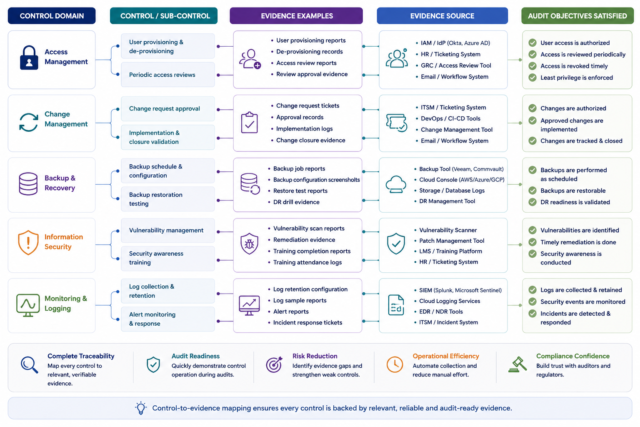
| Control Area | Required Evidence |
|---|---|
| Access Management | Access review reports |
| Change Management | Approved change tickets |
| Backup Management | Backup restoration reports |
| Vulnerability Management | Remediation evidence |
| Incident Response | Incident investigation records |
7. Audit Evidence Collection for ITGC Controls
Access Management Evidence
User provisioning approvals, access review reports, MFA enforcement screenshots, privileged access logs, termination records
Change Management Evidence
Approved change requests, UAT evidence, CAB approvals, deployment records, emergency change logs
Backup & Recovery Evidence
Backup job reports, restoration testing reports, DR drill evidence, recovery validation logs
Security Monitoring Evidence
SIEM alerts, log monitoring reports, firewall review evidence, incident investigation records
8. Audit Evidence Collection Challenges
- Spreadsheet Dependency: Manual tracking creates duplicate records, missing artifacts, version conflicts, and delayed audits
- Evidence Fragmentation: Evidence often distributed across shared drives, emails, cloud platforms, ticketing systems, and local folders
- Lack of Standardization: Different teams frequently collect evidence inconsistently
- Missing Audit Traceability: Many artifacts lack timestamps, approval references, ownership details, and change history
- Audit Fatigue: Security, compliance, audit, and operations teams spend excessive time gathering repetitive evidence manually
9. Manual vs Automated Audit Evidence Collection
| Manual Evidence Collection | Automated Evidence Collection |
|---|---|
| Spreadsheet-driven tracking | Centralized evidence repositories |
| Screenshot-based validation | API-based integrations |
| Fragmented evidence storage | Evidence lineage and traceability |
| Manual audit preparation | Real-time governance visibility |
| Higher operational effort | Automated workflows |
10. Continuous Assurance & Evidence-Based Governance
Modern organizations increasingly move from periodic evidence collection toward continuous assurance, ongoing control validation, automated evidence collection, real-time compliance visibility, and persistent monitoring.
This improves audit readiness, operational transparency, regulatory preparedness, governance maturity, and risk visibility.
Mature organizations increasingly integrate evidence collection directly into cloud infrastructure, SIEM platforms, DevOps workflows, identity systems, GRC platforms, and ticketing systems.
11. Audit Evidence Maturity Model
| Level | Maturity | Description |
|---|---|---|
| Level 1 | Reactive | Manual evidence collection, fragmented storage, no standardization |
| Level 2 | Defined | Basic checklists, documented processes, inconsistent evidence quality |
| Level 3 | Managed | Centralized evidence repository, periodic evidence validation, control mapping |
| Level 4 | Automated | Automated evidence collection, API integrations, evidence lineage tracking |
| Level 5 | Optimized | Continuous assurance, real-time monitoring, predictive compliance insights |
Ready to advance your audit evidence maturity?
Learn how ASPIA helps organizations automate audit evidence collection, control mapping, and continuous assurance.
Request an ASPIA Demo12. Automating Audit Evidence Collection With Aspia
Manual evidence collection is one of the largest operational burdens for security, compliance, audit, and GRC teams. Aspia helps organizations automate and centralize audit evidence collection across enterprise environments.
How Aspia Helps
- Centralize audit evidence repositories
- Automate evidence collection workflows
- Map evidence to controls and frameworks
- Track remediation activities
- Maintain audit trails
- Improve evidence traceability
- Streamline auditor collaboration
- Reduce spreadsheet dependency
Key Automation Capabilities
- Evidence management
- Integration with AWS, Azure, Jira, GitHub, SIEM, IAM, and ticketing platforms
- Evidence version tracking
- Control-to-evidence mapping
- Workflow automation
- Risk and remediation tracking
- Audit-ready reporting dashboards
13. Evidence Ownership & Accountability
| Role | Responsibility |
|---|---|
| Control Owners | Ensure controls operate effectively |
| Evidence Custodians | Maintain evidence repositories and traceability |
| Audit Reviewers | Validate evidence completeness and quality |
| Compliance Teams | Map evidence to regulatory requirements |
| Remediation Owners | Address audit findings and evidence gaps |
14. Best Practices for Audit Evidence Collection
- Centralize Evidence Management – Avoid fragmented evidence storage
- Standardize Collection Processes – Use consistent evidence mapping and workflows
- Validate Evidence Quality – Ensure artifacts contain timestamps, approvals, and audit traceability
- Automate Evidence Collection – Reduce manual effort using workflow automation and integrations
- Implement Continuous Assurance – Move beyond annual audit preparation toward ongoing governance visibility
- Align Evidence With Controls – Map artifacts directly to compliance and audit requirements
15. Frequently Asked Questions (FAQs)
What is audit evidence?
Why is audit evidence collection important?
What are common audit evidence examples?
What is continuous assurance?
How can audit evidence collection be automated?
16. Final Thoughts
As organizations increasingly operate across cloud platforms, SaaS ecosystems, DevOps pipelines, and distributed infrastructure, audit evidence collection has evolved from a manual compliance activity into a continuous governance discipline.
Organizations implementing mature evidence collection processes achieve faster audits, stronger governance, improved compliance visibility, reduced operational burden, better risk management, and improved regulatory preparedness.
Automated evidence collection is rapidly becoming a foundational capability for modern cybersecurity, compliance, audit, and enterprise GRC programs.
Modernize Audit Evidence Collection With Aspia
Aspia helps organizations automate audit evidence collection, control mapping, continuous assurance workflows, remediation tracking, compliance monitoring, audit reporting, evidence validation, and workflow automation.
- ✓ Automated evidence collection workflows
- ✓ Centralized evidence repositories
- ✓ Continuous Controls Monitoring (CCM)
- ✓ Control-to-evidence mapping
- ✓ Integration with cloud and security platforms
- ✓ Audit-ready reporting dashboards
- ✓ Workflow automation for remediation tracking
Reduce spreadsheet-driven audit preparation with centralized evidence automation.
Request an ASPIA Demo