Vendor due diligence is the process of evaluating third-party vendors before onboarding them to ensure they meet security, compliance, operational, financial, and regulatory requirements. Modern organizations increasingly rely on external vendors for cloud hosting, SaaS platforms, payment processing, IT operations, managed security services, and outsourced business functions.
For banks, fintech companies, healthcare organizations, and enterprises handling sensitive data, weak vendor due diligence can result in data breaches, regulatory penalties, supply-chain attacks, financial fraud, service outages, and compliance violations. That is why vendor due diligence has become a critical component of Third-Party Risk Management (TPRM), ISO 27001, SOC 2, RBI outsourcing governance, and enterprise GRC programs.
This guide explains the complete vendor due diligence process, including vendor assessments, risk scoring, compliance validation, evidence collection, onboarding workflows, fourth-party risk, and best practices.
1. What is Vendor Due Diligence?
Vendor due diligence is the process of validating whether a vendor has appropriate controls, governance practices, security measures, operational capabilities, and compliance readiness before establishing a business relationship.
The goal is to ensure vendors protect sensitive information, maintain strong cybersecurity controls, meet regulatory requirements, operate reliably, and do not introduce unacceptable risk.
Vendor due diligence is commonly performed during vendor onboarding, procurement reviews, cloud outsourcing evaluations, annual reassessments, critical vendor reviews, and mergers and acquisitions.
2. Why Vendor Due Diligence Is Important
A single weak vendor can compromise an entire enterprise ecosystem. Modern organizations share data, systems, APIs, infrastructure, and operational dependencies with third parties, increasing exposure to third-party cyber risk, supply-chain attacks, operational disruptions, data leakage, regulatory non-compliance, and service outages.
Industry Statistics & Research Insights
- According to IBM’s Cost of a Data Breach Report, third-party compromise remains one of the most expensive breach vectors due to delayed containment timelines.
- The Verizon DBIR has consistently highlighted credential compromise, phishing, and third-party exposure as major contributors to enterprise breaches.
- Research from ENISA and CrowdStrike indicates that supply-chain attacks and SaaS-related incidents continue to increase.
- Gartner and Ponemon research emphasize that organizations with mature vendor governance achieve faster onboarding, improved audit readiness, and better visibility into external dependencies.
Real-World Operational Challenges
During enterprise and banking assessments, common due diligence observations include:
- Vendors using shared privileged accounts
- Missing SOC 2 or ISO 27001 evidence
- Weak MFA implementation
- Incomplete backup restoration testing
- Lack of vendor incident response commitments
- Weak subcontractor visibility
- Inadequate cloud security monitoring
3. Regulatory & Compliance Expectations
Vendor due diligence is increasingly required by regulators and compliance frameworks.
Common Regulatory Drivers
- RBI outsourcing guidelines
- ISO 27001 vendor controls
- SOC 2 Trust Services Criteria
- PCI DSS third-party requirements
- HIPAA business associate requirements
- NIST supply-chain security guidance
RBI Expectations
The Reserve Bank of India (RBI) expects regulated organizations to:
- Perform vendor due diligence before onboarding
- Assess cloud outsourcing risks
- Maintain audit trails and evidence
- Periodically reassess critical vendors
- Validate business continuity capabilities
- Monitor vendor security posture continuously
Banks failing to demonstrate proper vendor governance often face observations related to weak onboarding controls, missing audit evidence, inadequate vendor monitoring, and lack of subcontractor oversight.
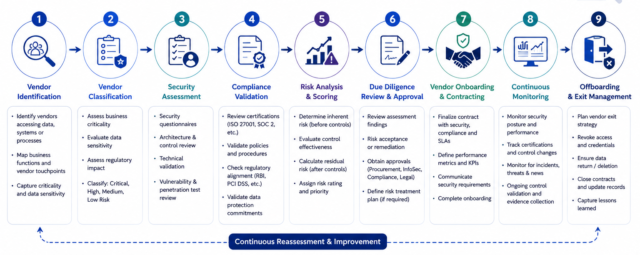
4. Vendor Due Diligence Process (Step-by-Step)
A mature vendor due diligence program follows a structured and evidence-driven workflow.
Step 1: Vendor Identification
Identify vendors interacting with sensitive data, production systems, internal applications, cloud infrastructure, or critical business operations. Examples include SaaS providers, cloud hosting vendors, payment processors, managed service providers, and security vendors.
Step 2: Vendor Classification
Classify vendors based on business criticality, data sensitivity, system access, regulatory impact, and cloud dependency. Typical classifications: Critical, High Risk, Medium Risk, Low Risk. Critical vendors typically require enhanced due diligence.
Step 3: Security Assessment
Security reviews evaluate whether vendors maintain adequate cybersecurity controls. Common assessment areas include MFA enforcement, IAM controls, privileged access management, SIEM monitoring, vulnerability management, endpoint protection, encryption standards, logging and monitoring, and incident response capabilities.
Organizations relying only on questionnaires without validating evidence often develop false confidence in vendor security posture. Many enterprises also struggle to validate whether vendor SOC 2 reports actually cover the in-scope services being procured.
Step 4: Compliance Validation
Organizations validate whether vendors meet applicable regulatory and compliance obligations. Common evidence reviewed includes ISO 27001 certificates, SOC 2 reports, PCI DSS attestations, security policies, internal audit reports, penetration testing reports, and data protection agreements.
Step 5: Financial & Operational Review
Common review areas include financial health, SLA commitments, operational maturity, incident management capabilities, business continuity planning, disaster recovery testing, and support responsiveness.
Step 6: Risk Scoring
Mature organizations separate inherent risk (exposure before evaluating controls) and residual risk (remaining exposure after evaluating safeguards). Many enterprises implement weighted scoring methodologies using likelihood-versus-impact analysis.
Step 7: Vendor Approval & Onboarding
Common onboarding controls include NDA execution, DPA reviews, access restrictions, SLA definitions, security clauses, and audit rights.
Step 8: Continuous Monitoring & Reassessment
Vendor due diligence should not end after onboarding. Modern organizations increasingly implement Continuous Controls Monitoring (CCM), ongoing evidence validation, security rating monitoring, API-based integrations, real-time risk tracking, and annual or periodic reassessments.
5. Common Vendor Due Diligence Artifacts
Enterprise vendor reviews commonly require organizations to collect and validate operational, security, compliance, and contractual evidence.
- SOC 2 reports
- ISO 27001 certificates
- Penetration testing reports
- Vulnerability assessment reports (VAPT)
- Security policies and procedures
- Data Processing Agreements (DPAs)
- Architecture diagrams
- Shared responsibility matrices
- Business Continuity and Disaster Recovery (BCP/DR) evidence
- Incident response policies
- Access control policies
- Audit reports and remediation evidence
6. Risk Scoring Factors
| Risk Area | Example Criteria |
|---|---|
| Data Sensitivity | PII, financial data, healthcare data |
| Access Exposure | Administrative or production access |
| Compliance Impact | RBI, ISO 27001, SOC 2 relevance |
| Business Dependency | Critical operational reliance |
| Cloud Exposure | Shared infrastructure or SaaS reliance |
| Security Maturity | MFA, monitoring, IR readiness |
7. Critical vs Non-Critical Vendor Due Diligence
| Area | Critical Vendors | Non-Critical Vendors |
|---|---|---|
| Assessment Scope | Full security and compliance assessment | Lightweight review |
| Evidence Validation | Detailed evidence verification | Basic questionnaire review |
| DR/BCP Review | Mandatory validation | Limited review |
| Reassessment Frequency | Annual or continuous | Periodic review |
| Monitoring Requirements | Ongoing oversight | Limited monitoring |
8. Vendor Due Diligence Checklist
Governance
- Vendor inventory maintained
- Vendor classification defined
- Due diligence policy approved
- Vendor ownership assigned
Security Controls
- MFA enabled
- Logging monitored
- Vulnerability scans conducted
- Endpoint protection active
- Encryption validated
Compliance Controls
- ISO 27001 evidence available
- SOC 2 reports reviewed
- Regulatory obligations mapped
- Audit evidence validated
Operational Controls
- Backup testing completed
- DR testing reviewed
- Incident response process validated
- SLA monitoring implemented
Access Controls
- Privileged access restricted
- User access reviews conducted
- Dormant accounts removed
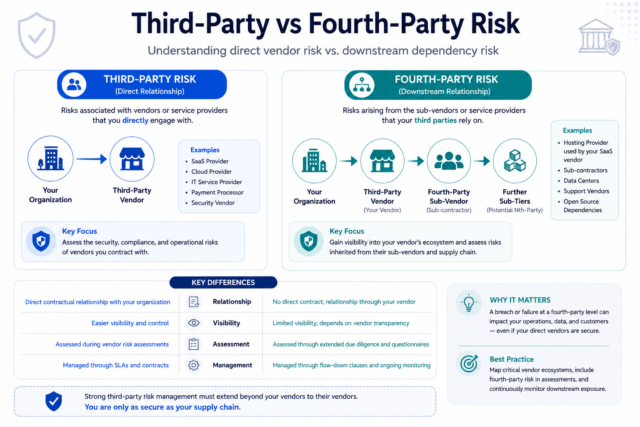
9. Fourth-Party Risk Management
Fourth-party risk refers to exposure introduced by a vendor’s own subcontractors, cloud providers, or external dependencies.
- SaaS vendors relying on cloud infrastructure providers
- Payment processors outsourcing hosting services
- Software vendors integrating third-party APIs
- Managed service providers outsourcing support functions
Mature organizations increasingly require vendors to disclose critical subcontractors, cloud hosting providers, external dependencies, and shared infrastructure exposure.
10. Common Vendor Due Diligence Findings
- Shared admin accounts
- Weak MFA enforcement
- Missing DR testing evidence
- Incomplete audit logs
- Weak vendor onboarding workflows
- Lack of continuous monitoring
- Missing subcontractor visibility
- Inconsistent evidence collection
- Spreadsheet-based vendor tracking
11. Vendor Due Diligence vs Vendor Risk Assessment
| Aspect | Vendor Due Diligence | Vendor Risk Assessment |
|---|---|---|
| Primary Focus | Initial vendor validation | Ongoing risk evaluation |
| Timing | Pre-onboarding and onboarding | Continuous or periodic |
| Objective | Validate vendor suitability | Measure operational and security risk |
| Teams Involved | Procurement, compliance, legal | Security, risk, audit, GRC |
12. Vendor Due Diligence Maturity Model
| Level | Maturity | Description |
|---|---|---|
| Level 1 | Reactive | Manual vendor reviews, no structured process |
| Level 2 | Defined | Policies documented, basic checklists |
| Level 3 | Managed | Periodic assessments, risk scoring |
| Level 4 | Automated | Workflow automation, centralized evidence |
| Level 5 | Optimized | Continuous monitoring, real-time risk tracking |
Ready to advance your vendor due diligence maturity?
Learn how ASPIA helps banks and enterprises automate vendor due diligence workflows, evidence collection, and continuous monitoring.
Request an ASPIA Demo13. TPRM Roles & Responsibilities
| Team | Responsibility |
|---|---|
| Security Team | Control validation and cybersecurity review |
| Compliance Team | Regulatory mapping and compliance validation |
| Procurement Team | Vendor onboarding coordination |
| Legal Team | Contractual clauses and DPA review |
| Internal Audit | Independent assessment and assurance |
| IT Operations | Operational integration and monitoring |
| Business Owners | Vendor relationship oversight |
14. Vendor Due Diligence Best Practices
- Maintain a Central Vendor Inventory – Track all vendors, risk ratings, and dependencies centrally
- Standardize Assessments – Use structured questionnaires and evidence validation workflows
- Validate Evidence – Never rely solely on vendor statements
- Automate Workflows – Reduce manual effort using workflow automation
- Implement Continuous Assurance – Avoid relying only on annual reviews
- Align With Enterprise GRC Programs – Integrate vendor governance with compliance, audit, and risk management processes
15. Frequently Asked Questions (FAQs)
What is vendor due diligence?
Why is vendor due diligence important?
What documents are reviewed during vendor due diligence?
What is the difference between vendor due diligence and TPRM?
What is fourth-party risk?
16. Final Thoughts
As organizations increasingly depend on interconnected cloud ecosystems, vendor due diligence has evolved from a procurement checkpoint into a continuous governance discipline central to enterprise resilience. Modern organizations must evaluate vendors through the lens of cybersecurity, compliance, operational resilience, cloud governance, supply-chain exposure, and continuous assurance.
Organizations that implement mature due diligence programs achieve better audit readiness, stronger vendor governance, faster onboarding, reduced operational risk, improved regulatory compliance, and greater visibility into third-party exposure. As vendor ecosystems become increasingly interconnected, effective due diligence becomes a foundational component of enterprise risk management.
Modernize Vendor Due Diligence With Aspia
Aspia helps organizations streamline and automate vendor onboarding, due diligence workflows, security questionnaires, evidence collection, risk scoring, ongoing vendor assurance, audit reporting, and remediation tracking.
- ✓ Automated assessment workflows
- ✓ Centralized evidence repositories
- ✓ Continuous Controls Monitoring (CCM)
- ✓ Risk dashboards and reporting
- ✓ Integration with cloud and security platforms
- ✓ Audit-ready evidence management
- ✓ Workflow automation for remediation tracking
Replace spreadsheet-based due diligence workflows with centralized governance automation.
Request an ASPIA Demo