Here is what most banks discover only after an audit failure: your controls are probably not as effective as your last spreadsheet says they are. Between assessment cycles, things drift. This guide explains how to stop finding out months later.
A compliance director’s worst week
A bank passed its quarterly IAM review. Every privileged account recertified. Every MFA enabled. Three weeks later, an internal audit found 47 dormant privileged accounts still active across cloud environments. The review relied on a CSV export generated 21 days before the meeting. The control “passed.” The environment had failed for 21 days. The bank spent 200 person-hours reconstructing what happened. They now monitor continuously.
Annual or quarterly audits assume a static environment. Banking IT is not static. Cloud configurations change daily. IAM roles accumulate permissions. Security groups get widened and never reverted. Logging gets disabled to save costs.
By the time the next audit arrives, the environment no longer looks like the attested state. Periodic compliance gives you a snapshot of a moment that no longer exists. Continuous Control Monitoring (CCM) is the alternative.
According to Gartner (2025), organizations with continuous control monitoring reduce audit preparation time by 50-70% compared to manual processes. IBM X-Force reports that 60% of cloud misconfigurations are introduced between audit cycles. The Ponemon Institute estimates that financial institutions spend 34% of audit cycle time on evidence collection alone.
What CCM Actually Does
Continuous Control Monitoring automatically checks, in real-time, whether your controls are still working. It pulls data from IAM, SIEM, cloud APIs, and ticketing systems. It compares current state to your baseline. It alerts when things drift. It tracks whether remediation actually happened.
The goal is not more controls. The goal is to know, at any given moment, whether the controls you already have are actually doing their job.
Periodic vs. Continuous
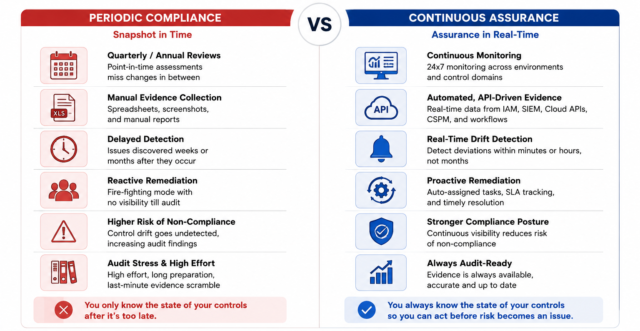
| Traditional audit | CCM | |
|---|---|---|
| Evidence collection | Manual, screenshots, batch | Automated, API-driven, continuous |
| Drift detection | Weeks or months later | Real-time or within hours |
| Remediation follow-up | Email, spreadsheets, no SLA | Auto-assigned, SLA-tracked |
Control Drift: The Reason Periodic Audits Miss Things
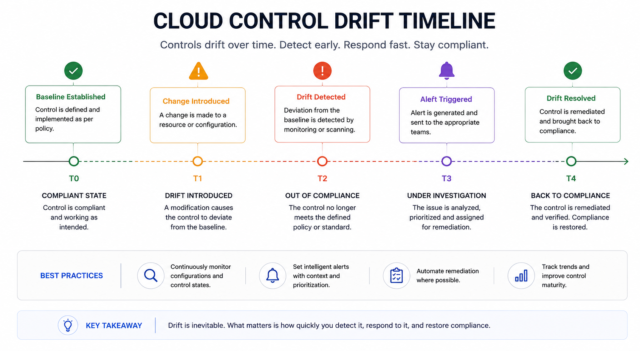
A security group gets widened for a weekend troubleshooting session. No one reverts it. Eighteen months later, it is still open.
CloudTrail logging gets disabled to reduce SIEM costs. No one re-enables it across 200 accounts.
An IAM role accumulates permissions over two years of incremental changes. No one reviews the cumulative effect.
This is control drift. It is not malice. It is operational reality. And periodic audits are not designed to catch it.
Why Screenshots Are Not Evidence
A screenshot taken in March shows MFA enabled. In April, someone adds an exception for a legacy integration. By June, 15% of privileged accounts have MFA disabled. The June audit uses the March screenshot as evidence. The control is marked compliant. It is not.
Static evidence captures a moment that no longer exists. CCM continuously re-validates. Every control assertion includes a timestamp and a source reference. Stale evidence is automatically flagged.
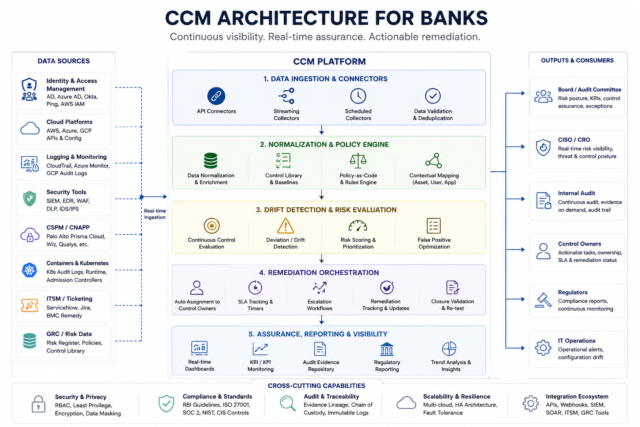
How CCM Fits Together
A working CCM implementation requires four layers:
- Telemetry sources: IAM logs, CloudTrail, Azure Monitor, GCP Audit Logs, CSPM APIs, ticketing systems
- Normalization: A policy engine that compares current state to your control baseline
- Drift detection: Rules that flag deviations — a security group change, a logging disable, IAM permission creep
- Orchestration: Findings auto-assigned to control owners, SLAs enforced, escalations for aging issues
Most banks have the telemetry. The missing pieces are the drift detection rules and the remediation workflows.
Cloud-Native Governance: Where CCM Gets Hard
A Kubernetes pod lives for hours. Traditional audit cycles cannot observe it. Workload identity federation (IRSA, Azure AD Workload Identity, GCP Workload Identity) creates new IAM governance surfaces that most banks do not monitor.
Admission controllers (OPA, Gatekeeper, Kyverno) can enforce policies — but are frequently bypassed during incident response. The bypass is rarely audited. Service mesh configurations (Istio, Linkerd) change daily. Policy propagation across 100+ clusters is often inconsistent.
Ephemeral credentials (SPIFFE, cert-manager) expire within hours. Monitoring their issuance and revocation is outside most CCM scopes. If your CCM approach does not handle ephemeral workloads and workload identity, you have a blind spot. Most banks do not capture Kubernetes audit logs. Most do not monitor API gateway configuration drift. This is where governance breaks in practice.
The Backlog Problem
Here is what happens when you turn on CCM without preparation: the tool finds hundreds of issues. Your cloud team can remediate maybe 50 per month. The backlog grows. After six months, no one looks at the dashboard anymore. CCM without a remediation workflow is just a reporting engine for an ever-growing backlog. You need auto-assignment, SLA tracking, and escalation. Otherwise, you have traded spreadsheets for an expensive dashboard.
What to Actually Measure
- Drift detection latency: How long between a configuration change and an alert? Target: hours, not days.
- Evidence age: What is the oldest control evidence in your repository? Target: under 30 days.
- Remediation SLA adherence: What percentage of critical findings close within 7 days?
- Backlog growth: Are you closing findings faster than you open them?
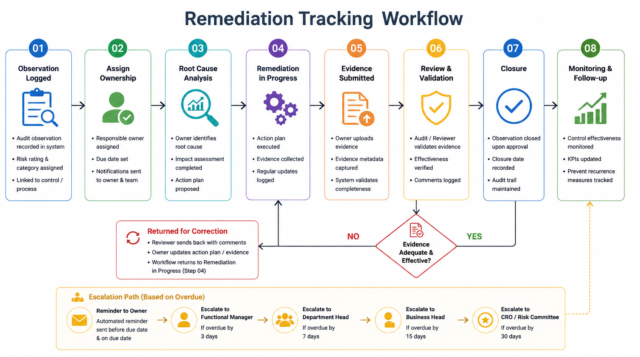
The Hard Part: Getting Remediation to Actually Happen
Detection without remediation is theater. In practice, findings get assigned to control owners who are on leave, no longer employed, or never agreed to the responsibility. Escalation workflows are manual. Aging findings sit for months.
A working remediation governance model requires: auto-assignment based on control ownership, SLA tracking per severity, automatic escalation to managers when SLAs are missed, and closure verification (not just a checkbox). Without these, CCM becomes a compliance reporting exercise.
What RBI Expects
The RBI Master Direction on IT Governance (2023) uses the phrase “continuous monitoring.” That is not accidental. The supervisory intent is clear: banks should be able to demonstrate control effectiveness at any point in time, not just at year-end.
Concurrent audit cycles require monthly evidence collection. ITGC audits require privileged access recertification and change management validation. Both are operationally impossible to do manually at scale. Most banks that attempt manual approaches find themselves reconstructing evidence after the fact. CCM automates the evidence collection and drift detection. It does not replace audit judgment. It replaces the manual labor of proving controls work.
Where CCM Implementations Go Wrong
- Alert fatigue: The tool generates thousands of alerts. No prioritization. Teams ignore it.
- Stale APIs: Evidence collected from APIs with 24-hour latency. Drift detected — but a day late.
- No ownership: Findings auto-assigned to “security team” — but security cannot change infrastructure. Nothing closes.
- Dashboards without action: Beautiful visualizations. No remediation workflows. Governance becomes reporting, not assurance.
- Assuming CCM replaces audits: CCM replaces manual evidence collection. It does not replace audit judgment or sampling strategy.
A Realistic Maturity Path
Phase 1: Instrument key controls for automated evidence collection (IAM, SIEM, cloud APIs).
Phase 2: Implement drift detection rules for high-risk controls.
Phase 3: Build remediation workflows — auto-assign findings, enforce SLAs, escalate aging issues.
Phase 4: Executive dashboards and continuous assurance reporting.
Phase 5: Auto-remediation for low-risk, high-frequency controls.
Most banks are between Phase 1 and Phase 2. Phase 4 is achievable within 18-24 months with sustained investment.
The Uncomfortable Question: Who Actually Owns the Risk?
A finding requiring cloud configuration changes may involve the IAM team, networking, security operations, and a business owner who never consented to the risk. No single accountable owner. Remediation stalls. The finding repeats in the next audit.
CCM does not fix organizational politics. But it exposes ownership ambiguity. When a finding ages past its SLA and escalates to a manager, the question becomes: who should have owned this? That visibility is often enough to force accountability conversations that spreadsheets never triggered.
Final Thoughts
CCM will not fix broken controls. It will not fix organizational politics. It will not replace audit judgment.
What it will do: tell you, in near real-time, when a control has stopped working. It will flag stale evidence. It will track whether remediation actually happened. It will reduce the manual labor of proving compliance.
For banks still using spreadsheets and annual audits, the gap is not going to close on its own. Cloud environments drift too fast. Concurrent audits generate too many findings. The institutions that adopt CCM will not eliminate risk. But they will stop discovering control failures months after they happen.
Identify where your control evidence goes stale
Most banks have drift they do not know about. A targeted assessment takes two hours.
Request a drift assessment →