From documentation compliance to operational observability — navigating the RBI audit lifecycle for scheduled commercial banks, urban co-operative banks, and payment infrastructure operators.
The RBI’s supervisory approach has undergone a quiet but fundamental rewrite. Where once a well-documented policy library sufficed, inspectors now test for continuously observable control effectiveness. Multiple audit practitioners report that a majority of banking entities received qualifications in 2025 — not because controls were missing, but because evidence lineage was broken or ITGC execution was inconsistent across quarterly cycles.
This guide covers the full landscape: cybersecurity domains, ITGC control families, third-party risk governance, cloud resilience, and the emerging expectation of continuous assurance. More importantly, it highlights where operational reality diverges from policy — and how mature institutions bridge that gap.
RBI Audit: Key Parameters at a Glance
Why Traditional Audit Preparation Models Are Failing
The old model — write policies, collect screenshots before audit, store evidence in shared drives — no longer works. Inspectors now ask: “Show me this control operating effectively on the third Tuesday of last month.” If you cannot answer with timestamps and lineage, your compliance is theoretical, not operational. The shift from episodic to continuous verification is irreversible.
What Banks Consistently Underestimate: Cloud Control Drift
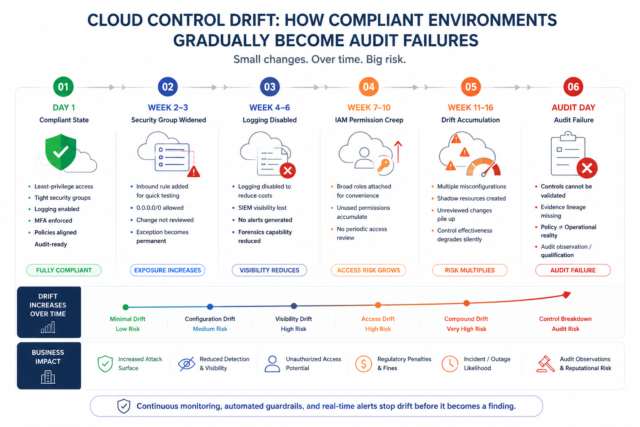
Quarterly audits cannot detect real-time governance failure. Between assessment periods, cloud-native configurations drift — security groups widen, logging is disabled, and IAM roles accumulate excessive permissions. By the time the next audit arrives, the environment no longer resembles the attested state. This is not a control failure; it is an observability failure. Mature programs address this with continuous scanning and automated remediation, not more frequent snapshots.
Why Banks Still Receive RBI Audit Observations (Despite Having Policies)
The gap isn’t policy — it’s operational reality.
Access reviews technically happen but the evidence is scattered across email threads and shared drives. Vulnerabilities are fixed, yet closure confirmation never reaches the audit file. Sub-processors operate without documented oversight because vendor due diligence stopped at Tier-1. Spreadsheet-based tracking works until you exceed 200 controls, then it breaks. These are not isolated failures; they are symptoms of manual, episodic compliance programs.
From Documentation Compliance to Operational Observability
Mature RBI audit programs have moved beyond “Do we have a policy?” to “Can we observe control effectiveness continuously?” Observability rests on evidence lineage (every artifact has timestamp and provenance), telemetry correlation (logs link to specific assertions), and continuous assurance (automated testing replaces sampling). Without these, compliance remains reactive. With them, banks can demonstrate control effectiveness on any given day — not just at year-end.
Governance thesis: The institutions best positioned for future supervisory scrutiny are not those with the largest policy repositories, but those capable of sustaining observable governance across cloud infrastructure, vendor ecosystems, and cybersecurity operations.
Critical Control Families Under RBI Scrutiny
Identity & Privileged Access
The control expectation: Centralized identity with automated JML (including vendors), phishing-resistant MFA for all privileged accounts, just-in-time access with session recording for CBS and payment switch, and quarterly recertification with documented business sign-off.
Vulnerability & Patch Management
The control expectation: Automated asset inventory including cloud workloads, patch SLA (critical ≤15 days, high ≤30 days), and a formal vulnerability exception process with CISO and business head approval.
Security Operations & SIEM
The control expectation: 24×7 log aggregation from all critical systems (CBS, ATM switch, internet banking), quarterly SOC playbook testing against MITRE ATT&CK, and tamper-evident logging with centralized NTP synchronization.
Incident Response & Cyber Resilience
The control expectation: Board-approved IRP with playbooks for ransomware and data leak, CCMP (2019) testing twice a year, and breach notification drills with defined internal thresholds.
Third-Party Risk & Cloud Governance
The control expectation: Risk-based vendor classification, contractual clauses for RBI audit rights and sub-processor disclosure, annual on-site or remote audits for all CSPs, and documented exit strategies with data retrieval and deletion certification.
Business Continuity & Disaster Recovery
The control expectation: BCP with RTO/RPO per critical process (payment systems ≤4 hours), geographically diverse DR site tested biannually with full failover, and quarterly backup restoration validation including random file and database restore tests.
The Operational Cost of Manual RBI Audit Preparation
For a mid-sized bank with 600+ ITGC controls and 150+ material vendors, manual compliance processes consume significant resources. Based on implementation benchmarks across multiple banking deployments, evidence collection alone consumes over 1,000 person-hours annually — much of it spent hunting for screenshots and reconciling version conflicts.
| Activity | Manual Effort (Annual) | Automated Reduction* |
|---|---|---|
| Evidence collection for 600 controls | ~1,200 person-hours | 75-85% |
| Vendor risk assessment (150 vendors) | ~600 person-hours | 60-70% |
| Audit finding remediation tracking | ~300 person-hours | 70-80% |
*Based on internal ASPIA deployment benchmarks across banking implementations, 2024-2025.
Mature vs. Immature RBI Audit Programs
| Immature Program | Mature Program |
|---|---|
| Spreadsheet-based evidence tracking | Automated evidence collection with lineage |
| Annual control reviews | Continuous monitoring (daily/weekly) |
| Reactive, audit-driven remediation | SLA-driven remediation orchestration |
Industry context: IBM X-Force Threat Intelligence Index 2025: financial services remained the most targeted sector for ransomware, accounting for 19% of all attacks. Verizon DBIR 2025: 74% of financial-sector breaches involve human error, privileged misuse, or third-party vulnerabilities. CERT-In’s 2025 annual report noted a 27% year-over-year increase in reported incidents from the BFSI sector, with cloud misconfiguration emerging as a top-three root cause.
How Aspia Automates RBI Audit & ITGC Governance
Aspia delivers a purpose-built operational governance and compliance automation platform for banks, eliminating manual evidence collection and audit friction. The platform provides automated evidence collection from 100+ sources with immutable audit trails, Continuous Controls Monitoring dashboards aligned to the RBI Cyber Security Framework, audit-ready reporting with role-based access and evidence lineage, remediation workflow orchestration that auto-assigns findings and tracks SLAs, and a third-party risk management hub with automated vendor assessment and risk scoring.
Observed outcome: In one implementation, a leading private bank reduced audit evidence collection effort by an estimated 75%
Frequently Asked Questions
What actually gets tested in an RBI IT audit?
How frequently do banks need to test controls?
What are the most common audit findings right now?
Final Thoughts: The Future of RBI Audit Management
The institutions best prepared for future RBI scrutiny will not be those producing the largest compliance repositories. They will be those capable of sustaining continuously observable governance across cybersecurity operations, cloud infrastructure, vendor ecosystems, and executive oversight. Continuous assurance, automation, and centralized evidence management are rapidly becoming foundational — not optional. Banks that cling to spreadsheets and periodic sampling will face escalating audit observations, operational friction, and ultimately, regulatory intervention. The question is not whether to modernize, but how quickly.
Assess Your Operational Observability Maturity
Benchmark your current control observability against 2026 supervisory expectations — including cloud drift detection and continuous evidence lineage.