Introduction
Security and compliance teams rarely operate in an environment where every policy, control, and regulatory requirement can be implemented immediately.
A legacy application may not support a required security control. A third-party vendor may need additional time to meet a contractual security requirement. A business-critical system may require a temporary deviation because implementing a control immediately could disrupt operations.
These situations create exceptions.
The challenge is not necessarily eliminating every exception. The challenge is ensuring that every exception is justified, risk-assessed, approved by the right authority, monitored, time-bound, and eventually closed.
This is where a structured exception approval process becomes essential.
An effective exception management process connects policy and control requirements with risk assessment, business ownership, approval, compensating controls, evidence, remediation, and governance oversight.
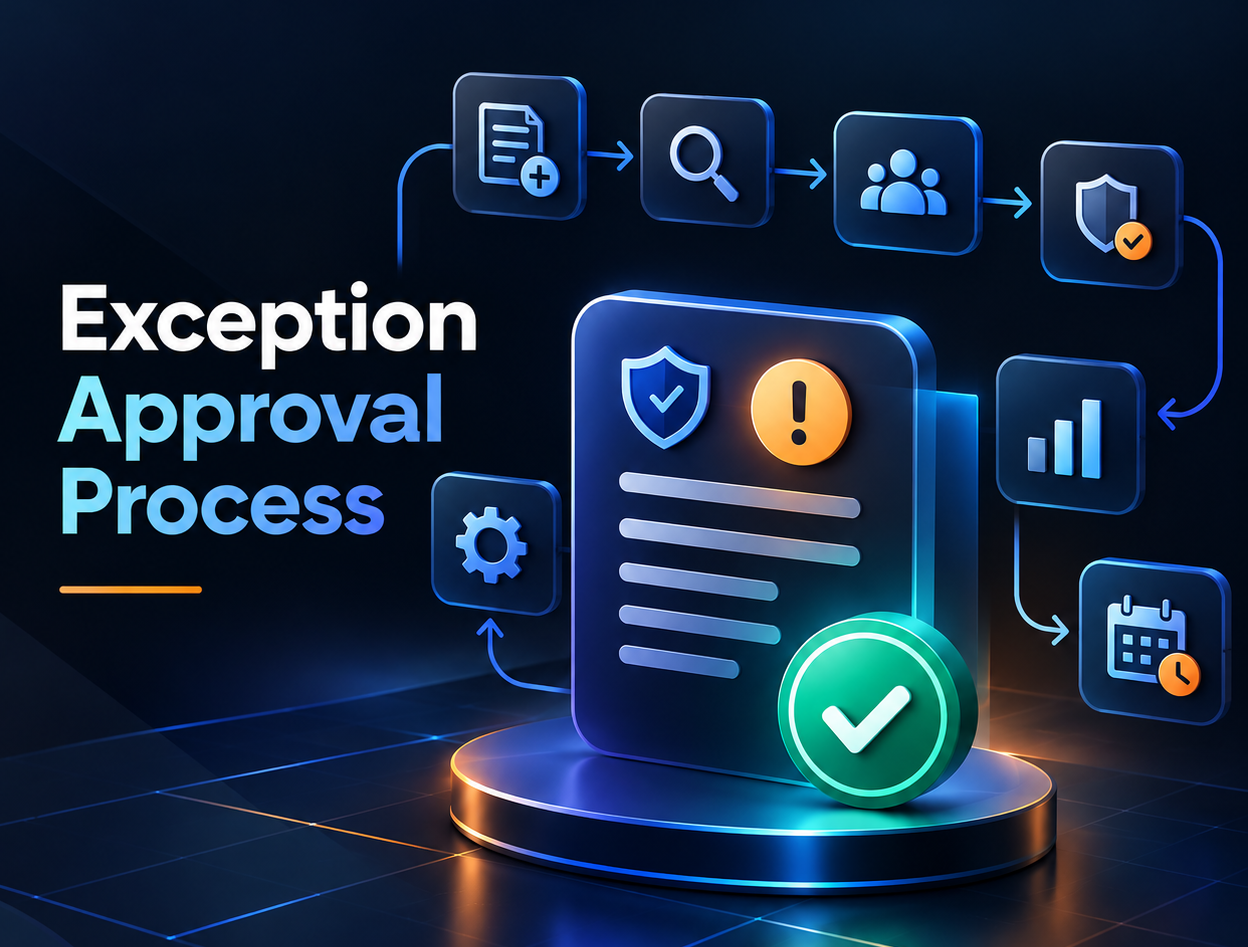
This guide explains the complete exception approval workflow, key roles and responsibilities, approval criteria, risk assessment approach, best practices, governance metrics, and how organizations can automate exception management using a GRC platform.
What Is an Exception Approval Process?
An exception approval process is a formal workflow used to request, evaluate, approve, monitor, and close a temporary or authorized deviation from an established policy, security control, compliance requirement, standard, or procedure.
A security exception should not simply mean:
“We cannot comply with this requirement.”
A properly managed exception should answer:
- What requirement cannot currently be met?
- Why can it not be met?
- What risk does the exception introduce?
- What compensating controls are available?
- Who owns the exception?
- Who is authorized to accept the risk?
- How long will the exception remain valid?
- What is the remediation plan?
- What evidence supports the request?
- When will the exception be reviewed or closed?
A mature exception approval process therefore transforms an exception from an informal deviation into a controlled governance decision.
Why Is an Exception Approval Process Important?
Exceptions are common in enterprise environments. However, unmanaged exceptions can create significant operational, security, compliance, and audit challenges.
Without a structured process, organizations may encounter:
A formal exception approval workflow establishes accountability. It allows an organization to answer questions such as:
- How many security exceptions are currently active?
- Which exceptions represent high or critical risk?
- Which exceptions are approaching expiry?
- Which business units have the most exceptions?
- Which security controls are repeatedly being excepted?
- Who accepted the associated risk?
- Which exceptions are overdue for remediation?
Exception Approval Process: The Complete Workflow
A typical enterprise exception approval workflow follows this lifecycle:
1. Identify the Requirement or Control
The process starts when an organization identifies a requirement that cannot currently be satisfied. The requirement could originate from internal security policies, information security controls, regulatory requirements, industry frameworks, customer requirements, contractual obligations, audit findings, security standards, technology standards, or third-party requirements.
For example: An internal policy requires Multi-Factor Authentication for privileged access, but a legacy application currently supports only password-based authentication.
The first step is to identify the exact requirement being excepted. The exception should ideally be linked to the relevant policy, control, framework requirement, application, asset, vendor, or business process.
2. Submit the Exception Request
The requester formally submits an exception request. A strong exception request should contain enough information for reviewers to understand both the business requirement and the associated risk.
3. Validate the Request
Before conducting a detailed risk assessment, the exception request should be validated. The reviewer can check:
- Is the applicable policy or control correctly identified?
- Is the business justification clear?
- Is the affected scope defined?
- Is an owner assigned?
- Is the requested duration reasonable?
- Is supporting evidence available?
- Are compensating controls identified?
- Is there already an existing exception covering the same situation?
Incomplete requests should be returned to the requester rather than proceeding directly to approval.
4. Perform a Risk Assessment
Risk assessment is one of the most important stages in the exception approval process. The organization should determine the risk introduced by not implementing the required control.
Confidentiality
Could the exception expose sensitive or confidential information?
Integrity
Could the exception allow unauthorized modification or manipulation of information?
Availability
Could the exception increase the likelihood of service disruption?
Regulatory Impact
Could the exception affect a regulatory or statutory requirement?
Business Impact
Could exploitation or failure affect critical business operations?
Does the exception increase exposure to known or emerging threats?
The outcome should establish the inherent risk and, where compensating controls exist, the residual risk.
5. Define Compensating Controls
An exception does not necessarily mean that all security protection is removed. Where the original control cannot be implemented, organizations should consider whether alternative controls can reduce the associated risk.
For example, if a legacy application cannot immediately support MFA, compensating measures could include network segmentation, restricted administrative access, IP allowlisting, additional authentication controls, increased monitoring, enhanced logging, additional vulnerability assessments, privileged access restrictions, and manual access reviews.
Compensating controls should be clearly documented, assigned to an owner, implemented within a defined timeframe, monitored for effectiveness, and included in the exception review. The objective is not to make the exception risk-free. The objective is to understand and manage the residual risk.
6. Determine the Approval Authority
Not every exception should follow the same approval path. Approval authority should be determined according to the organization’s governance framework and risk appetite.
These are illustrative governance patterns. Organizations should define their own thresholds and approval authorities based on their policies, risk appetite, regulatory obligations, and organizational structure.
7. Review and Approve or Reject
The designated approver reviews the complete exception package. The review should consider business justification, risk assessment, residual risk, compensating controls, remediation plan, exception duration, regulatory implications, business impact, and existing risk acceptance.
Possible outcomes include: Approved, Rejected, Returned for additional information, Returned for modification, or Escalated for higher-level approval.
The approval record should capture approver, decision, decision date, comments, conditions, approved duration, required controls, and required remediation. This creates a defensible audit trail.
8. Activate and Monitor the Exception
Approval is not the end of exception management. Once approved, the exception should be actively monitored. Organizations should track exception status, risk rating, owner, expiry date, review date, remediation progress, compensating controls, outstanding actions, and changes in risk exposure.
9. Renewal or Remediation
As the exception approaches its expiry date, the organization should determine what happens next. There are typically three possibilities:
- Close: The original requirement has been implemented and the exception is no longer required.
- Renew: The requirement still cannot be met and the organization needs another defined exception period.
- Escalate: The exception has become overdue, the risk has increased, or remediation is not progressing as planned.
Renewal should not simply be an automatic extension. The organization should reassess whether the original justification is still valid, whether the risk has changed, whether compensating controls are still effective, whether the business context has changed, whether remediation is progressing, and whether another approval is required.
10. Close the Exception
The exception should be formally closed once the underlying requirement has been addressed. Closure may require evidence such as configuration changes, security testing results, audit evidence, updated architecture, vulnerability remediation evidence, control implementation evidence, business confirmation, and vendor confirmation.
Exception Approval Workflow Example
↓
↓
↓
↓
↓
↓
↓
↓
↓
↓
Roles and Responsibilities in Exception Management
Exception Requester
- Identifies the requirement
- Provides business justification
- Describes the scope
- Provides evidence
- Proposes remediation
- Identifies compensating controls
Exception Owner
- Tracks remediation
- Maintains evidence
- Monitors compensating controls
- Prepares renewal requests
- Coordinates stakeholders
- Ensures timely closure
Business Owner
- Business necessity
- Operational impact
- Business criticality
- Acceptable remediation timelines
Security or Risk Team
- Risk assessment
- Residual risk evaluation
- Compensating control assessment
- Risk treatment recommendations
- Monitoring
Compliance Team
- Regulatory requirements
- Internal policies
- Control frameworks
- Contractual requirements
- Audit commitments
CISO or Risk Approver
- Formally accepts residual risk within delegated authority
Exception Approval RACI Matrix
R = Responsible, A = Accountable, C = Consulted, I = Informed
How to Assess Risk for a Security Exception
Risk assessment should be consistent with the organization’s enterprise risk methodology. A simplified model can consider:
However, enterprise risk models can incorporate additional dimensions such as asset criticality, data classification, threat exposure, vulnerability severity, regulatory impact, business impact, existing controls, and control effectiveness.
Inherent Risk
The risk before considering additional compensating controls.
Residual Risk
The risk that remains after existing and compensating controls are considered.
What Makes a Security Exception Approveable?
A strong exception request generally contains the following characteristics:
- Clear requirement
- Specific scope
- Valid business justification
- Defined risk
- Documented risk assessment
- Appropriate compensating controls
- Named owner
- Defined remediation plan
- Specific expiry date
- Appropriate approval authority
- Supporting evidence
Weak Request
“Vendor cannot comply with the MFA requirement. Please approve the exception.”
Stronger Request
“Vendor X currently cannot support MFA for the legacy administrative interface. Access is restricted to approved internal IP ranges, administrative sessions are logged, access is reviewed periodically, and MFA implementation is scheduled for 30 November. The exception applies only to the identified interface and is requested until the remediation date.”
Exception Management Best Practices
Common Exception Management Mistakes
Managing Exceptions in Spreadsheets Alone
Version conflicts, missing evidence, manual reminders, limited workflow control, and inconsistent approval records.
Approving Without Risk Assessment
Difficult to demonstrate why the exception was accepted.
No Expiry Date
Exceptions without expiry dates can become permanent deviations.
Repeated Extensions Without Remediation
A recurring renewal may indicate accepting the same risk indefinitely.
Missing Ownership
If nobody is accountable for remediation, the exception can remain active indefinitely.
Poor Evidence Management
Audit preparation becomes unnecessarily difficult when evidence is scattered.
Exception Management Metrics for CISOs and GRC Teams
Exception Management vs Risk Acceptance
Exception Management
The operational process used to request, assess, route, approve, monitor, renew, and close an exception.
Risk Acceptance
The formal decision by an authorized party to accept the residual risk.
How to Automate the Exception Approval Process
As organizations grow, managing exceptions through email and spreadsheets becomes increasingly difficult. A GRC platform can automate multiple parts of the lifecycle.
How ASPIA Supports Exception Management
For enterprise security and compliance teams, exception management rarely exists in isolation. Exceptions can be connected to policies, controls, risk, assets, applications, vendors, vulnerabilities, audit observations, compliance requirements, and remediation activities.
ASPIA provides a centralized platform for managing security, risk, compliance, audit, and related governance workflows.
Centralized Exception Register
Consolidated view of pending, active, expired, rejected, renewed, and closed exceptions.
Configurable Approval Workflows
Route exceptions through defined approval stages based on governance requirements.
Risk & Residual Risk Tracking
Capture risk assessment information and connect it to the exception decision.
Policy and Control Mapping
Associate exceptions with relevant policies, controls, frameworks, and governance requirements.
Evidence Management
Maintain supporting documentation and evidence alongside the exception record.
Governance Visibility
Consolidated view of exception exposure and outstanding actions for management and security teams.
The broader value is that exception management becomes part of a connected governance operating model, rather than another standalone spreadsheet or email process.
Exception Approval Process Checklist
Before approving an exception, use the following checklist:
Frequently Asked Questions
Conclusion
A strong exception approval process is more than a form and an approval button.
It is a governance mechanism that connects policy requirements, risk assessment, business justification, compensating controls, accountability, remediation, and management oversight.
The most effective exception management programs provide clear answers to five fundamental questions:
- What requirement was not met?
- Why was an exception necessary?
- What risk was introduced?
- Who accepted the residual risk?
- What is being done to eliminate the exception?
When these answers are captured in a structured workflow, exceptions become visible and manageable rather than remaining buried in email threads and spreadsheets.
ASPIA helps organizations bring these governance activities together through centralized workflows, ownership, evidence, approvals, risk tracking, remediation, and operational visibility.
Operationalize Your Exception Approval Process with ASPIA
Is your organization still managing security and compliance exceptions through spreadsheets and email? Explore how ASPIA can help centralize exception requests, risk assessment, approvals, evidence, expiry tracking, remediation, and governance visibility.