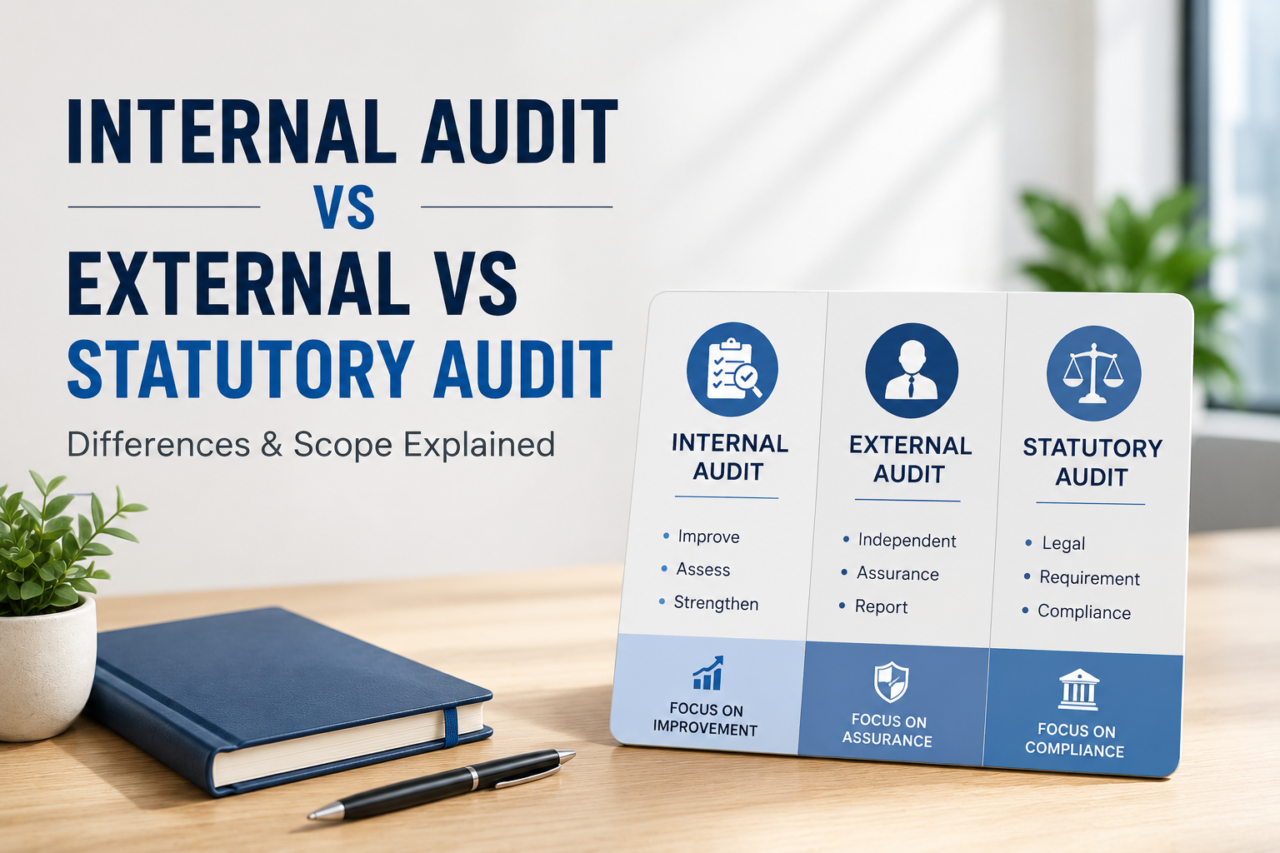
Key Takeaway:
Internal Audit: Are our risks and controls working effectively?
External Audit: Can an independent party provide assurance over the defined subject matter?
Statutory Audit: Is this audit required by applicable law?
Internal Audit vs External vs Statutory Audit: Quick Comparison
What Is Internal Audit?
Internal audit is an independent and objective assurance and advisory function that evaluates an organization’s risk management, internal controls, governance, compliance, and business processes.
Unlike an audit limited to financial statements, internal audit can cover almost any area within the organization’s audit universe.
Common Internal Audit Areas
Under Section 138 of the Companies Act, 2013, prescribed classes of companies are required to appoint an internal auditor to conduct an internal audit of the company’s functions and activities.
Objectives of Internal Audit
- Identify and assess business risks
- Evaluate the design and effectiveness of controls
- Identify control weaknesses
- Improve business processes
- Strengthen governance
- Assess compliance
- Provide assurance to management and the Board
- Track corrective actions
- Support continuous improvement
What Is External Audit?
An external audit is an independent examination performed by an auditor who is not part of the organization’s internal audit function. For financial statement audits, the auditor’s overall objectives and responsibilities are defined under the applicable Standards on Auditing (SAs).
The term external audit describes the auditor’s relationship with the organization. It does not, by itself, define the legal basis or exact purpose of the audit.
Depending on the engagement, an external audit or assurance engagement may cover:
- Financial statements
- Internal controls
- Compliance
- Cybersecurity
- Information security
- Regulatory requirements
- Other defined subject matter
The exact objective and scope depend on the engagement.
What Is Statutory Audit?
A statutory audit is an audit required by applicable law or regulation, with its scope, auditor responsibilities, and reporting requirements determined by the relevant statutory and professional framework.
For companies governed by the Companies Act, 2013, provisions relating to the appointment and responsibilities of statutory auditors are contained in the Act, including:
- Section 139 – Appointment of auditors
- Section 143 – Powers and duties of auditors
- Section 144 – Services not to be rendered by auditor
Key Distinction:
External describes who performs the audit; Statutory describes why the audit is required.
Internal Audit vs External vs Statutory Audit: Complete Comparison
Difference Between Internal Audit and External Audit
Difference Between Internal Audit and Statutory Audit
In Simple Terms:
Internal audit asks: Are our processes, risks and controls working effectively?
Statutory audit asks: Do the financial statements and related matters meet the applicable statutory and auditing requirements?
External Audit vs Statutory Audit
The Easiest Way to Remember It:
External = Who performs it
Statutory = Why it is performed
Scope of Internal Audit
Internal audit can have a broader scope because its audit universe can extend across financial, operational, technology, compliance, risk and governance areas.The scope and periodicity of individual audits are typically organized through an audit program, which helps define the audit areas, objectives, procedures, timing, and resources required.
Financial Controls
- Revenue
- Expenses
- Accounts payable
- Accounts receivable
- Cash management
Operational Processes
- Procurement
- Inventory
- Sales
- Operations
- Service delivery
IT and Cybersecurity
- User access management
- Privileged access
- Change management
- Vulnerability management
- Backup and restoration
Compliance & Risk
- Regulatory requirements
- Internal policies
- Contractual obligations
- Risk identification
- Control effectiveness
Scope of External Audit
The scope of external audit depends on the specific engagement. For a financial audit, the auditor may examine:
- Financial statements
- Accounting records
- Material transactions
- Supporting evidence
- Relevant controls
- Accounting estimates
- Financial disclosures
For a cybersecurity or compliance assurance engagement, the scope may instead focus on specific technology or control areas.
Scope of Statutory Audit
The scope of statutory audit is determined by:
- Applicable law
- Accounting standards
- Auditing standards
- Financial reporting framework
- Regulatory requirements
- Audit objectives
Who Is Responsible for Each Audit?
Internal Audit
Internal audit evaluates and reports on risks and controls. Management remains responsible for designing controls, operating controls, managing risks, and implementing corrective actions.
External Audit
The external auditor is responsible for performing the engagement in accordance with applicable requirements and reporting its conclusions.
Statutory Audit
The statutory auditor has responsibilities prescribed by applicable law and auditing standards. Section 143 of the Companies Act, 2013 sets out important powers and duties of auditors.
When Is Each Audit Required?
Internal Audit in India
Internal audit is not automatically mandatory for every company simply because it is incorporated in India. Section 138 of the Companies Act, 2013 applies to prescribed classes of companies. See our guide: Internal Audit Applicability in India.
Statutory Audit
Statutory audit requirements arise from the applicable law. For companies governed by the Companies Act, 2013, Sections 139 and 143 deal with appointment and duties of statutory auditors.
External Audit
There is no single universal answer because external audit is a broad term. An external audit may be required by law, regulator, contract, investors, lenders, customers, or voluntarily commissioned by management.
Practical Examples
Example 1: Procurement Control Review
A company wants to determine whether its procurement controls are operating effectively. The auditor reviews vendor onboarding, purchase approvals, invoices, payments, and segregation of duties. This is Internal Audit.
Example 2: Annual Financial Statement Audit
A company prepares its annual financial statements and undergoes an audit required under the applicable statutory framework. The independent auditor performs audit procedures and issues the required audit report. This is Statutory Audit.
Example 3: Independent Cybersecurity Review
A company appoints an independent audit firm to assess its cybersecurity controls for an investor requirement. The engagement covers access management, security monitoring, incident management, and vulnerability management. This is External Assurance Engagement.
Example 4: Internal Audit Finding
During an internal audit, the auditor identifies that periodic user access reviews are not being performed consistently. The finding includes risk, control gap, corrective action, owner, and due date. The internal audit team follows up on corrective action and validates evidence before closure.
How Internal and External Audits Work Together
Internal and external audits should not be viewed as competing functions. They can provide complementary forms of assurance.
Internal Audit vs External vs Statutory Audit: Decision Guide
Need to identify and reduce control and process risks?
→ Internal Audit
Need independent assurance from an external party?
→ External Audit
Is the audit specifically required by law or regulation?
→ Statutory Audit
Internal Audit and External Audit Classification Checklist
- ☐ Who is performing the audit?
- ☐ Is the auditor independent of management?
- ☐ Why is the audit being performed?
- ☐ Is it required by law?
- ☐ What is the audit objective?
- ☐ What is the scope?
- ☐ Is the focus financial, operational, technological, compliance-related, or broader?
- ☐ Who will receive the report?
- ☐ Are corrective actions expected to be tracked?
- ☐ What legal or professional requirements apply?
Managing Internal Audit Findings After the Audit
An internal audit report summarizes the audit scope, findings, risks, recommendations, management responses, and agreed corrective actions. An audit report is not the end of the audit process. Once findings are identified, teams still need to:
- Assign ownership
- Define corrective actions
- Set due dates
- Collect supporting evidence
- Monitor overdue actions
- Validate remediation
- Maintain an audit trail
- Close observations
This is where many organizations move from an audit reporting problem to an audit remediation problem.
Manage the Complete Internal Audit Lifecycle With ASPIA
ASPIA helps organizations manage the complete internal audit lifecycle—from planning and evidence collection to observations, remediation, validation, and closure.
The objective is to move findings through: Identification → Ownership → Remediation → Validation → Closure
Frequently Asked Questions
Conclusion
Internal audit, external audit, and statutory audit serve different purposes and should not be treated as interchangeable terms.
The simplest distinction is:
- Internal Audit → Focuses on risks, controls, governance, compliance, and improvement
- External Audit → Provides independent assurance through an external party
- Statutory Audit → Performed because applicable law or regulation requires it
The most important distinction is between external and statutory: external describes who performs the audit; statutory describes why the audit is required.
Ultimately, an audit creates value not merely when a report is issued, but when the resulting findings are assigned, remediated, evidenced, validated, and closed.
Ready to Manage Your Audit Lifecycle?
Centralize audit planning, evidence, observations, action tracking and reporting with ASPIA Internal Audit Management.