Here is a claim that will make some vendors uncomfortable: Most enterprises already collect enough telemetry for effective cloud governance. The failure is not visibility generation — it is governance prioritization and remediation orchestration. This guide explains why tooling density without operational observability is a trap, and how to build continuous assurance instead.
Traditional IT governance collapses in cloud environments. The velocity of infrastructure changes, ephemeral workloads, and API-driven configurations create control drift that periodic audits cannot detect. According to Gartner, through 2026, 70% of cloud governance failures will result from organizational fragmentation, not technical tool gaps. Leading enterprises have shifted from documentation-based cloud governance to continuously observable operational control — but most are still mistaking tooling density for maturity.
This guide introduces the Aspia Continuous Governance Observability Maturity Model™, a proprietary framework for assessing cloud governance across five dimensions: telemetry completeness, drift detection latency, evidence lineage, remediation orchestration, and organizational accountability. Written for CISOs, cloud architects, GRC leaders, and IT executives who need operational realism, not checklists.
The Tooling Density Trap: Why More Security Tools Often Make Governance Worse
Many organizations mistake tooling density for governance maturity. The average enterprise now runs 6-8 cloud security tools: CSPM, CNAPP, CIEM, DSPM, CWPP, SIEM, and cloud-native logging. Each generates findings. Findings require investigation, prioritization, and remediation. The result? Governance paralysis. According to IBM X-Force 2025, organizations with fragmented tooling actually had 23% longer mean time to remediate cloud misconfigurations than those with unified governance workflows. More tools do not equal better governance — they often equal more noise, more spreadsheets, and more organizational friction.
The Uncomfortable Truth: Most Enterprises Already Collect Enough Telemetry
Here is a contrarian observation drawn from dozens of cloud governance assessments: Most enterprises already collect sufficient telemetry for effective cloud governance. AWS CloudTrail, Azure Monitor, and GCP Audit Logs provide rich, detailed activity records. The failure is not collection — it is correlation, prioritization, and remediation orchestration. Enterprises drown in findings while remediating a fraction. The governance gap is not visibility; it is actionable observability linked to accountable ownership. According to NIST SP 800-207 (Zero Trust Architecture), continuous verification requires not just telemetry but closed-loop remediation workflows — which most organizations lack.
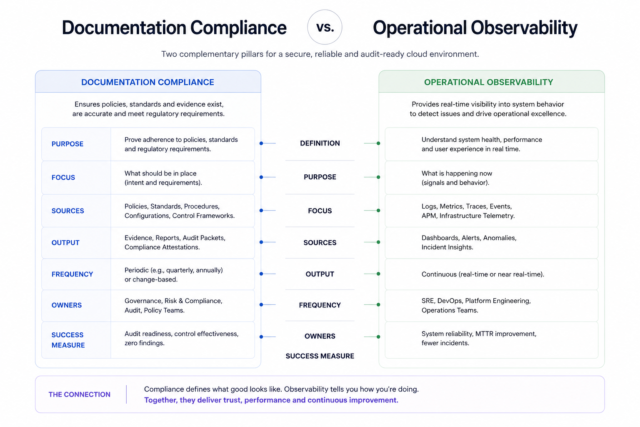
Aspia Continuous Governance Observability Maturity Model™
This proprietary framework assesses cloud governance across five continuous observability dimensions:
| Maturity Dimension | Level 1: Reactive | Level 3: Observable | Level 5: Continuous Assurance |
|---|---|---|---|
| Telemetry Completeness | Critical logs missing | All Tier-1 workloads covered | Automated coverage validation |
| Drift Detection Latency | Monthly/quarterly | Real-time (<15 min) | Predictive drift prevention |
| Evidence Lineage | Spreadsheets, manual | Immutable, timestamped | Fully auditable chain-of-custody |
| Remediation Orchestration | Backlog, no SLA | SLA-driven, auto-assigned | Auto-remediation where feasible |
| Organizational Accountability | Fragmented ownership | RACI with evidence | Board-level governance metrics |
Framework application: Organizations can use this model to benchmark current maturity, identify the largest observability gaps, and prioritize investments — from telemetry coverage to remediation orchestration.
The Cascade Problem: Why Small Control Failures Become Big Breaches
Cloud governance failures cascade. A single weak IAM policy → privileged account compromise → attacker disables CloudTrail → logs stop flowing to SIEM → incident response has no forensic timeline → breach goes undetected for months. According to Verizon DBIR 2025, 74% of cloud-related breaches involved credential misuse or configuration drift that could have been detected with continuous observability — but wasn’t because governance interdependencies were not mapped or tested. Mature programs map these cascades and test them continuously, not annually.
Cloud Control Drift: Why Periodic Audits Cannot Detect Real-Time Governance Failure
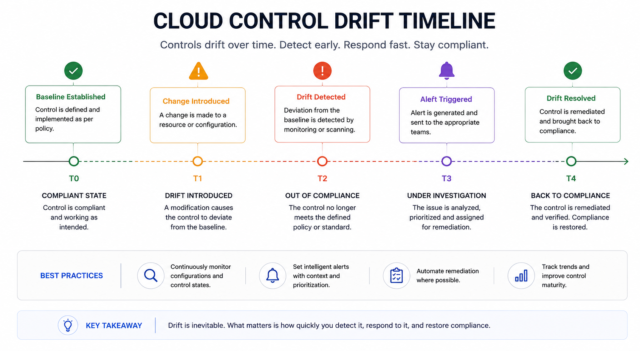
The Hidden Economics: Why Cloud Governance Fails Operationally, Not Technically
- SIEM ingestion cost explosion: Cloud-native workloads generate 10-100x more logs than on-prem. Many organizations disable critical logs to control costs — creating blind spots.
- Telemetry retention tradeoffs: Retaining 12+ months of cloud audit logs is expensive. Organizations truncate, potentially destroying evidence.
- Remediation bottleneck: CSPM tools generate findings faster than engineering teams can remediate. The backlog becomes the new normal.
- Tooling fragmentation: The average enterprise runs 6-8 cloud security tools. Integration and maintenance costs often exceed license costs.
Economic reality: Organizations that succeed are not those with unlimited budgets — they are those that make deliberate tradeoffs between detection coverage, remediation SLAs, and operational overhead.
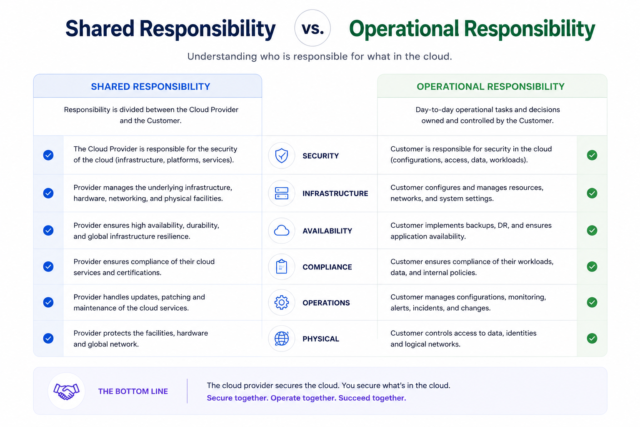
The Shared Responsibility Trap: From Contractual to Operational Accountability
CSPs secure the cloud — but customers are responsible for configuration, identity, access, and workload security. The operational gap appears in: cloud console IAM misconfigurations, disabled logging services, publicly exposed storage, unpatched container images, and API gateway authorization gaps. Mature governance extends shared responsibility into operational accountability with continuous verification. NIST SP 800-207 explicitly requires this continuous approach.
Evidence Lineage: How Continuous Assurance Actually Works
Evidence lineage requires: immutable evidence capture (timestamped, source-verified), chain-of-custody logging (every access to evidence is recorded), reconciliation across sources (CloudTrail + CSPM + IAM logs must align), and audit-ready packaging (on-demand evidence packs for any control on any date). Without these, audit readiness remains manual and reactive.
Kubernetes Governance: Ephemeral Workloads and Admission Control
Mature Kubernetes governance includes: runtime policy orchestration, ephemeral workload observability, sidecar log aggregation validation, cluster tenancy models, admission controller conflict resolution, and workload identity recertification.
BFSI & Government Cloud Governance: Regulatory Reality
RBI Master Direction on IT Governance (2023) explicitly requires boards to be accountable for cloud governance. Evidence must demonstrate continuous control effectiveness, not periodic snapshots. Similarly, MeitY’s sovereign cloud guidance requires audit trail integrity and data residency verification. The regulatory gap is not awareness — it is operational verification. CSP sub-processor telemetry access is often contractually limited, creating blind spots for regulated entities.
Common Cloud Governance Failures: Real-World Breakdowns
- Unlogged workloads: A bank migrated a customer-facing application to EKS but never enabled CloudTrail. No logs for 9 months.
- Remediation backlog economics: A CSPM generated 500+ critical findings. The cloud team remediated 50 per month. Backlog grew indefinitely.
- Shadow APIs: Development teams deployed API gateways without security review. A shadow API exposed customer data for 14 months.
- Control drift (incentive misalignment): A security group was opened for troubleshooting and never reverted. Cloud team was measured on uptime, not configuration compliance.
Mature vs. Immature: The Observable Gap
| Immature | Mature |
|---|---|
| Manual CSPM reports, spreadsheet tracking | Automated evidence collection with lineage |
| Periodic drift detection (monthly/quarterly) | Real-time drift detection with auto-remediation |
| Reactive remediation (30-60 day lag) | SLA-driven remediation (<7 days) |
Key Risk Indicators (KRIs) for Cloud Governance
| KRI | Benchmark |
|---|---|
| Workloads outside SIEM coverage | <5% |
| Drift detection latency | <15 minutes |
| Remediation backlog age (critical) | <7 days |
| Orphaned IAM roles/keys | <2% of total |
What’s Next: AI Workloads, Autonomous Infrastructure, and Policy-as-Code
AI workload governance (model training pipelines, inference endpoints, data lineage) will become a top regulatory focus by 2027. Autonomous infrastructure requires policies that adapt without human intervention. Policy-as-Code (PaC) maturity is still low — most organizations have not version-controlled governance policies. Organizations that do not invest in PaC and continuous observability today will face unmanageable governance debt within 24 months.
Operational Governance: Reference Implementation Approach
Aspia provides a unified operational governance platform addressing the gaps identified in this guide: continuous drift detection (real-time alerts for configuration deviations), automated evidence collection (immutable, lineage-tracked), Kubernetes governance (RBAC recertification, admission policies), unified multi-cloud dashboards, and audit-ready reporting. In one deployment, a leading bank reduced cloud drift detection time from 45 days to near real-time and improved audit readiness from fragmented spreadsheets to on-demand evidence packs — reducing preparation effort by an estimated 70%.
Frequently Asked Questions
What is cloud governance?
What is cloud control drift?
Why do most cloud governance programs fail?
Final Strategic Thoughts: Governance Maturity Requires Continuously Observable Cloud Operations
Cloud governance has shifted from documentation-based compliance to continuously observable operational control. The enterprises best prepared for future cloud risks are not those with the most tools — they are those that have addressed organizational fragmentation, governance economics, and control interdependencies. Continuous observability, policy-as-code, and integrated remediation workflows are rapidly becoming foundational, not optional. Organizations that cling to periodic manual audits and fragmented ownership will face escalating governance debt, compliance violations, and operational risk. The question is not whether to modernize — it is whether executive leadership will recognize that tooling density without orchestration is a trap, and invest in fixing the organizational gaps instead of buying more dashboards.
Benchmark Your Cloud Governance Operating Model
Evaluate your current cloud governance maturity against the Continuous Governance Observability Maturity Model™ — including drift detection latency, evidence lineage, and remediation orchestration.
Request a Governance Maturity Assessment →