Audit Management Software for Banks & Regulated Entities: Complete RBI Audit Workflow Guide 2026
Complete guide to audit management software for banks and RBI regulated entities. Learn how to digitize internal audits, track observations, manage CAPA, and achieve regulatory compliance.
15 min readASPIA Editorial
Introduction: The Audit Reality in Indian Banking
Your audit team already has enough evidence. The problem is not collection — it is orchestration and accountability.
Traditional audit workflows collapse under concurrent audits, continuous monitoring expectations, and distributed evidence. Spreadsheets fragment ownership. Evidence goes stale. Remediation lags. The problem is not audit quality — it is audit visibility and accountability.
Key Challenge:
The institutions best prepared for future RBI scrutiny will replace manual audit management with structured workflows, centralized evidence, and real-time visibility.
What is Audit Management Software?
Audit Management Software is a centralized platform that digitizes and streamlines the end-to-end internal audit lifecycle — from planning and scheduling to fieldwork, observation management, remediation tracking, and closure. It replaces spreadsheets and email with structured workflows, centralized evidence repositories, and real-time dashboards that provide complete visibility into audit programs.
Featured Snippet:
Audit Management Software is a centralized platform for planning, executing, tracking, and reporting on audits — replacing spreadsheets with workflow automation and evidence management.
Objectives of Audit Management Software
How ASPIA Helps Banks Digitize Internal Audits
ASPIA is an enterprise audit management platform designed specifically for banks, NBFCs, and regulated entities.
Challenges of Manual Audit Management
The Spreadsheet Problem
Real Banking Audit Use Cases
Mobile-enabled checklists for branch inspections with offline capability and centralized evidence collection.
Specialized audit program templates for treasury operations with concurrent audit workflow support.
IS audit program templates aligned with RBI cybersecurity framework and structured observation tracking.
Secure external access for vendor evidence submission with contractual compliance tracking.
Integration with security tools for evidence collection and compliance mapping to RBI cybersecurity framework.
Centralized evidence repository for inspections with post-inspection CAPA tracking.
Benefits of Audit Management Software
Less manual follow-up, faster report preparation, better observation visibility, improved accountability, easier Audit Committee reporting.
Real-time visibility, improved decision-making, reduced audit risk, regulatory confidence, resource optimization.
Committee-ready reporting, risk oversight, trend analysis, confidence in audit coverage and quality.
Reduced email dependency, better governance, standardized audit execution, improved branch governance, regulatory readiness.
RBI Expectations and Governance Framework
The Reserve Bank of India expects regulated entities to adopt a Risk-Based Internal Audit approach. This means audit planning should be driven by risk assessment — allocating audit resources to higher-risk areas and ensuring audit coverage aligns with the organization’s risk profile.
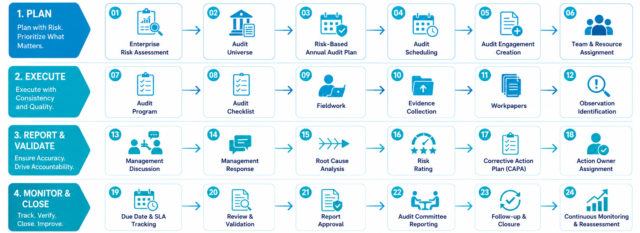
Complete Bank Audit Lifecycle
The complete internal audit lifecycle as it operates in banking institutions — from annual planning through closure.
Key Features of ASPIA Audit Management
Planning Features
- Annual Audit Plan with risk-based scheduling
- Audit Universe with risk scoring
- Audit Scheduling with resource optimization
Execution Features
- Audit Programs with pre-configured templates
- Audit Checklists with regulatory references
- Workpapers with version control
- Evidence Collection with timestamping
Observation Management
- Structured observation forms
- Risk Rating with automated scoring
- Root Cause Analysis templates
CAPA Management
- Automated CAPA creation from observations
- Stakeholder assignment with accountability
- Escalation workflows for overdue actions
Governance Features
- Role-Based Access Control
- Immutable Audit Trail
- Maker-Checker approvals
Reporting Features
- Real-time Dashboards
- Pre-configured KPIs
- Audit Committee-ready reports
Dashboards and KPIs for Audit Oversight
Executive Dashboard KPIs
Multi-Entity Audit Management
For banking groups, holding companies, and financial conglomerates, audit management must span multiple entities while maintaining consolidated visibility.
Scheduled commercial banks
NBFC, insurance, AMC
Non-Banking Financial Companies
Life, general, health
Branch networks across geographies
Technology partners
How ASPIA Differs from Generic Audit Tools
Best Practices for Audit Management
- Establish a comprehensive audit universe covering all departments, branches, processes, and systems
- Implement risk-based audit planning aligned with organizational risk appetite and regulatory requirements
- Standardize audit programs with consistent templates and checklists across all audit types
- Adopt digital evidence management with immutable timestamping and version control
- Enforce maker-checker segregation of duties for observation approval, report sign-off, and closure validation
- Maintain clear ownership of audit observations and CAPAs with single accountable stakeholders
- Implement SLA-based due date tracking with automated escalations for overdue items
- Create role-specific dashboards for audit teams, management, and Audit Committee
Common Mistakes in Audit Operations
- Treating audit management as a compliance checkbox rather than a strategic governance capability
- Sticking with spreadsheets because “we’ve always done it this way” despite proven limitations
- Failing to maintain audit universe updates after business changes
- No clear ownership of audit observations, leading to delayed remediation
- Ignoring SLA performance on closure deadlines, allowing backlog to normalize
- Using generic project management tools not designed for audit rigor
- Overlooking branch audits as “too small” when they represent significant regulatory risk
- Failing to validate closure evidence before closing observations
Advanced Audit Analytics
Governance Intelligence
- Audit Coverage Metrics
- Remediation Velocity
- Finding Recurrence Rates
- Control Effectiveness Scores
Root Cause Analysis
- Systemic vs. Procedural Issues
- Control Failure Patterns
- Departmental Trends
- Regulatory Themes
Trend Analysis
- Closure Trends
- Risk Rating Trends
- Audit Efficiency
- Resource Utilization
Future of Audit Management
Automation & Efficiency
Organizations are automating repetitive audit activities such as evidence collection, notifications, workflow routing, and reporting to reduce manual effort, improve consistency, and accelerate audit execution.
Analytics-Driven Auditing
Real-time dashboards, trend analysis, observation aging, risk heat maps, and performance metrics enable audit teams and management to make faster, data-driven decisions.
Connected Governance
Audit, risk, compliance, policy, vendor, and incident management are increasingly being unified into a single governance platform, providing centralized visibility and stronger organizational oversight.
Continuous Auditing
Organizations are moving beyond periodic audits toward continuous monitoring, automated evidence collection, and proactive risk identification to strengthen governance and regulatory readiness.
Frequently Asked Questions (FAQs)
Conclusion
The gap in most audit functions is not execution — it is visibility, traceability, and accountability. The institutions best prepared for future RBI scrutiny will replace manual audit management with structured workflows, centralized evidence, and real-time visibility across the entire audit lifecycle.
The question is not whether to modernize, but how quickly leadership recognizes that audit visibility is a strategic resilience capability, not a compliance cost.
ASPIA provides a unified audit operations platform for RBI-regulated entities with capabilities including audit planning, fieldwork execution, observation management, CAPA management, reporting, governance, and multi-entity management.
See How ASPIA Digitizes the Entire Internal Audit Lifecycle
Request a personalized demonstration of ASPIA Audit Management to see how your organization can digitize audit planning, streamline fieldwork, centralize observations, automate CAPA tracking, and improve governance visibility across branches and entities.