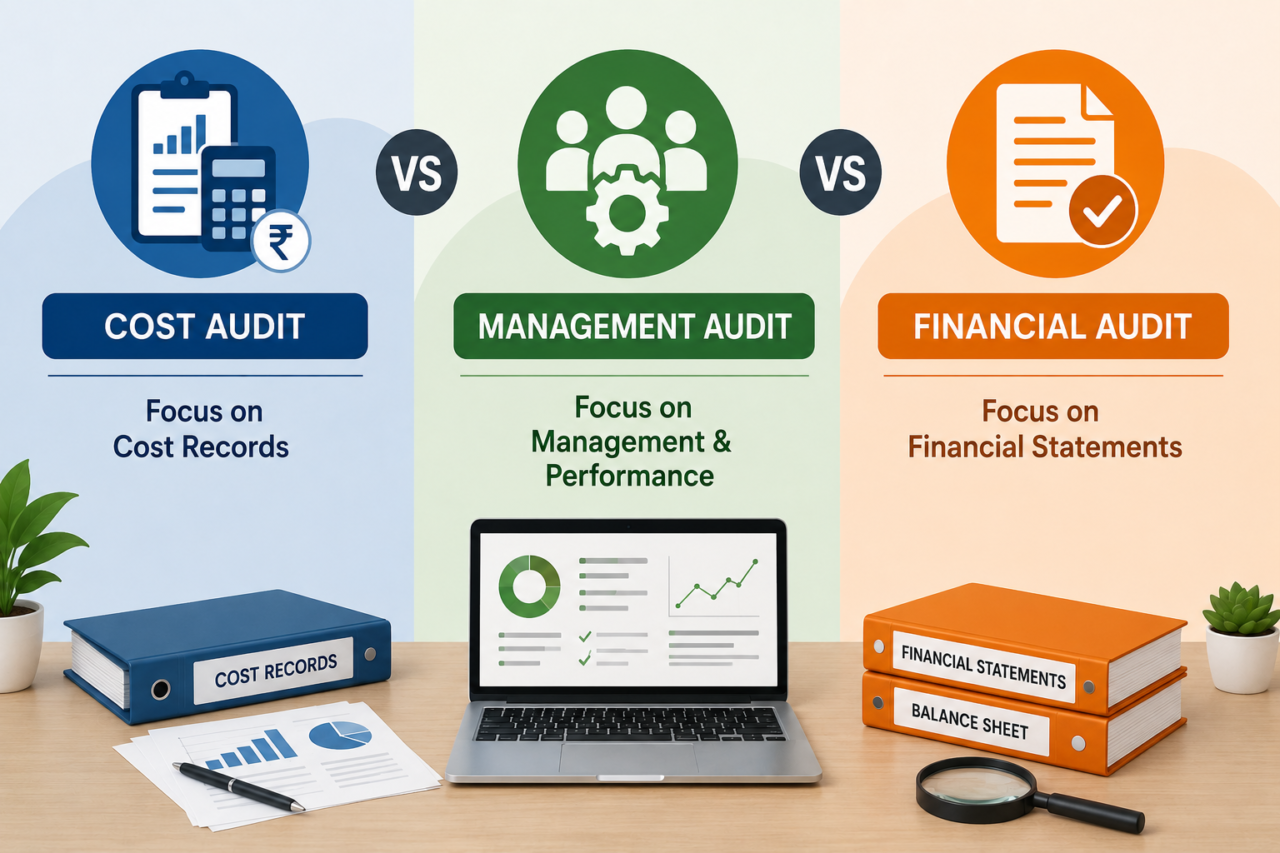
In Simple Terms:
Cost Audit → Cost
Management Audit → Management & Performance
Financial Audit → Financial Statements
Cost Audit vs Management Audit vs Financial Audit at a Glance
What Is Cost Audit?
A cost audit is an independent examination of applicable cost records, cost statements and related cost information.
In India, Section 148 of the Companies Act, 2013 provides the statutory basis for prescribing classes of companies and cost-related information for which cost records and cost audit requirements apply. The detailed applicability is set out under the Companies (Cost Records and Audit) Rules, 2014.
A cost audit may examine areas such as:
What Is Management Audit?
A management audit is a systematic examination of management practices, organizational processes, resource utilization and managerial performance.
Unlike a statutory financial or cost audit, there is no single universal statutory checklist that defines every management audit. Its scope is generally designed around the objectives, risks and performance areas of the engagement.
A management audit may ask:
- Are organizational objectives being achieved?
- Are resources being used efficiently?
- Are management decisions effective?
- Are responsibilities clearly defined?
- Are business processes operating efficiently?
- Are performance indicators being monitored?
- Are management controls adequate?
- Are policies being implemented effectively?
- Where can performance be improved?
What Is Financial Audit?
A financial audit is an independent examination of financial statements and relevant accounting records and evidence.
For a financial statement audit, the auditor obtains sufficient appropriate audit evidence and forms an opinion on whether the financial statements are prepared, in all material respects, in accordance with the applicable financial reporting framework.
A financial audit may cover:
Difference Between Cost Audit and Management Audit
Easy Way to Remember:
Cost Audit: Are the company’s costs properly determined, recorded and controlled?
Management Audit: Is the organization being managed effectively and efficiently?
Difference Between Cost Audit and Financial Audit
Difference Between Management Audit and Financial Audit
Objectives of Cost Audit
- Examine cost records: Determine whether applicable cost records are properly maintained
- Examine cost information: Review the accuracy, consistency and reliability of relevant cost information
- Evaluate cost structure: Understand the components contributing to product or service costs
- Identify cost inefficiencies: Highlight unusual costs, inefficient utilization or areas requiring management attention
- Support cost control: Provide reliable cost information that can support management decisions and cost-control initiatives
- Support regulatory compliance: For companies covered by the applicable cost-audit framework, provide the required independent examination of cost records
Objectives of Management Audit
A useful way to understand management audit is through three concepts:
- Economy: Are resources acquired at an appropriate cost?
- Efficiency: Are resources being converted into outputs efficiently?
- Effectiveness: Are organizational objectives actually being achieved?
Objectives of Financial Audit
- Obtaining sufficient appropriate audit evidence
- Assessing risks of material misstatement
- Examining accounting records
- Testing relevant transactions and balances
- Evaluating applicable financial reporting requirements
- Considering relevant internal controls
- Reporting the auditor’s conclusion
Scope of Cost Audit
- Material consumption
- Labour cost
- Production overheads
- Cost allocation
- Production cost
- Capacity utilization
- Inventory-related cost information
- Cost of sales
- Product-wise profitability
- Cost records and statements
- Reconciliation between cost and financial information
Scope of Management Audit Strategic Management
- Business objectives
- Strategic plans
- Performance against objectives
Operations
- Process efficiency
- Productivity
- Resource utilization
- Operational controls
Organization & Information
- Roles and responsibilities
- Delegation of authority
- Organizational structure
- KPIs and management reports
Risk, Controls & HR
- Risk management
- Internal controls
- Compliance processes
- Workforce utilization
Scope of Financial Audit
- Assets
- Liabilities
- Revenue
- Expenses
- Equity
- Cash flows
- Receivables
- Payables
- Accounting estimates
- Financial disclosures
- Supporting accounting records
Cost Records vs Cost Audit: What Is the Difference?
Cost Records
Cost records relate to the maintenance of prescribed cost information and records for applicable products or services.
Cost Audit
Cost audit is the independent examination of applicable cost records by a cost auditor where the conditions for cost audit are satisfied.
Important:
Cost records ≠ Cost audit — A company should assess these requirements separately.
When Is Cost Audit Mandatory in India?
Cost audit is not mandatory for every company. Section 148 of the Companies Act, 2013 provides the statutory basis, while the detailed applicability is determined under the Companies (Cost Records and Audit) Rules, 2014.
Cost Audit Thresholds
Important:
The threshold cannot be applied simply as “Company turnover is above ₹100 crore, therefore cost audit is mandatory.” The company must first determine whether its products or services are covered under Table A, Table B, or both, and then apply the relevant Rule 4 conditions.
Who Conducts Cost, Management and Financial Audits?
Cost Audit
A statutory cost audit under Section 148 is conducted by a cost accountant appointed as cost auditor in accordance with the applicable requirements.
Management Audit
Can be performed by an appropriately qualified professional or audit team with relevant expertise in management accounting, internal audit, risk management, operations, or process improvement.
Financial Audit
A statutory financial audit is performed by an independent auditor appointed in accordance with applicable legal requirements, governed by the applicable Standards on Auditing.
Practical Example: One Company, Three Audits
Consider a manufacturing company that produces industrial equipment. The company notices that profit margins have fallen sharply.
Cost Auditor
Examines raw material costs, material consumption, labour costs, production overheads, capacity utilization, product-wise costs, and cost of production.
Question: Why has the cost of producing the product changed?
Financial Auditor
Examines revenue, expenses, inventory, receivables, payables, assets, liabilities, and financial disclosures.
Question: Are the financial statements appropriately reflecting the company’s financial position and performance?
Management Auditor
Investigates procurement decisions, production planning, resource allocation, management reporting, approval processes, operational efficiency, and organizational responsibilities.
Question: Why is the organization underperforming, and can management processes be improved?
Regardless of the audit type, conclusions should be supported by appropriate evidence. A structured audit evidence collection process helps auditors organize the records, documents and other evidence supporting their conclusions.
Key Differences: Cost Audit vs Management Audit vs Financial Audit
Frequently Asked Questions
Conclusion
The difference between cost audit vs management audit vs financial audit comes down to the perspective from which the organization is being examined.
- Cost Audit focuses on cost records, cost information and cost-related processes.
- Management Audit focuses on management effectiveness, efficiency and organizational performance.
- Financial Audit focuses on financial statements and financial reporting.
The three audits should not be viewed as competing alternatives. They can provide different layers of assurance and insight.
Manage the Complete Audit Lifecycle with ASPIA
Centralize audit planning, audit execution, evidence, observations, action plans, ownership, remediation and follow-up in one platform. Explore ASPIA’s Audit Management Platform.