Introduction
Not every business or cybersecurity risk can be eliminated immediately.
A bank may discover a vulnerability in a legacy application that cannot be patched without disrupting a critical service. An organization may identify a control gap while a replacement system is being implemented. A third-party risk may remain temporarily because remediation requires contractual or operational changes.
In these situations, organizations need more than an email saying: “Management has agreed to accept the risk.”
They need a structured risk acceptance process that answers:
- What exactly is the risk?
- How serious is it?
- What controls already exist?
- What treatment options were considered?
- What residual risk remains?
- Is the risk within defined acceptance criteria?
- Who is authorized to accept it?
- Why is the risk being accepted?
- How long is the acceptance valid?
- What happens if the risk changes?
- When will it be reviewed?
- What evidence proves that the decision was properly authorized?
A mature risk acceptance process turns risk acceptance from an informal decision into a controlled, documented, accountable and auditable governance activity.
NIST’s current cybersecurity risk guidance emphasizes documenting risk scenarios, likelihood, impact, risk tolerance, risk response and monitoring through cybersecurity risk registers integrated with enterprise risk management.
ISO/IEC 27005:2022 provides guidance for managing information security risks across the risk-management lifecycle, including risk assessment, treatment, communication, monitoring and review.
What Is Risk Acceptance?
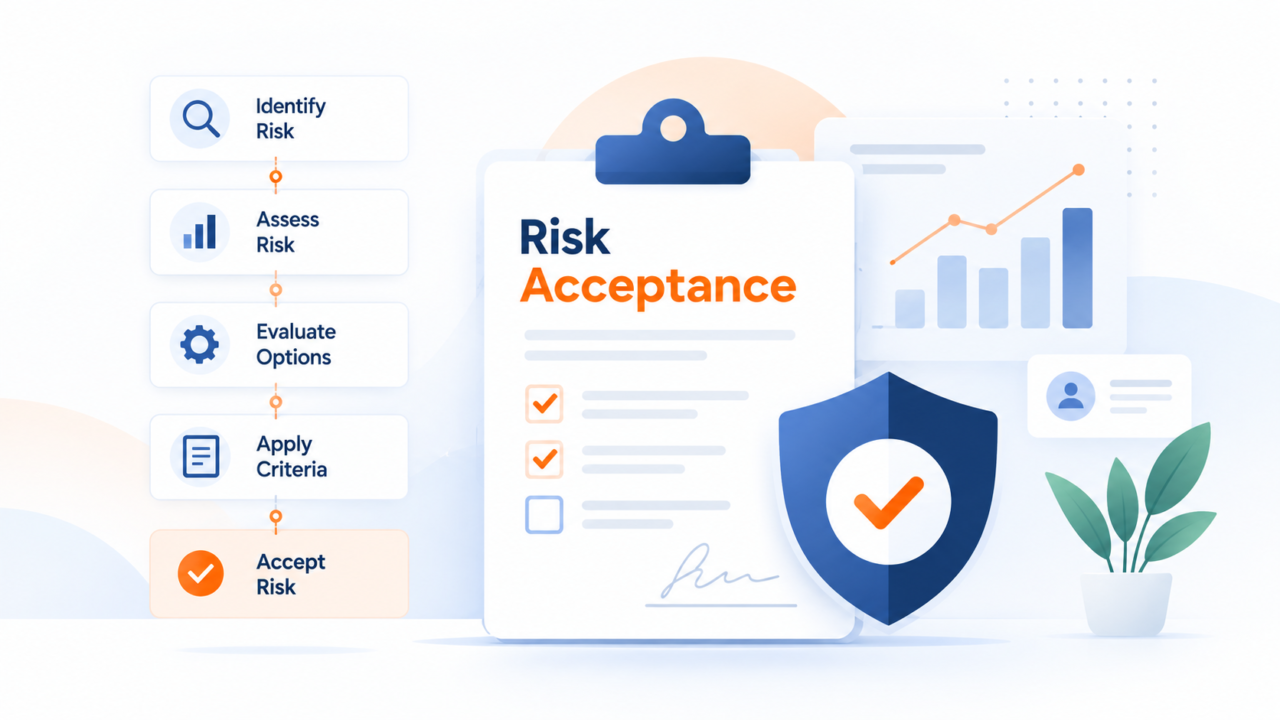
Risk acceptance is an informed decision to retain a particular risk after the organization has evaluated the risk and determined that retaining it is appropriate under its defined risk criteria and governance process.
ISO/IEC 27005 defines risk acceptance as an informed decision to take a particular risk and notes that accepted risks remain subject to monitoring and review.
In practical terms, risk acceptance means: the organization knows the risk exists, understands the potential consequences, has considered available treatment options, and formally decides to retain the risk under defined conditions.
Risk acceptance is therefore not the same as ignoring a risk. For example:
Ignoring a risk
“The vulnerability cannot be fixed right now, so we will leave it open.”
Risk acceptance
“The vulnerability cannot be remediated immediately due to a documented technical dependency. The residual risk has been assessed, compensating controls have been implemented, the appropriate authority has approved temporary acceptance, and the risk will be reviewed before the defined expiry date.”
What Is an Acceptable Risk?
An acceptable risk is a level of residual risk that falls within the organization’s defined risk appetite, risk tolerance and applicable risk criteria. NIST defines acceptable risk as residual risk that falls within the organization’s defined risk appetite and risk tolerance.
This means that a risk should not be called “acceptable” simply because:
- remediation is expensive,
- remediation is inconvenient,
- the system is old,
- the business owner wants to keep it open, or
- nobody has objected to it.
The organization needs a defined basis for the decision.
Risk Acceptance in Cybersecurity
In cybersecurity and IT risk management, risk acceptance may apply to:
A cybersecurity risk acceptance decision should connect the technical finding with its business context. A vulnerability may have a high technical severity, but its actual risk to the organization depends on factors such as asset criticality, exposure, exploitability, existing controls, business impact, data sensitivity and regulatory obligations. This is why a mature risk acceptance process should not rely on a single technical score.
Risk Acceptance Process at a Glance
↓
↓
↓
↓
↓
↓
↓
↓
↓
↓
↓
↓
↓
10 Steps in the Risk Acceptance Process
1. Identify the Risk
The first step is to clearly define the risk. A useful risk statement should describe: Threat or cause + vulnerability/condition + affected asset/process + potential consequence.
Weak
“Security issue exists.”
Better
“A known vulnerability in the legacy payment application could allow unauthorized access to the application server, potentially affecting the confidentiality and integrity of transaction-related information.”
2. Register the Risk
The risk should be assigned a unique identifier and recorded in the organization’s risk register. NIST’s current cybersecurity risk guidance specifically emphasizes risk registers containing scenarios, likelihood, impact and risk-response information to support prioritization, communication and monitoring.
3. Assess the Risk
Before accepting a risk, the organization should understand its potential impact and likelihood. Common assessment factors include likelihood, impact, asset criticality, data sensitivity, external exposure, threat context, and regulatory impact.
4. Evaluate Risk Treatment Options
Risk acceptance should not automatically be the first response. The organization should consider available treatment options.
ISO’s information-security risk terminology recognizes risk treatment as a process that can include avoiding risk, changing likelihood or consequences, sharing risk, or retaining risk by informed choice.
5. Determine the Residual Risk
The organization should distinguish between inherent risk (before considering controls) and residual risk (remaining after existing and planned controls). The acceptance decision should consider the remaining exposure after controls, not just the initial finding.
Risk Acceptance Criteria
Risk acceptance criteria are predefined rules used to determine whether a particular risk can be retained and under what conditions. This is one of the most important parts of a mature risk acceptance program. Without defined criteria, risk acceptance can become subjective: “The business says it is okay.”
A stronger governance model asks: “Does this risk meet the organization’s defined criteria for acceptance, and does the person approving it have the authority to make that decision?”
Risk Acceptance Criteria Example
This is an illustrative example, not a universal approval matrix. Banks, financial institutions and other regulated organizations should define their own thresholds based on their risk appetite, risk tolerance, internal policies, delegated authority and applicable regulatory requirements.
Can a Risk Above the Normal Threshold Be Accepted?
Sometimes, an organization may permit conditional or temporary acceptance under defined governance rules. A temporary acceptance should normally have a documented reason, additional controls where appropriate, a responsible owner, an authorized approver, a defined validity period, a remediation or treatment commitment, and a review mechanism.
Risk Acceptance Approval Process
A formal approval workflow should answer:
- Who requests it? Usually the risk owner or responsible business/system owner.
- Who reviews it? Depending on the risk: Security, Risk, GRC, Compliance, Application owner, Business owner.
- Who approves it? The person or committee with delegated authority for that risk level.
Risk Acceptance Approval Matrix
Risk Acceptance RACI
Risk Acceptance Form
A risk acceptance form should contain enough information for an independent reviewer or auditor to understand the decision without reconstructing the entire history from emails.
1. Risk Information
- Risk ID
- Risk title
- Risk category
- Risk source
- Business unit
- Affected asset/process
- Risk owner
- Date identified
2. Risk Description
- Risk statement
- Threat
- Vulnerability/condition
- Potential consequence
- Business impact
3. Risk Assessment
- Likelihood
- Impact
- Inherent risk
- Existing controls
- Residual risk
4. Treatment Analysis
- Remediation considered
- Mitigation considered
- Transfer considered
- Avoidance considered
- Acceptance rationale
5. Compensating Controls
- Documented controls that reduce exposure while the risk remains open
6. Acceptance Justification
- Why is acceptance necessary?
- Why can the risk not be remediated immediately?
- What alternatives were considered?
- What residual risk remains?
- Why does it meet acceptance criteria?
- What controls are operating or planned?
7. Approval
- Risk owner
- Reviewer
- Approver
- Approval authority
- Approval date
- Approval comments
8. Validity
- Effective date
- Expiry date
- Review date
- Remediation target
- Renewal conditions
- Escalation conditions
Risk Acceptance Example
Consider a financial institution that identifies a high-severity vulnerability in a legacy internal application.
Risk Identified
The application contains a vulnerability that could potentially allow unauthorized access.
Business Context
The application supports an important internal business process and cannot be immediately replaced.
Existing Controls
Network segmentation, MFA, restricted administrative access, security monitoring, centralized logging.
Treatment Options
Immediate patching, application upgrade, compensating controls, application isolation, temporary risk acceptance.
Why Immediate Remediation Is Not Possible
The required software update requires vendor certification and application testing.
Compensating Controls
Additional access restrictions, monitoring, logging, network controls.
Residual Risk
The risk is reassessed after controls are considered.
Acceptance
The risk owner submits a formal acceptance request with risk assessment, business justification, compensating controls, remediation plan, and expiry date.
Approval
The request is routed to the appropriate authority based on the organization’s risk acceptance matrix.
That is a risk acceptance process. Simply changing the vulnerability status to “Accepted” is not.
Risk Acceptance vs Risk Exception
Risk acceptance and risk exception can overlap, but they are not interchangeable concepts. Organizations can manage these approval, review, expiry and renewal workflows through structured exception management processes.
Risk Acceptance vs Risk Tolerance
Risk Appetite
Broad amount and type of risk an organization is willing to accept in pursuit of its objectives.
Risk Tolerance
Level of risk or uncertainty the organization is prepared to bear in a particular context.
Risk Acceptance
Decision to retain a particular risk.
Risk Acceptance vs Risk Mitigation and Risk Treatment
These are not necessarily competing decisions. They can occur together.
Risk treatment is the broader concept, involving selection and implementation of measures to modify risk. Risk acceptance is one possible outcome of that decision process.
Vulnerability Risk Acceptance
One of the most common cybersecurity applications of risk acceptance is vulnerability risk acceptance. A vulnerability risk acceptance workflow should consider more than CVSS. Relevant factors may include CVSS, exploitability, EPSS or other threat context, asset criticality, internet exposure, business impact, data sensitivity, existing controls, compensating controls, remediation availability, regulatory requirements, vulnerability age, and threat intelligence.
↓
↓
↓
↓
↓
↓
↓
↓
↓
Should CVSS Determine Risk Acceptance?
No—not by itself. CVSS can help quantify technical severity, but organizational risk also depends on context. Consider two systems with the same vulnerability:
System A
Internal, segmented, limited users, strong access controls, no sensitive data.
System B
Internet-facing, customer-facing, handles sensitive data, high business criticality, active exploitation concerns.
Technical severity is an input to the risk decision, not necessarily the complete risk decision.
When Should a Risk Not Be Accepted?
Risk acceptance should receive additional scrutiny when it involves:
A risk being expensive or difficult to remediate does not automatically make it acceptable. The organization still needs to evaluate the risk against its criteria and governance requirements.
Compensating Controls in Risk Acceptance
A risk acceptance decision does not necessarily mean that no additional controls are required. Where practical, organizations can use compensating controls to reduce exposure.
The controls should themselves be documented, assigned to an owner, monitored, periodically reviewed, and validated where appropriate. A compensating control that exists only on paper should not be treated as an effective reduction in risk.
Risk Acceptance Expiry and Review
One of the biggest weaknesses in manual risk acceptance programs is that temporary decisions become permanent. Every temporary acceptance should therefore have an effective date, expiry date, review date, responsible owner, remediation target, renewal conditions, and escalation conditions.
What Should Trigger an Early Risk Review?
This creates event-driven risk governance rather than relying only on calendar-based reviews.
What Happens When Risk Acceptance Expires?
↓
↓
↓
↓
A renewal should not simply copy the previous approval. It should trigger a reassessment.
Risk Acceptance Audit Trail
An auditor should be able to answer five basic questions:
What?
What risk was accepted?
Why?
Why was it accepted?
Who?
Who owned and approved it?
When?
When was the decision made and when does it expire?
What happened afterward?
Was the risk remediated, renewed, escalated or closed?
Risk Acceptance Metrics
Active Risk Acceptances
How many risks are currently accepted?
High/Critical Accepted Risks
How many high or critical risks are currently being retained?
Average Acceptance Age
How long have accepted risks remained open?
Expiring Risks
How many acceptances expire within 7, 30, 60, 90 days?
Overdue Reviews
How many accepted risks have missed their review date?
Renewal Rate
How many accepted risks are repeatedly renewed?
Risk Acceptance for Banks and Financial Institutions
Risk acceptance is particularly relevant for banks and financial institutions because technology, cybersecurity, operational, third-party and regulatory risks often intersect. A technology risk may simultaneously affect customer services, operational resilience, information security, third-party dependencies, regulatory obligations, and business continuity.
Risk Acceptance Policy: What Should It Define?
Common Risk Acceptance Mistakes
1. Treating Acceptance as “Risk Closed”
Accepted risk is not necessarily eliminated risk.
2. No Acceptance Criteria
If there are no criteria, approval becomes subjective.
3. Wrong Approval Authority
A system owner should not automatically have authority to accept any level of enterprise risk.
4. No Business Context
Technical severity alone may not represent organizational risk.
5. No Expiry
Temporary acceptance can become permanent.
6. No Compensating Controls
Where practical, risk-reduction measures should be evaluated.
7. Automatic Renewal
A renewal should involve reassessment.
8. No Evidence
The organization should be able to demonstrate how the decision was reached.
9. No Ownership
Every accepted risk needs a clearly accountable owner.
10. Acceptance as a Shortcut Around Remediation
Acceptance should be a deliberate risk decision, not a mechanism for indefinitely avoiding remediation.
How to Automate the Risk Acceptance Process
At enterprise scale, email and spreadsheets create several governance problems: approval history becomes fragmented, expiry dates are missed, evidence is stored in different locations, ownership becomes unclear, renewals happen without reassessment, management lacks consolidated visibility, and auditors must reconstruct decisions manually.
↓
↓
↓
↓
↓
↓
↓
↓
How ASPIA Supports Risk Acceptance
ASPIA is positioned as an enterprise governance, risk and security operations platform that connects risk, audit, exception management, third-party risk, vulnerability remediation, application security and related governance workflows.
For risk acceptance, the workflow can connect: Risk Identification → Assessment → Treatment → Acceptance Request → Approval → Monitoring → Review → Closure.
ASPIA’s risk-management capabilities include centralized risk registers, ownership, assessment, treatment plans, review cycles and governance oversight. Its exception-management capabilities support risk acceptance, policy exceptions, approvals, compensating controls, review cycles and expiry management.
For cybersecurity teams, ASPIA can also connect vulnerability findings with risk-based prioritization, remediation, exception governance, expiry tracking, validation and closure. The value is not simply having a digital approval form. The value is maintaining the relationship between the risk, owner, treatment, approval, controls, evidence, expiry and final outcome.
Risk Acceptance Maturity Model
Risk Acceptance Checklist
Risk Identification
- ☐ Risk is clearly documented
- ☐ Risk ID assigned
- ☐ Risk source recorded
- ☐ Affected asset/process identified
- ☐ Risk owner assigned
Assessment
- ☐ Likelihood assessed
- ☐ Impact assessed
- ☐ Inherent risk determined
- ☐ Existing controls documented
- ☐ Residual risk assessed
Treatment
- ☐ Remediation considered
- ☐ Mitigation considered
- ☐ Other treatment options evaluated
- ☐ Compensating controls evaluated
- ☐ Business justification documented
Acceptance
- ☐ Acceptance criteria checked
- ☐ Risk owner confirmed
- ☐ Appropriate approval authority identified
- ☐ Approval recorded
- ☐ Approval comments documented
Monitoring
- ☐ Expiry date defined
- ☐ Review date defined
- ☐ Remediation target defined
- ☐ Reminder configured
- ☐ Escalation conditions defined
Closure
- ☐ Remediation completed or decision renewed
- ☐ Evidence collected
- ☐ Effectiveness validated
- ☐ Acceptance formally closed or renewed
Frequently Asked Questions
Final Takeaway
A mature risk acceptance process is not a way to avoid remediation. It is a structured mechanism for making an informed decision about residual risk.
The strongest risk acceptance programs have clearly defined risk acceptance criteria, explicit risk ownership, appropriate approval authority, documented business justification, consideration of alternative treatments, defined compensating controls, time-bound acceptance where appropriate, review and escalation mechanisms, complete audit trails, and management visibility into accepted-risk exposure.
For banks, financial institutions and other regulated enterprises, risk acceptance becomes especially important when cybersecurity, technology, operational, third-party and compliance risks intersect.
The objective is not simply to reduce the number of open risks. It is to ensure that every accepted risk is understood, assessed, justified, authorized, owned, monitored and reviewable.
Operationalize Risk Acceptance with ASPIA
Connect risk identification, assessment, treatment, acceptance, approval, compensating controls, expiry tracking, review and closure in one governed workflow.