CUSTOMER SUCCESSCase Studies

Discover how organizations across banking, insurance, manufacturing, and technology sectors operationalize governance programs, improve remediation accountability, and strengthen executive visibility with ASPIA.
AllApplication SecurityAuditGRCRisk-Based Internal AuditTPRMVulnerability Management

Security workflow management in a large enterprise relies heavily on a variety of IT systems, and security teams to support its operations. To protect these assets, the company maintains a team of cybersecurity analysts who are responsible for orchestrating, monitoring, and responding to security alerts and incidents. However, as the volume and complexity of threats have increased, the company has struggled to keep up with the volume of security assessments, alerts, and incidents, leading to delays in response and missed opportunities to prevent or mitigate attacks.

To address these challenges, the organization decided to implement ASPIA. ASPIA is designed to automate many of the manual tasks, simplify the workflows, and integrate with the company’s existing security tools and processes.

Challenges:

Before implementing ASPIA, the organization faced several challenges in managing its cybersecurity operations:

  • Huge amount of Manual effort:
    The amount of manual effort required by the security team to manage the workflows caused delays in response and missed opportunities to prevent or mitigate attacks.
  • Distributed systems and tools:
    Adding to the fatigue of manual efforts security teams also are required to manage all the systems and tools required for the orchestration and management of security workflows, and no platform is available to use all tools from one dashboard.
  • Poor security insights:
    Since the existing processes were complex and time-consuming the organizations often lacked security insights and were not able to get real-time updates on their security.


Solutions:

To address these challenges, ASPIA was chosen as a solution provider, which included the following capabilities:

  • Automation of incident response tasks:
    ASPIA automates many of the manual tasks involved in managing the security workflows, such as gathering and analyzing evidence, preparing reports, listing affected resources, and deploying remediation measures. This allows the security team to respond to threats more quickly and effectively.
  • Integration with existing security tools and processes:
    The ASPIA integrates with the company’s existing security tools and processes, allowing the security team to manage and respond to incidents from a single interface.
  • Granular insights:
    ASPIA analyzes and prioritizes vulnerabilities and threats based on their potential impact. With ASPIA analysis organization was able to visualize the granular insights about their security posture. This helped the security team to focus on the most important threats and to respond to incidents more efficiently.
Results:


As a result of implementing ASPIA, the organization has seen significant improvements in its cybersecurity operations:

  • The automation of manual tasks has allowed the security team to respond to threats more quickly and with greater accuracy. This has helped to prevent or mitigate a number of attacks and to reduce the number of false positives.
  • By automating many manual tasks and providing a unified platform. ASPIA has freed up time for the security team to focus on more strategic tasks. This has resulted in an overall increase in productivity and effectiveness.
  • ASPIA has helped the organization improve its security posture by automating, orchestrating, and simplifying the security workflows effectively.


Conclusion:

The implementation of ASPIA has been a major success for the organization. By automating many of the manual tasks, orchestrating the security workflows, and receiving granular insights. The organization has been able to improve its overall security posture. ASPIA offers cost-effective innovative cybersecurity solutions and services to enterprise customers in order to achieve matured security state. With ASPIA organizations can achieve a mature security state with the orchestration and automation of their security workflows.


Security operations center

A leading European manufacturing organization partnered with ASPIA to improve vulnerability remediation coordination across multiple security, infrastructure, and technology teams.

With growing digital infrastructure, increasing vulnerability volumes, and multiple disconnected security tools, the organization faced challenges maintaining visibility into remediation activities, assigning ownership, and tracking vulnerabilities through to closure.

ASPIA implemented a centralized Vulnerability Remediation Management framework to improve accountability, accelerate remediation activities, and provide real-time visibility into enterprise-wide vulnerability exposure.


Key Security & Operational Challenges
Limited Visibility Into Remediation Activities
  • Vulnerabilities distributed across multiple security tools
  • Limited centralized tracking of remediation activities
  • Inconsistent reporting across teams
  • Difficulty identifying remediation bottlenecks

Security and technology teams lacked a unified view of vulnerability status and remediation progress.

Manual Remediation Coordination
  • Significant manual effort required to track remediation activities
  • Follow-ups managed through spreadsheets and email
  • Multiple teams involved in remediation workflows
  • Extended timelines for vulnerability closure

Manual coordination slowed remediation efforts and reduced operational efficiency.

Limited Accountability & Ownership
  • Difficulty assigning ownership for remediation actions
  • Inconsistent tracking of remediation responsibilities
  • Limited visibility into overdue activities
  • Challenges monitoring closure status across teams

Lack of structured accountability made it difficult to consistently drive remediation outcomes.


ASPIA Solution: Vulnerability Remediation Management

ASPIA implemented its Vulnerability Remediation Management capabilities within its Enterprise Governance, Risk & Security Operations Platform to centralize vulnerability tracking, establish ownership, coordinate remediation activities, and improve executive visibility.

Centralized Vulnerability Management
  • Continuous synchronization of assets and vulnerabilities with Tenable.io
  • Unified vulnerability repository
  • Centralized asset and issue management
  • Real-time vulnerability visibility
Ownership & Remediation Coordination
  • Structured remediation workflows
  • Assigned ownership for remediation activities
  • Centralized issue tracking
  • SLA monitoring and escalation workflows
  • Remediation progress tracking
Security Visibility & Reporting
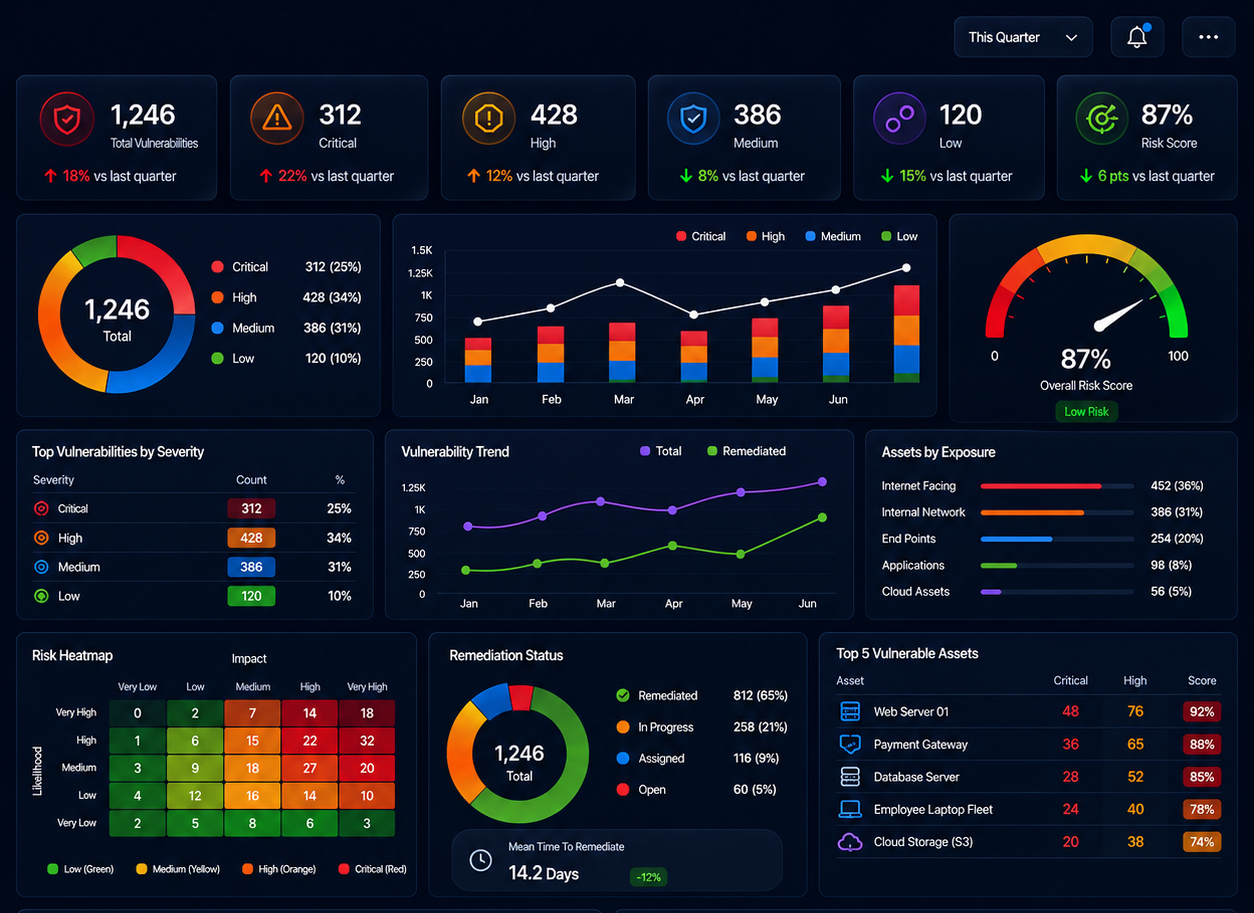
    • Real-time remediation dashboards
    • Risk-based vulnerability prioritization
    • Executive reporting and oversight
    • Security posture visibility across teams


Business Impact & Measurable Results

Improved Remediation Accountability

Structured ownership tracking improved accountability across security, infrastructure, and application teams responsible for remediation activities.

Faster Remediation Coordination

Centralized workflows reduced manual effort and improved collaboration between teams, accelerating remediation execution and vulnerability closure.

Enhanced Executive Visibility

Leadership gained real-time visibility into vulnerability status, remediation progress, risk exposure, and outstanding actions through centralized dashboards and reporting.

Improved Security Prioritization

Risk-based prioritization enabled teams to focus remediation efforts on the vulnerabilities with the greatest potential business impact.


Why This Matters

As vulnerability volumes continue to grow, organizations often struggle not with identifying vulnerabilities but with coordinating remediation activities across multiple teams and systems.

By operationalizing vulnerability remediation through structured ownership, centralized tracking, workflow-driven coordination, and executive reporting, ASPIA helped the organization move from fragmented vulnerability management to a connected vulnerability remediation operating model.

The result was improved accountability, stronger remediation execution, better security visibility, and faster vulnerability closure.


Looking to Improve Vulnerability Remediation Coordination?

ASPIA helps organizations:

  • Centralize vulnerability management activities
  • Improve remediation accountability
  • Coordinate actions across security and technology teams
  • Gain real-time visibility into remediation progress
  • Accelerate vulnerability closure through structured workflows
NULL