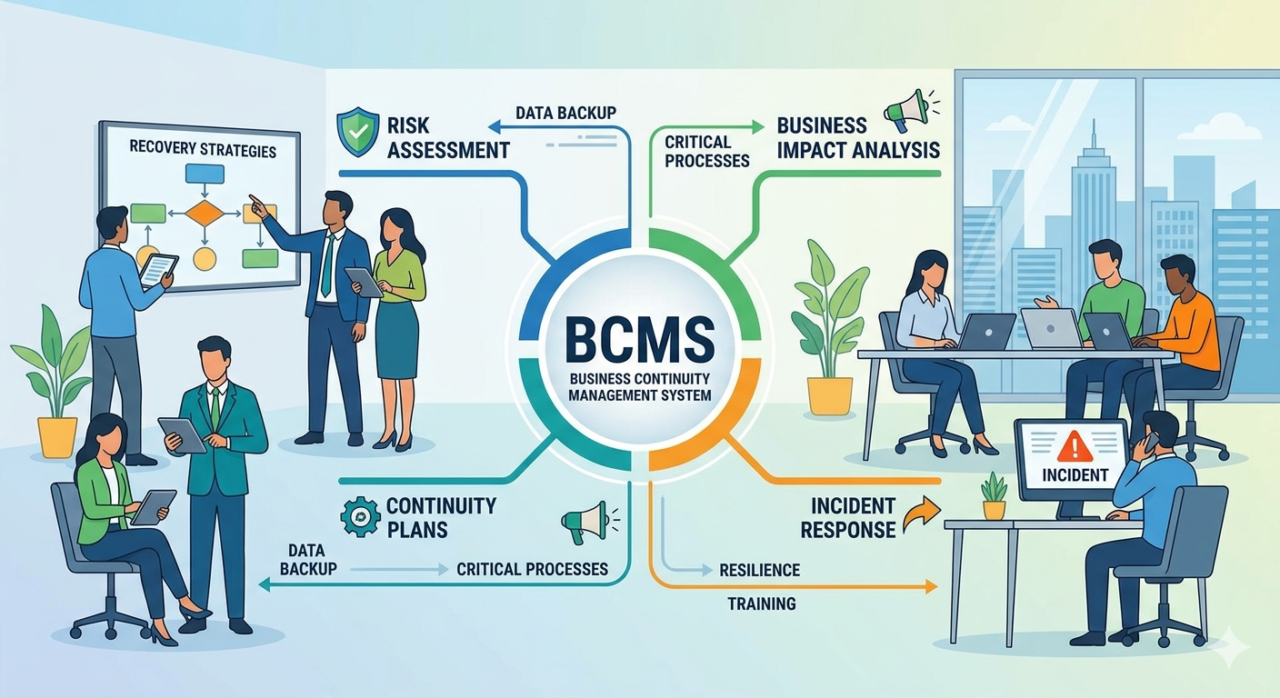
What happens if a bank’s systems go down for several hours? There would be no transactions, no customer access, and significant financial and reputational damage. This is why organizations implement BCMS (Business Continuity Management System)—to ensure that critical operations continue even during disruptions.
In today’s environment of increasing cyber threats, operational risks, and regulatory pressure, BCMS is not optional. It is a business-critical capability, particularly for banks and financial institutions. The average cost of IT downtime now exceeds $9,000 per minute, and regulatory fines for non-compliance can reach millions.
This guide provides a complete framework for understanding, implementing, and automating BCMS—from foundational concepts to advanced GRC integration. It covers the Plan-Do-Check-Act lifecycle, key components like BIA and BCP, real banking use cases, and how automation transforms reactive continuity into proactive operational resilience.
1. What Does BCMS Stand For in Business Continuity?
BCMS stands for Business Continuity Management System.
It is a structured, holistic approach used by organizations to:
- Identify potential threats such as cyberattacks, system outages, natural disasters, and supply chain failures
- Assess their impact on business operations, including financial, operational, and reputational consequences
- Ensure continuity of critical services and products during disruptions
- Enable faster recovery with minimal downtime, meeting defined Recovery Time Objectives (RTO) and Recovery Point Objectives (RPO)
Unlike ad-hoc disaster recovery plans, BCMS is a systematic, documented, and continuously improving framework embedded into an organization’s governance and operational culture.
2. What is BCMS? Definition and Core Purpose
A Business Continuity Management System (BCMS) is a comprehensive framework that helps organizations prepare for, respond to, and recover from disruptions. It encompasses policies, procedures, plans, risk assessments, testing mechanisms, and continuous improvement processes designed to protect critical business functions.
BCMS is aligned with ISO 22301, the international standard for business continuity management systems. Organizations certified to ISO 22301 demonstrate that they have implemented a robust, auditable, and effective BCMS.
In simple terms, BCMS ensures that when disruptions occur—whether a ransomware attack, a data center fire, or a pandemic—organizations can continue critical operations and recover quickly with minimal impact.
3. Why BCMS is Critical in Modern Business Environments
Without BCMS, organizations face severe consequences:
- Financial losses due to operational downtime: Average cost of IT downtime exceeds $9,000 per minute for large enterprises
- Regulatory penalties: Fines from authorities such as RBI, SEC, or EU regulators for non-compliance with business continuity requirements
- Loss of customer trust and reputational damage: Prolonged outages lead to customer churn and brand erosion
- Business disruption and service unavailability: Inability to serve customers, process transactions, or meet contractual obligations
With BCMS in place, organizations benefit from:
- Faster recovery through defined Recovery Time Objectives (RTO) and Recovery Point Objectives (RPO)
- Improved regulatory compliance with ISO 22301, Basel, DORA, and local banking regulations
- Enhanced operational resilience across all business units and geographies
- Better visibility into risks, dependencies, and single points of failure
- Competitive advantage through demonstrated reliability and customer trust
For banks and financial institutions, BCMS is mandatory due to strict regulatory requirements and high operational dependency on systems and data. Regulators expect demonstrable evidence of continuity capabilities, not just documented plans.
4. Key Components of a Business Continuity Management System
A mature BCMS comprises six core components that work together to create end-to-end resilience.
| Component | Description | Key Output |
|---|---|---|
| Business Impact Analysis (BIA) | Identifies critical business processes and their recovery priorities. Quantifies financial and operational impact of disruption over time. | RTO, RPO, criticality rankings, dependency maps |
| Risk Assessment (RA) | Identifies potential threats and vulnerabilities that could disrupt operations. Assesses likelihood and impact. | Risk register, threat scenarios, mitigation priorities |
| Business Continuity Plan (BCP) | Defines how operations will continue during disruption. Includes response procedures, roles, and communication protocols. | Continuity strategies, manual workarounds, call trees |
| Disaster Recovery Plan (DRP) | Focuses specifically on recovery of IT systems, data, and technology infrastructure. | System recovery procedures, backup validation, failover steps |
| Testing and Exercises | Ensures plans are effective, executable, and understood by response teams through regular drills. | Test results, gap analysis, corrective actions |
| Continuous Improvement | Ensures BCMS evolves with changing business processes, technologies, and threat landscapes. | Management reviews, corrective actions, plan updates |
These components are not isolated activities but integrated processes that feed into each other. For example, BIA outputs inform BCP development, and testing results drive continuous improvement.
5. BCMS Framework Explained: The Plan-Do-Check-Act (PDCA) Lifecycle
ISO 22301 structures BCMS around the Plan-Do-Check-Act (PDCA) lifecycle, which ensures continuous improvement and alignment with organizational objectives.
Plan
Establish BCMS scope, objectives, and policies. Conduct Business Impact Analysis (BIA) to identify critical functions and recovery priorities. Perform risk assessment to identify threats and vulnerabilities. Define business continuity strategies and select solutions.
Key outputs: BIA reports, risk register, continuity strategies, RTO/RPO definitions
Do
Implement and operate the BCMS. Develop Business Continuity Plans (BCP) and Disaster Recovery Plans (DRP). Establish incident response structures and communication protocols. Train employees on their roles and responsibilities. Deploy necessary technology and alternate facilities.
Key outputs: Documented plans, trained response teams, alternate site readiness
Check
Monitor, measure, and evaluate BCMS performance. Conduct testing and exercises (tabletop, functional, full-scale). Perform internal audits and management reviews. Track key metrics such as RTO/RPO attainment and test success rates.
Key outputs: Test results, audit findings, performance reports, gap analyses
Act
Take corrective and preventive actions based on monitoring and audit findings. Update plans, strategies, and procedures. Communicate changes to stakeholders. Continuously improve BCMS effectiveness and maturity.
Key outputs: Corrective action plans, updated documentation, improved RTO/RPO attainment
The PDCA cycle is iterative and ongoing. Organizations that truly embed BCMS repeat this cycle continuously, ensuring resilience keeps pace with business change.
6. BCMS vs BCP vs DRP: Understanding the Differences
These terms are often confused, but they represent different scopes and purposes within business continuity.
| Term | Meaning | Scope | Focus |
|---|---|---|---|
| BCMS | Business Continuity Management System | Organization-wide – strategic framework | Governance, policies, continuous improvement, compliance |
| BCP | Business Continuity Plan | Business operations – departmental/process level | Maintaining critical business functions during disruption |
| DRP | Disaster Recovery Plan | IT systems and data – technology focus | Recovering technology infrastructure, applications, and data |
Key takeaway: BCMS is the umbrella system that encompasses and governs BCP and DRP. BCP and DRP are plans within the BCMS framework. An organization can have a BCP and DRP without a mature BCMS, but true resilience requires the full management system.
7. BCMS in Banking: A Real-World Use Case
Banks face unique continuity challenges: 24/7 operations, real-time transactions, sensitive customer data, and stringent regulatory oversight from bodies like the Reserve Bank of India (RBI), European Central Bank (ECB), and FDIC.
Scenario: A regional bank experiences a ransomware attack that encrypts core banking systems, including customer account databases and transaction processing engines.
Without BCMS:
- Systems become unavailable indefinitely – no customer transactions, no ATM access, no online banking
- Recovery is delayed due to lack of documented procedures – IT team improvises under pressure
- Customers lose access to funds and services for days – mass customer churn and reputational damage
- Regulatory escalation occurs – RBI imposes penalties and restricts business activities
- Share price drops 15% following disclosure of prolonged outage
With BCMS:
- Incident response team activates within 15 minutes following documented procedures
- Backup systems at alternate data center are activated within defined RTO (2 hours for critical services)
- Critical services (account balances, payments, customer verification) restored within 2 hours
- Communication plan executes automatically – customers informed via SMS, email, and website
- Regulatory reporting triggers as required – proactive disclosure meets compliance obligations
- Post-incident review identifies improvements – BCMS updated to prevent recurrence
- Customer trust maintained through transparent communication and rapid restoration
This demonstrates how BCMS transforms a potentially catastrophic event into a manageable, recoverable incident. For banks, BCMS is not just about IT recovery—it’s about maintaining customer trust, regulatory standing, and financial stability.
8. Steps to Implement BCMS: A Structured Approach
Implementing BCMS is a multi-phase project. The following steps provide a structured path from initiation to operational maturity.
- Obtain leadership commitment and define scope: Secure executive sponsorship, define BCMS boundaries, and identify critical business functions across the organization.
- Conduct Business Impact Analysis (BIA): Interview process owners to identify critical activities, dependencies, and recovery priorities. Define RTO and RPO for each critical function.
- Perform risk assessment: Identify threats (cyber, natural, human, technical) and vulnerabilities. Assess likelihood and impact. Link risks to business processes.
- Develop business continuity strategies: Select appropriate strategies for each critical function (e.g., alternate sites, manual workarounds, cloud failover).
- Write Business Continuity and Disaster Recovery plans: Document response procedures, roles and responsibilities, communication protocols, and recovery steps.
- Test plans through drills and simulations: Conduct tabletop exercises, functional tests, and full-scale simulations. Validate RTO/RPO attainment.
- Train employees on their roles and responsibilities: Ensure all response team members understand their duties. Conduct awareness training for all staff.
- Establish monitoring and continuous improvement: Implement metrics, conduct regular management reviews, and update plans based on test findings and business changes.
BCMS implementation is not a one-time project but an ongoing capability. Organizations should plan for 6-12 months for initial implementation, followed by continuous refinement.
9. How to Automate BCMS Using GRC Tools
Managing BCMS manually through spreadsheets, documents, and email is inefficient, error-prone, and difficult to scale. Modern Governance, Risk, and Compliance (GRC) platforms automate and streamline BCMS processes, enabling organizations to move from reactive continuity management to proactive operational resilience.
Governance-Integrated BCMS: Unlike standalone continuity tools, GRC-integrated BCMS links business continuity directly to enterprise risk management, compliance obligations, and audit workflows. When a BIA update identifies a new critical process, the system automatically updates risk registers and compliance dashboards. When a test fails, corrective actions flow into issue management and board reporting.
Key Automation Capabilities
- Centralized BIA and risk data: All BIA questionnaires, process dependencies, and risk assessments in a single, auditable repository
- Automated workflow management: Approvals for plan updates, test scheduling, and corrective action tracking
- Compliance monitoring: Automated tracking against ISO 22301 clauses and regulatory requirements (RBI, DORA, FFIEC)
- Test and exercise management: Schedule tests, assign participants, track results, and generate after-action reports
- Incident and crisis management integration: Trigger BCMS processes from incident detection, with automated notifications and plan activation
- Audit-ready reporting: One-click reports on plan status, test history, RTO/RPO attainment, and compliance gaps
- Dashboard visualization: Real-time views of continuity readiness, open issues, and improvement trends
Organizations increasingly use platforms like Aspia to integrate BCMS with broader GRC capabilities, improving visibility, reducing manual effort, and enhancing audit readiness.
10. BCMS Maturity Model: From Ad-Hoc to Resilient
Assess your organization’s BCMS maturity using this five-level model.
| Level | Name | Characteristics | BCMS Capability |
|---|---|---|---|
| Level 1 | Ad-Hoc | No formal BCMS. Individual departments may have informal plans. No testing or governance. | Minimal; recovery depends on heroics |
| Level 2 | Repeatable | Documented BCP and DRP exist for critical functions. Annual testing. Basic BIA completed. | Reactive but repeatable |
| Level 3 | Defined | BCMS established with policies, RTO/RPO defined across all critical processes. Regular testing and management reviews. Aligned with ISO 22301. | Proactive and defined |
| Level 4 | Managed & Measured | Integrated with risk management. Automated testing and monitoring. Metrics drive improvement. Board-level reporting. Continuous BIA updates. | Optimized and data-driven |
| Level 5 | Resilient | BCMS fully integrated with GRC. Predictive analytics identify emerging risks. Automated orchestration of failover and recovery. Continuous compliance certification. | Anticipatory and resilient |
Most organizations operate at Level 2 or 3. Advancing to Level 5 requires automation, governance integration, and a shift from compliance-driven continuity to business-driven resilience.
Ready to advance your BCMS maturity?
Learn how ASPIA’s GRC platform automates business continuity management, linking BIA, testing, and incident response to enterprise risk and compliance.
Request an ASPIA Demo11. Regulatory and Compliance Drivers for BCMS
BCMS is not just a best practice—it is increasingly mandated by regulations worldwide. Governance-integrated BCMS automates compliance evidence collection and reporting.
- ISO 22301: International standard specifying requirements for a BCMS. Certification demonstrates third-party validation of continuity capabilities.
- RBI Guidelines (India): Mandates banks and financial institutions to implement robust business continuity management frameworks with defined RTO/RPO and annual testing.
- DORA (EU): Digital Operational Resilience Act requires financial entities to have comprehensive ICT business continuity plans and testing programs.
- FFIEC (US): Requires financial institutions to maintain business continuity management programs aligned with regulatory expectations.
- Basel Committee Principles: Operational resilience principles require banks to identify critical functions and maintain continuity capabilities.
- SEC Cybersecurity Rules: Requires public companies to disclose material incidents and describe business continuity processes.
- PCI-DSS Requirement 12: Requires formal business continuity plans for cardholder data environments.
12. Frequently Asked Questions (FAQs)
What does BCMS stand for?
What is the main purpose of BCMS?
Is BCMS mandatory for banks?
What is ISO 22301?
What are RTO and RPO?
How often should BCMS be tested?
Can BCMS be automated?
13. Conclusion: From Compliance to Resilience
BCMS is no longer a “nice-to-have” for large enterprises or regulated industries. In an era of escalating cyber threats, climate-related disruptions, and interconnected supply chains, business continuity management is a critical organizational capability.
Organizations that treat BCMS as a checkbox compliance exercise remain vulnerable. Those that embed BCMS into their operational DNA—with continuous improvement, automation, and governance integration—achieve true resilience. They recover faster, protect their reputation, and maintain customer trust even during major disruptions.
For banks and financial institutions, BCMS is not optional—it is a regulatory requirement and a competitive differentiator. The organizations that invest in mature, automated, governance-integrated BCMS will be the ones that survive and thrive in an uncertain future.
Use the maturity model in this guide to assess your current state. Then chart a path toward Level 5: Resilient. With the right framework, automation, and governance integration, business continuity becomes not just a safety net, but a strategic advantage.
Elevate Your BCMS with Governance-Integrated ASPIA
ASPIA provides a unified GRC platform that transforms business continuity management from manual spreadsheets to automated, auditable resilience. Our solution enables:
- ✓ Centralized Business Impact Analysis (BIA) and risk assessment
- ✓ Automated BCP/DRP development and version control
- ✓ Test scheduling, execution tracking, and after-action reporting
- ✓ Direct integration with enterprise risk registers and compliance workflows
- ✓ Executive dashboards showing continuity readiness and RTO/RPO attainment
- ✓ Automated ISO 22301 and regulatory compliance evidence collection
- ✓ Incident and crisis management with BCMS trigger integration
Move from reactive continuity management to proactive, governance-integrated resilience.
Request an ASPIA Demo