Every organization has policies—but very few manage them effectively. Outdated documents, inconsistent approvals, and lack of visibility often lead to compliance gaps, audit failures, and operational risks. This is where policy management becomes critical.
Policy management is the structured process of creating, reviewing, approving, distributing, and monitoring organizational policies to ensure compliance and consistency. In regulated industries like banking and financial services, effective policy management is essential for governance, risk control, and regulatory compliance.
This guide provides a complete framework for modern policy management—from foundational concepts and lifecycle processes to advanced GRC automation. Learn how to transform policy management from a manual, reactive burden into a strategic governance advantage that reduces risk, streamlines audits, and ensures organization-wide compliance.
1. What is Policy Management? Definition and Core Purpose
Policy management refers to the structured lifecycle of creating, reviewing, approving, distributing, and monitoring organizational policies to ensure compliance, consistency, and effectiveness.
It ensures that:
- Policies align with regulatory requirements and industry standards
- Employees understand and follow policies through training and acknowledgment
- Updates are tracked and documented with complete version history
- Compliance is maintained consistently across all departments and locations
- Audit trails demonstrate governance and control effectiveness
In simple terms, policy management ensures that organizational rules are clearly defined, accessible, understood, and enforced—transforming static documents into active governance controls.
2. Why Policy Management is Critical for Modern Organizations
Without effective policy management, organizations face significant consequences:
- Compliance violations: Outdated or missing policies lead to regulatory fines and enforcement actions
- Audit failures: Inability to demonstrate policy version control, distribution, and acknowledgment
- Operational inconsistencies: Different departments following different rules, creating risk and inefficiency
- Increased risk exposure: Unclear policies result in non-compliant employee behavior
- Reputational damage: Policy failures become public during investigations or breaches
With strong policy management, organizations can:
- Ensure regulatory compliance with frameworks like SOX, PCI-DSS, HIPAA, and local regulations
- Standardize processes across departments, geographies, and subsidiaries
- Improve governance and accountability with clear policy ownership and approval chains
- Reduce operational and compliance risks through proactive policy maintenance
- Streamline audits with centralized, audit-ready policy repositories
For banks, financial institutions, and regulated enterprises, policy management is a core component of GRC frameworks—not an optional administrative function.
3. The Policy Management Process: Complete Lifecycle
A structured policy management process ensures consistency, compliance, and continuous improvement. The lifecycle typically includes six phases.
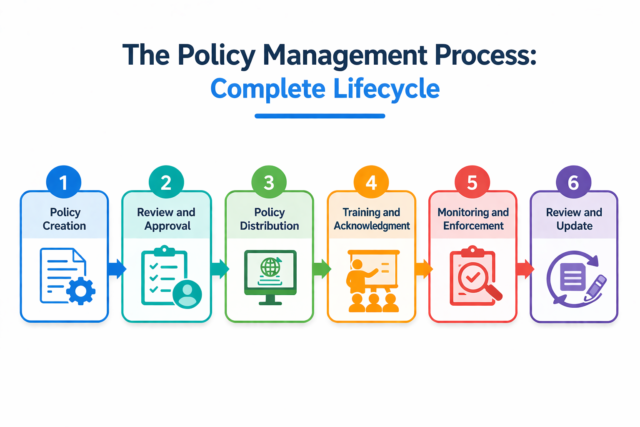
Phase 1: Policy Creation
Identify the need for a new or updated policy based on regulatory changes, operational requirements, or risk assessments. Draft policy content using standardized templates. Ensure alignment with applicable laws and industry standards.
Key activities: Needs analysis, drafting, template selection, regulatory mapping
Phase 2: Review and Approval
Subject matter experts, legal, compliance, and leadership review the draft. Incorporate feedback. Obtain formal approval from designated authority (e.g., CCO, CISO, Board). Maintain complete approval history.
Key activities: Stakeholder review, compliance validation, approval workflow, sign-off documentation
Phase 3: Policy Distribution
Publish the approved policy to a centralized, accessible repository. Notify relevant employees and stakeholders. Ensure policies are available in appropriate languages and formats. Control access based on roles.
Key activities: Central publishing, role-based access, notification, version control
Phase 4: Training and Acknowledgment
Conduct training sessions or assign e-learning modules. Require employees to formally acknowledge receipt and understanding of policies. Track acknowledgment rates and follow up on non-acknowledgment.
Key activities: Training assignment, acknowledgment capture, exception tracking, reporting
Phase 5: Monitoring and Enforcement
Monitor compliance with policy requirements through controls, audits, and exception reporting. Identify violations and enforce consequences consistently. Maintain evidence of monitoring activities.
Key activities: Compliance monitoring, exception tracking, violation remediation, audit trails
Phase 6: Review and Update
Periodically review policies for continued relevance and effectiveness. Update policies in response to regulatory changes, operational changes, or incident learnings. Manage version control and archive superseded policies.
Key activities: Periodic review scheduling, change management, version updates, archiving
This lifecycle is continuous and iterative. Policies are living documents that require ongoing attention, not one-time efforts.
4. Key Components of an Effective Policy Management System
A mature policy management capability includes these essential components:
| Component | Description | Business Value |
|---|---|---|
| Policy Repository | Centralized, searchable storage for all policies with role-based access control | Single source of truth, eliminates version confusion |
| Version Control | Track all changes, maintain history, compare versions, revert when needed | Audit-ready change tracking, accountability |
| Approval Workflows | Configurable routing for review, feedback, and formal approval | Consistent governance, reduced cycle time |
| Access Control | Role-based permissions for viewing, editing, approving, and archiving | Security, segregation of duties |
| Audit Trail | Immutable log of all actions: views, edits, approvals, acknowledgments | Demonstrable compliance, forensic capability |
| Compliance Tracking | Map policies to regulations, track gaps, monitor compliance status | Proactive compliance, reduced penalties |
| Acknowledgment Management | Track employee reading and acknowledgment, automate reminders | Proof of policy awareness, reduced liability |
5. Policy Management vs Document Management: Key Differences
Organizations often confuse policy management with general document management. While related, they serve different purposes and offer different capabilities.
| Aspect | Policy Management | Document Management |
|---|---|---|
| Primary Purpose | Governance, compliance, and risk control | Storage, retrieval, and collaboration |
| Focus | Policy lifecycle (creation → acknowledgment → review) | Files and documents (any type) |
| Workflow Capabilities | Approval routing + compliance tracking + acknowledgment | Basic review and approval |
| Audit Readiness | High – built for regulatory audits | Limited – basic file history only |
| Compliance Mapping | Direct mapping to regulations and controls | Typically none |
| Acknowledgment Tracking | Native – required for compliance | Manual workarounds only |
Key takeaway: Document management systems (like SharePoint, Google Drive) are not adequate for policy management in regulated environments. They lack the governance, tracking, and compliance features required for audit readiness.
6. Common Challenges in Policy Management
Organizations consistently struggle with these policy management challenges, especially as they scale:
- Decentralized policy storage: Policies scattered across network drives, email attachments, SharePoint sites, and printed binders – no single source of truth
- Manual approval processes: Email chains, physical signatures, and spreadsheets create delays, lost approvals, and incomplete records
- Outdated or duplicate policies: Multiple versions circulating with no clear indication of which is current, leading to inconsistent compliance
- Lack of visibility: No easy way to see which policies exist, when they expire, or who has acknowledged them
- Difficulty tracking employee acknowledgment: No systematic method to ensure all employees have read and understood policies
- Poor audit readiness: Manual gathering of policy evidence takes weeks; auditors find gaps in version control and approval history
- No regulatory change management: When regulations update, organizations struggle to identify affected policies and track remediation
These challenges increase exponentially with organizational scale and regulatory complexity. A bank with 500 policies and 10,000 employees cannot manage policy manually.
7. Policy Management Best Practices (2026)
Implement these best practices to build a mature, audit-ready policy management capability.
1. Centralize Policy Storage
Maintain a single source of truth for all policies. Eliminate network drives, email attachments, and local copies. Ensure the repository is searchable, accessible to authorized users, and backed up.
2. Standardize Policy Templates
Use consistent templates for all policies including: purpose, scope, policy statements, roles and responsibilities, compliance references, effective date, and review schedule. Standardization improves readability and auditability.
3. Implement Version Control
Track every change with version numbers, timestamps, and author attribution. Maintain complete history. Ensure only current versions are accessible to general employees while archived versions are available for auditors.
4. Define Clear Policy Ownership
Assign an owner to each policy (e.g., CISO for security policies, CCO for ethics policies). Owners are accountable for reviews, updates, and compliance. No orphaned policies.
5. Automate Approval Workflows
Replace email chains with automated routing. Define approval sequences (e.g., Legal → Compliance → CCO → Board). Track status, send reminders, and maintain complete approval records.
6. Track Employee Acknowledgment Systematically
Require formal acknowledgment for all policies. Automate reminders for non-responders. Maintain proof of acknowledgment for each policy version. Report on acknowledgment rates by department and role.
7. Schedule Regular Policy Reviews
Establish review cycles (typically annual) for every policy. Trigger reviews automatically based on schedule or regulatory changes. Document review outcomes even if no changes are needed.
8. Map Policies to Regulations and Controls
Link each policy to applicable regulations (e.g., SOX, PCI-DSS, GDPR) and internal controls. This enables impact analysis when regulations change and demonstrates compliance during audits.
9. Maintain Audit-Ready Evidence
Ensure your policy management system can produce: complete version history, approval signatures, acknowledgment records, review documentation, and change logs – all within minutes, not weeks.
8. Policy Management Maturity Model
Assess your organization’s policy management capability using this five-level maturity model.
| Level | Name | Characteristics | Audit Experience |
|---|---|---|---|
| Level 1 | Ad-Hoc | No centralized policy management. Policies in emails, shared drives. No version control. Manual acknowledgments. No review schedule. | Painful – weeks to gather evidence; frequent findings |
| Level 2 | Repeatable | Basic policy repository exists. Some version control. Inconsistent approval documentation. Manual tracking. | Stressful – evidence has gaps; some findings |
| Level 3 | Defined | Centralized system with version control. Standard templates. Defined approval workflows. Scheduled reviews. | Manageable – evidence in days; minor findings |
| Level 4 | Managed & Measured | Automated workflows. Acknowledgment tracking. Compliance mapping. Dashboards. Continuous monitoring. | Efficient – evidence in hours; no findings |
| Level 5 | Optimized | Fully integrated with GRC. Predictive analytics identify needed updates. Automated regulatory change impact. Continuous compliance certification. | Effortless – real-time evidence; audit-ready always |
Most organizations operate at Level 2 or 3. Advancing to Level 4 and 5 requires automation and GRC integration.
Ready to advance your policy management maturity?
Learn how ASPIA’s GRC platform automates the entire policy lifecycle – from creation and approval to acknowledgment and audit reporting.
Request an ASPIA Demo9. How to Automate Policy Management Using GRC Tools
Managing policy manually through spreadsheets, email, and shared drives is inefficient, error-prone, and impossible to scale. Modern Governance, Risk, and Compliance (GRC) platforms automate the entire policy lifecycle.
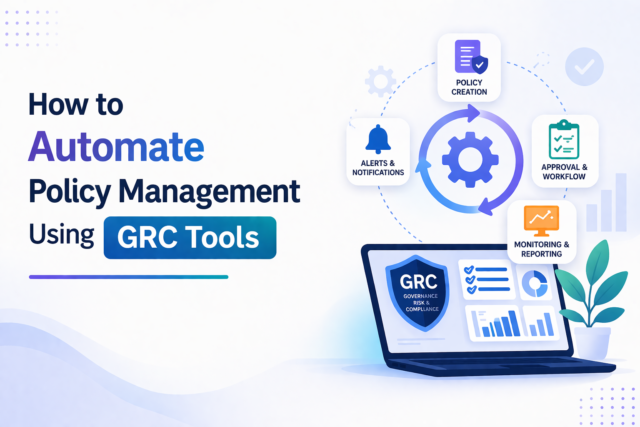
Governance-Integrated Policy Management: Unlike standalone policy tools, GRC-integrated policy management links policies directly to risk registers, control frameworks, and compliance obligations. When a policy updates, the system automatically identifies affected controls and risk assessments. When an employee acknowledges a policy, that acknowledgment feeds into compliance dashboards and audit evidence packages.
Key Automation Capabilities
- Centralized policy repository: Single source of truth with role-based access, full-text search, and version control
- Automated approval workflows: Configurable routing, automatic notifications, escalation for delays, complete audit trails
- Version control and change management: Track every change, compare versions, maintain complete history, automate archiving
- Acknowledgment tracking: Assign policies to employee groups, track read status, automate reminders, maintain proof of acknowledgment
- Review scheduling and reminders: Automatic notifications to policy owners when reviews are due, track review completion
- Regulatory change management: Map policies to regulations, receive automated alerts when regulations change, identify affected policies
- Audit-ready reporting: One-click reports for any policy: version history, approval chain, acknowledgment rates, review documentation
- Dashboard visibility: Real-time views of policy status, expiring policies, acknowledgment gaps, and compliance metrics
Organizations increasingly use platforms like Aspia to transform policy management from a manual administrative burden into an automated governance advantage.
10. Regulatory and Compliance Drivers for Policy Management
Policy management is explicitly required or implicitly mandated by numerous regulations. GRC-integrated policy management automates compliance evidence.
- SOX Section 404: Requires documented policies and procedures for financial controls, plus evidence of communication and enforcement
- PCI-DSS Requirement 12: Requires formal security policies, annual review, and employee acknowledgment
- HIPAA Security Rule: Requires policies and procedures for protecting ePHI, plus documentation of policy distribution
- ISO 27001 Clause 7.5: Requires documented information (policies) with version control, approval, and distribution controls
- GDPR Article 24: Requires data protection policies and demonstration of accountability
- RBI Guidelines: Requires banks to maintain documented policies with approval from Board or designated committees
- SEC Rules: Requires policies governing insider trading, disclosure controls, and code of ethics
11. Frequently Asked Questions (FAQs)
What is policy management?
What are policy management tools?
Why is policy management important?
How often should policies be reviewed?
What is the role of policy management in GRC?
Can policy management be automated?
What is the difference between policy management and document management?
12. Conclusion: From Documentation to Active Governance
Policy management is a critical component of governance and compliance. Without a structured approach, organizations risk inefficiencies, compliance failures, operational inconsistencies, and painful audits.
However, effective policy management is not just about avoiding negative outcomes. It enables organizations to:
- Demonstrate governance maturity to regulators and stakeholders
- Reduce risk through clear, enforced policies
- Improve operational efficiency with standardized procedures
- Build a culture of compliance and accountability
- Transform audits from stressful events to routine validations
For banks, financial institutions, and regulated enterprises, policy management is non-negotiable. By implementing a strong policy management process and leveraging GRC automation, organizations ensure policies are not just documented—but actively enforced, monitored, and continuously improved.
Use the maturity model in this guide to assess your current state. Then chart a path toward Level 5: Optimized. With the right framework, automation, and governance integration, policy management becomes a strategic advantage—not a compliance burden.
Transform Policy Management with Governance-Integrated ASPIA
ASPIA provides a unified GRC platform that automates the entire policy lifecycle—from creation to acknowledgment to audit reporting. Our solution enables:
- ✓ Centralized policy repository with full-text search and version control
- ✓ Automated approval workflows with audit-ready sign-off trails
- ✓ Employee acknowledgment tracking and automated reminders
- ✓ Direct integration with risk registers, controls, and compliance frameworks
- ✓ Review scheduling, automated notifications, and completion tracking
- ✓ One-click audit reports with complete policy history
- ✓ Regulatory change management with policy impact analysis
Move from manual policy tracking to automated, audit-ready governance.
Request an ASPIA Demo