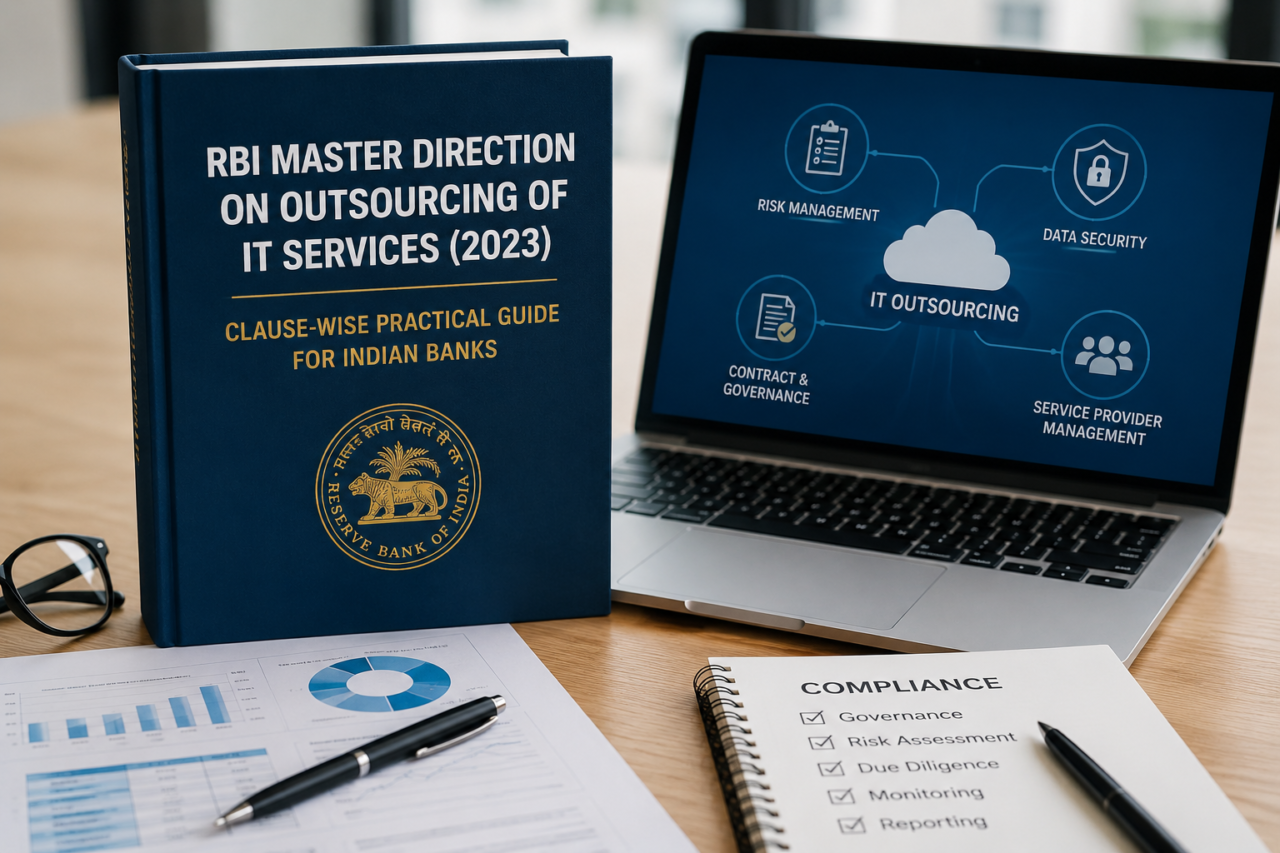
Executive Summary: Inspection Readiness Focus
RBI inspections of IT outsourcing arrangements are increasingly forensic. Inspectors no longer accept policy statements at face value—they demand evidence of implementation. This checklist translates the RBI Master Direction on Outsourcing of IT Services (2023) and the 2025 updates into a practical, auditor-ready framework. Based on recent supervisory trends, inspectors are specifically examining:
- Whether materiality is correctly assessed (Para 5.2) [citation:1]
- Explicit RBI audit rights in all material contracts (Para 6) [citation:3]
- Adherence to the six-hour cyber incident reporting rule (Para 8.2) [citation:5]
- Documented and tested exit strategies (Para 9) [citation:2]
- Concentration risk analysis, especially for cloud vendors (Para 7.2, Appendix I) [citation:1]
- Board-level oversight and half-yearly reviews [citation:5]
This article provides a complete RBI IT outsourcing audit checklist structured by regulatory clause, covering exactly what inspectors verify, what documentation must be ready, and the common gaps observed in Indian banks. Use this as your roadmap for RBI outsourcing inspection readiness.
1. Vendor Inventory & Identification (Para 3)
The foundation of IT outsourcing compliance framework is a complete and accurate vendor inventory. You cannot manage what you do not track.
What RBI Inspectors Verify
- Whether the bank maintains a centralized inventory of all IT outsourcing arrangements [citation:1]
- Whether the inventory includes all IT services listed in Para 3(a)(iv) (infrastructure, cloud, ASPs, managed security, etc.) [citation:1]
- Whether excluded services (e.g., SMS gateways, off-the-shelf software) are properly documented [citation:5]
- Whether subcontractors (fourth parties) are identified and tracked [citation:3]
Documentation Required
- Centralized vendor registry (preferably automated, not spreadsheets)
- Data flow maps showing vendor access to systems and customer information
- Business owner mapping for each vendor
- Subcontractor disclosure logs
Common Failure Patterns
- Decentralized vendor lists maintained by individual business units
- SaaS subscriptions and cloud tools excluded from inventory
- Incomplete tracking of subcontractors [citation:3]
Maturity Comparison
Basic compliance: Spreadsheet updated annually.
Advanced compliance: Automated vendor registry with real-time updates, data flow mapping, and subcontractor tracking integrated with procurement.
2. Materiality Assessment (Para 5.2)
Materiality is not defined by contract value—it is impact-based. This is the single most misunderstood concept in vendor risk management for Indian banks.
Definition: Material Outsourcing of IT Services are those which, if disrupted or compromised, have the potential to significantly impact business operations OR materially impact customers through unauthorized access, loss, or theft of customer information [citation:1].
What RBI Inspectors Verify
- Whether the bank has defined materiality criteria in its Board-approved policy [citation:5]
- Whether the criteria include operational impact, data sensitivity, and substitutability—not just financial exposure
- Whether materiality assessments are documented for each vendor
- Whether the list of material vendors is reviewed and approved by appropriate authority
Documentation Required
- Materiality assessment framework approved by Board
- Completed assessment reports for all vendors classified as material
- Approval records for material vendor classification
Common Failure Patterns
- Materiality based solely on contract value (e.g., > ₹1 crore)
- Low-cost vendors with deep system access escaping material classification
- Inconsistent application across business units
Maturity Comparison
Basic compliance: Fixed financial thresholds.
Advanced compliance: Dynamic scoring based on business impact, data classification, and operational criticality.
3. Due Diligence Requirements (Para 6.3)
Risk-based due diligence must be completed before onboarding any IT service provider [citation:1].
What RBI Inspectors Verify
- Financial soundness and ability to perform under adverse conditions
- Technical capability and infrastructure
- Information security posture (certifications, controls)
- Data protection practices
- Business continuity readiness (BCP/DR documentation)
- Track record, reputation, and market feedback
- Subcontractor (fourth-party) transparency
Documentation Required
- Due diligence checklist with sign-offs
- Information security questionnaires (with evidence)
- ISO 27001 certificates (with scope validation)
- SOC reports (Type II preferred)
- BCP/DR documents (test results)
- Subcontractor disclosure logs
- Risk scoring worksheet with inherent/residual risk
Common Failure Patterns
- Certificates accepted without validating scope (e.g., ISO 27001 certified for corporate office but not data centre hosting bank data)
- Superficial financial viability checks
- No verification of subcontractor arrangements
Maturity Comparison
Basic compliance: Checklist completed once at onboarding.
Advanced compliance: Continuous due diligence with automated certificate expiry alerts and trigger-based reassessments.
4. Mandatory Contractual Clauses (Para 6)
The Direction mandates specific contractual provisions. These are non-negotiable. RBI inspectors treat contracts as regulatory instruments, not commercial documents [citation:3].
Mandatory Clauses [citation:1][citation:5]
- Right to Audit: Unrestricted right for the bank AND the RBI to audit vendor facilities and records (including subcontractors)
- Data Ownership & Confidentiality: Unambiguous clauses affirming bank’s ownership of data; prohibition on secondary use
- Incident Reporting Timelines: Cyber incidents reported to bank without undue delay, enabling RBI reporting within six hours of detection
- Subcontracting Controls: Prior written approval required; prime vendor remains fully liable
- Business Continuity Obligations: Documented BCP/DR plans commensurate with service
- Termination and Exit Assistance: Data return, secure destruction, transition support
- Governing Law: Must not impede RBI supervision
- Data Localization: All data stored in India per extant regulatory requirements
What RBI Inspectors Verify
- Presence of RBI audit clause in all material vendor contracts
- Defined incident notification timelines (consistent with six-hour rule)
- Clear data ownership language
- Exit support commitments
- Subcontractor approval logs
Common Failure Patterns
- Legacy contracts (pre-2023) lack explicit RBI audit rights [citation:3]
- Incident timelines undefined or inconsistent with six-hour rule
- Data localization clauses missing for cloud vendors
Maturity Comparison
Basic compliance: One-size-fits-all contract template.
Advanced compliance: Risk-tiered contract playbooks with mandatory clauses for Tier 1/2 vendors and exception workflows.
5. Concentration Risk & Cloud Outsourcing (Para 7.2, Appendix I)
The Direction requires banks to assess and mitigate concentration risk, especially in cloud outsourcing [citation:1].
What RBI Inspectors Verify
- Vendor concentration analysis (spend + criticality)
- Dependency mapping for critical services
- Documented alternate arrangements
- Cloud exit strategy per Appendix I
- Cloud adoption policy approved by Board
- Security measures for data isolation
- Audit rights over cloud infrastructure
Documentation Required
- Concentration risk dashboard (top vendors by risk)
- Cloud risk assessment report
- Exit feasibility study for critical cloud vendors
- Cloud adoption policy
- Data isolation controls documentation
Common Failure Patterns
- Tracking vendor spend without systemic concentration risk analysis
- Single points of failure unidentified
- Cloud exit strategy not tested
Realistic Inspection Scenario
Inspector asks: “Show us your top three cloud vendors. If the primary cloud provider fails today, what is your fallback? Have you tested this?” Banks without documented and tested alternate arrangements receive observations.
6. Continuous Monitoring (Para 8)
Outsourcing oversight is continuous. Onboarding is just the beginning [citation:1].
What RBI Inspectors Verify
- Annual reassessments for Tier 1 and 2 vendors
- SLA monitoring dashboards with breach trends
- Incident logs and root cause analysis
- Remediation tracking for audit findings
- Subcontractor change monitoring
Documentation Required
- Annual reassessment reports
- SLA performance reports
- Incident register with resolution timelines
- Audit finding remediation logs
- Subcontractor change approval records
Common Failure Patterns
- Reassessments delayed or skipped
- SLA breaches documented but not trend-analyzed
- Subcontractor changes go unnoticed
Maturity Comparison
Basic compliance: Annual review exercise.
Advanced compliance: Continuous monitoring with automated SLA tracking, real-time incident alerts, and trigger-based reassessments.
7. Incident Reporting – 6 Hour Rule (Para 8.2)
This is a zero-tolerance area. Cyber incidents must be reported to RBI within six hours of detection by the service provider [citation:5].
What RBI Inspectors Verify
- Vendor incident escalation process (contractualized)
- Timeline adherence logs (detection → bank → RBI)
- Evidence of regulatory reporting within six hours
- Post-incident root cause analysis
Documentation Required
- Incident register with detection-to-reporting timestamps
- RBI acknowledgment of incident reports
- Vendor incident response plan
- Contractual clauses defining “undue delay”
Common Failure Patterns
- Incident reporting clauses vague (“promptly” without defined timeline)
- Internal escalation delays
- Six-hour clock starts at vendor detection, but detection not communicated to bank
Realistic Inspection Scenario
Inspector asks: “Show us the incident from [date]. When did the vendor detect it? When did you report to RBI? Where is this documented in your contract?” Inconsistencies here attract严厉 observations.
8. Exit Strategy & Reversibility (Para 9)
Banks must not become “hostage” to vendors. Exit plans must be practical and tested [citation:3].
What RBI Inspectors Verify
- Existence of exit plans for Tier 1 vendors
- Evidence of exit testing (tabletop exercises, simulations)
- Contractual transition support clauses
- Data extraction feasibility (format, timeline)
- Secure data destruction certification
Documentation Required
- Exit plans for each material vendor
- Exit testing logs (simulation reports, tabletop exercise minutes)
- Contracts with exit assistance provisions
- Data portability format specifications
Common Failure Patterns
- Exit plans exist as documents but never tested
- Data portability formats unspecified
- Transition assistance not pre-agreed in contracts
Maturity Comparison
Basic compliance: Exit clause in contract.
Advanced compliance: Annually tested exit playbook with data migration runbooks and stakeholder training.
9. Cross-Border Outsourcing
Additional requirements apply when service providers are based outside India [citation:1].
What RBI Inspectors Verify
- Country risk assessments (political, economic, legal conditions)
- Jurisdictional escalation procedures
- Contractual provisions for record access upon liquidation
- Data localization compliance
- RBI audit rights preserved despite jurisdiction
Documentation Required
- Country risk assessment reports
- Jurisdictional risk mitigation plans
- Legal opinion on enforceability of RBI audit rights
- Data localization compliance evidence
Common Failure Patterns
- Cross-border contracts lack RBI audit rights overseas
- Jurisdictional risks not reassessed periodically
- Foreign regulators may access Indian customer data
10. Intra-Group Outsourcing & Conflict of Interest
Intra-group arrangements must not receive preferential treatment. Conflict of interest rules apply strictly [citation:1].
Key Requirements
- Board-approved policy for intra-group outsourcing
- Arm’s length dealings (objective selection criteria)
- Appropriate service level agreements
- Identical risk management practices as for third parties
- Service providers not owned/controlled by directors, KMPs, or approvers (exceptions require Board approval) [citation:1]
What RBI Inspectors Verify
- Intra-group outsourcing policy
- SLA documentation with group entities
- Evidence of arm’s length evaluation
- Conflict-of-interest declarations
- Board approval records for exceptions
Common Failure Patterns
- Intra-group arrangements informal, without SLAs
- Conflict disclosures missing
- Preferential treatment without justification
11. Grievance Redressal
Customers’ rights against the bank remain unaffected by outsourcing. The bank cannot take the defence that functions were outsourced [citation:1].
What RBI Inspectors Verify
- Grievance policy coverage for outsourced services
- Customer complaint logs related to vendor services
- Resolution timelines and escalation
- Ownership of complaints (not redirected to vendors)
Common Failure Patterns
- Customer complaints redirected to vendors without bank ownership
- No tracking of vendor-related complaints separately
12. Board Oversight & Governance Reporting
The Board has ultimate responsibility. Half-yearly review of material outsourcing is mandatory [citation:5].
Sample Board Dashboard Metrics
| Metric | Definition | Regulatory Reference |
|---|---|---|
| Material Vendors Reviewed | % of Tier 1 vendors reviewed by Board in last 6 months | Para 4.2 [citation:5] |
| Vendor Incident Severity Index | Weighted score of incidents by severity | Para 8.2 [citation:5] |
| Exit Readiness Coverage | % of critical vendors with tested exit plans | Para 9 [citation:2] |
| Concentration Exposure Index | % of IT spend/criticality in top 3 vendors | Para 7.2 [citation:1] |
| High-Risk Remediation | % of audit findings closed within 90 days | Para 8.1 |
What RBI Inspectors Verify
- Board-approved outsourcing policy (updated for 2023/2025 requirements)
- Evidence of half-yearly board review (minutes, dashboard reports)
- Documentation of risk acceptance decisions
- Escalation logs for material vendor incidents
- Annual Compliance Certificate submission to RBI [citation:5]
Common Failure Patterns
- Outsourcing policies not updated for 2023/2025 requirements
- Board reporting high-level, not risk-driven
- Conflict-of-interest declarations missing
Risk Taxonomy for IT Outsourcing
A complete third party risk management audit India framework must address these risk dimensions:
- Operational Risk: Service disruptions impacting core banking, payments, customer-facing channels
- Cyber Risk: Data breaches, ransomware, privileged access misuse through vendors
- Compliance Risk: Violation of RBI guidelines, data localization breaches, KYC lapses
- Concentration Risk: Over-reliance on single vendor/technology/geography
- Reputational Risk: Vendor actions damaging bank’s brand and customer trust
Measurable KRIs for Audit Readiness
| KRI Category | Indicator | Threshold for Escalation |
|---|---|---|
| Vendor Inventory Completeness | % of known vendors in centralized registry | < 95% |
| Materiality Assessment | % of material vendors with documented assessment | < 100% |
| Contractual Compliance | % of material contracts with RBI audit clause | < 100% |
| Incident Reporting | % of incidents reported to RBI within 6 hours | < 100% |
| Exit Readiness | % of Tier 1 vendors with tested exit plans | < 100% |
FAQs
What documents does RBI request during IT outsourcing inspection?
RBI typically requests: (i) complete vendor inventory with tiering, (ii) materiality assessment reports, (iii) sample contracts for 3-5 critical vendors, (iv) board minutes showing half-yearly reviews, (v) incident logs and regulatory reporting evidence, (vi) exit plans and testing records, (vii) concentration risk analysis, and (viii) due diligence documentation [citation:3].
How often must material vendors be reviewed?
Material vendors must be reassessed annually. Additionally, the Board must review all material outsourcing arrangements on a half-yearly basis [citation:5]. Reassessment is also triggered by material changes in vendor services, ownership, or risk posture.
What is the six-hour reporting rule?
Cyber incidents must be reported to RBI within six hours of detection by the service provider. This requires contracts to prescribe tight notification timelines from vendors to the bank, enabling the bank to meet its regulatory obligation [citation:5].
What makes outsourcing “material”?
Materiality is determined by potential impact, not contract value. IT services are material if disruption would significantly impact business operations OR if unauthorized access/loss of customer information would materially impact customers [citation:1]. This includes low-cost vendors with deep system access.
Does RBI inspect cloud vendors directly?
Yes. Contracts must include unrestricted audit rights for RBI to inspect cloud vendors’ facilities and records. If RBI cannot inspect the vendor, the vendor cannot be used [citation:3]. Appendix I of the Direction specifically addresses cloud computing requirements including audit rights [citation:1].
What happens if mandatory contract clauses are missing?
Missing mandatory clauses constitute regulatory non-compliance. Legacy contracts without RBI audit rights or defined incident timelines must be remediated by April 10, 2026 (for existing agreements) [citation:5]. Inspectors may issue supervisory observations requiring immediate remediation.
Can banks outsource to group entities?
Yes, subject to Board-approved policy, arm’s length dealings, appropriate SLAs, and identical risk management practices as for third parties. Preferential treatment without justification attracts supervisory scrutiny [citation:1].
What is the deadline for existing contract compliance?
For existing IT outsourcing agreements, compliance is required either at renewal or by April 10, 2026, whichever is earlier. New agreements entered after October 1, 2023 must comply from the agreement date [citation:5].
Conclusion: From Compliance to Inspection Defensibility
The RBI Master Direction on Outsourcing of IT Services (2023) and the 2025 updates have fundamentally shifted expectations. RBI outsourcing inspection readiness now requires:
- Complete and accurate vendor inventory with dynamic tiering
- Impact-based materiality assessment
- Enforceable contracts with RBI audit rights
- Demonstrated adherence to six-hour incident reporting
- Tested exit strategies for all material vendors
- Systemic concentration risk analysis
- Board-level oversight with measurable KRIs
Banks that operationalize these controls systematically—moving from manual spreadsheets to structured automation—are significantly better positioned during supervisory inspections. The Direction is not about checking boxes; it is about building operational resilience in an increasingly vendor-dependent ecosystem.
Ready to move beyond spreadsheets? Book a compliance readiness discussion to see how structured automation can help you achieve inspection-ready vendor risk management for Indian banks.