Banks operate in one of the most risk-sensitive environments. From operational failures to regulatory breaches, even small control gaps can lead to significant financial and reputational damage. This is why banks rely on structured risk management frameworks like RCSA (Risk Control Self Assessment).
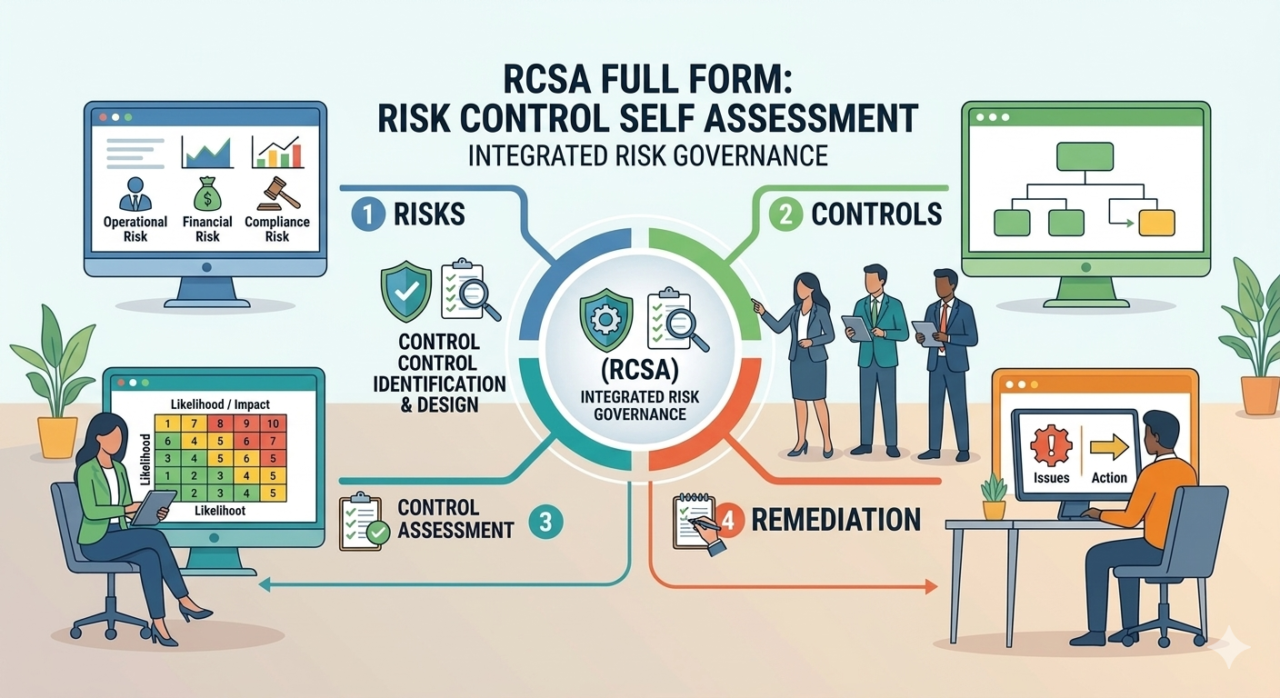
RCSA stands for Risk Control Self Assessment. It is a structured process used by organizations to identify risks, evaluate controls, and assess their effectiveness. In today’s regulatory landscape, RCSA is a core component of operational risk management and Governance, Risk, and Compliance (GRC) frameworks—particularly for banks and financial institutions subject to Basel guidelines and central bank requirements.
This guide provides a complete framework for understanding, implementing, and automating RCSA—from foundational concepts and process steps to advanced GRC integration. Learn how banks use RCSA to strengthen operational resilience, reduce control failures, and maintain regulatory compliance.
1. What is RCSA? Full Form and Core Meaning
RCSA stands for Risk Control Self Assessment.
It is a structured, business-led process where business units and process owners:
- Identify potential risks inherent in their operations, processes, and systems
- Evaluate existing controls designed to mitigate those risks
- Assess control effectiveness using defined criteria and scoring models
- Determine residual risk after accounting for control effectiveness
- Develop action plans for risks exceeding acceptable thresholds
In simple terms, RCSA helps organizations understand: What risks exist? How well are they controlled? Where are the gaps requiring improvement?
Unlike traditional top-down risk assessments, RCSA is decentralized and participatory—the business units that own the risks also perform the assessment, leveraging their operational expertise.
2. Why RCSA is Critical in Banking and Financial Services
Banks face multiple types of risks that require structured oversight:
- Operational risk: Risk of loss from inadequate or failed internal processes, people, or systems
- Compliance risk: Risk of legal or regulatory sanctions, financial loss, or reputational damage
- Fraud risk: Internal or external fraudulent activities impacting assets or customers
- IT and cybersecurity risk: Technology failures, data breaches, and cyberattacks
- Third-party risk: Vendor and outsourcing failures impacting bank operations
Without RCSA, banks may experience:
- Control failures that lead to financial losses and operational disruptions
- Audit findings with negative ratings and mandatory remediation
- Regulatory penalties from bodies like RBI, ECB, OCC, or PRA
- Reputational damage that erodes customer trust and market position
With RCSA, banks can:
- Proactively identify risks before they materialize into losses
- Strengthen internal controls based on effectiveness assessments
- Improve compliance readiness with demonstrable risk management processes
- Enhance decision-making with risk-informed business insights
- Reduce operational losses by addressing control gaps before exploitation
RCSA is also aligned with regulatory expectations including Basel Committee operational risk principles, ISO 31000, and central bank requirements for banks and financial institutions.
3. RCSA Process Explained: Step-by-Step
A typical RCSA process follows these seven structured steps, often conducted annually or semi-annually for each business unit.
Step 1: Risk Identification
Identify potential risks across processes, systems, departments, and products. Use risk taxonomies, loss event data, scenario analysis, and expert judgment. Document each risk with description, category, and inherent risk rating.
Key outputs: Risk register entries, inherent risk scores, risk descriptions
Step 2: Risk Assessment (Likelihood & Impact)
Evaluate the inherent likelihood of each risk occurring and the potential financial, operational, and reputational impact. Use defined scoring models (e.g., 1-5 scale). Calculate inherent risk score as Likelihood × Impact.
Key outputs: Inherent risk scores, risk heat map positioning
Step 3: Control Identification
Map existing controls to each identified risk. Document control types (preventive/detective/corrective), control owners, and control descriptions. Leverage a centralized control library where possible.
Key outputs: Risk-control mappings, control inventory
Step 4: Control Effectiveness Assessment
Assess whether each control is effective, partially effective, or ineffective based on design and operating effectiveness. Consider past testing results, incidents, and audit findings. Assign control effectiveness ratings.
Key outputs: Control effectiveness ratings, control gaps
Step 5: Residual Risk Evaluation
Determine the remaining risk after applying controls. Residual risk = Inherent risk adjusted for control effectiveness. Compare residual risk against risk appetite thresholds to identify unacceptable risks.
Key outputs: Residual risk scores, risk appetite exceptions
Step 6: Action Planning
Define mitigation actions for risks with residual risk above acceptable thresholds. Assign action owners, due dates, and tracking mechanisms. Prioritize actions based on risk severity.
Key outputs: Action plans, remediation tracking
Step 7: Monitoring and Reporting
Track risk status, control effectiveness changes, and action plan progress over time. Generate dashboards and reports for management, risk committees, and regulators. Update assessments periodically or when changes occur.
Key outputs: Risk dashboards, management reports, regulatory submissions
4. Key Components of an Effective RCSA Framework
A mature RCSA program includes these essential components:
| Component | Description | Purpose |
|---|---|---|
| Risk Register | Centralized inventory of identified risks with descriptions, categories, owners, and statuses | Single source of truth for risks |
| Control Library | Reusable inventory of controls with types, descriptions, owners, and effectiveness criteria | Standardize control documentation and reuse across assessments |
| Risk Scoring Methodology | Defined scales for likelihood (1-5) and impact (financial, operational, reputational, compliance) | Consistent, comparable risk ratings across the organization |
| Control Effectiveness Criteria | Defined ratings (e.g., Effective, Partially Effective, Ineffective) with supporting evidence requirements | Objective, auditable control assessments |
| Action Tracking Mechanism | System to track remediation actions, owners, due dates, and status | Ensure gaps are closed in a timely manner |
| Reporting Dashboards | Visual displays of risk heat maps, control effectiveness, residual risk, and action status | Management visibility and decision support |
5. RCSA vs Traditional Risk Assessment: Key Differences
RCSA is often confused with general risk assessment, but they serve different purposes and scopes.
| Aspect | RCSA | Traditional Risk Assessment |
|---|---|---|
| Scope | Risk + control evaluation combined | Risk identification only |
| Focus | Control effectiveness and residual risk | Risk exposure (inherent risk) |
| Approach | Business-led self-assessment (decentralized) | Often centralized (risk department led) |
| Outcome | Residual risk profile + action plans for control gaps | Risk prioritization and ranking |
| Actionability | Directly actionable (control improvements) | May require additional analysis for action |
Key takeaway: RCSA provides a more comprehensive and actionable view compared to traditional risk assessments. By evaluating controls alongside risks, RCSA directly identifies where improvements are needed to reduce residual risk to acceptable levels.
6. RCSA in Banking: A Real-World Use Case
Consider a bank’s digital banking platform—a critical channel with significant operational and fraud risk exposure.
Scenario: A regional bank identifies a risk of unauthorized transactions in its digital banking system due to credential theft and account takeover attacks.
Without RCSA:
- Risk remains unidentified or poorly documented – no formal assessment
- Controls may be weak or missing – no systematic evaluation
- Fraud incidents increase as attackers exploit control gaps
- Customer losses lead to complaints, regulatory scrutiny, and reputational damage
- Audit identifies control deficiencies – management letter findings
With RCSA:
- Risk is formally identified during annual RCSA – documented in risk register
- Inherent risk assessed as High (Likelihood 4, Impact 5) – priority attention
- Existing controls evaluated: Multi-factor authentication (MFA) rated Effective; transaction monitoring rated Partially Effective
- Residual risk calculated – remains Medium/High due to monitoring gaps
- Action plan developed: Enhance transaction monitoring rules, implement real-time alerting
- Actions tracked to completion – residual risk reduced to Low/Medium
- Audit evidence demonstrates proactive risk management – positive findings
This demonstrates how RCSA strengthens operational risk management in banks—transforming reactive incident response into proactive risk reduction.
7. Common Challenges in RCSA Implementation
Organizations often face significant challenges that undermine the effectiveness and scalability of RCSA programs:
- Manual, spreadsheet-based processes: Hundreds of spreadsheets with inconsistent formats, broken links, and version control nightmares
- Inconsistent risk scoring: Different business units using different scales and interpretations – risks not comparable
- Lack of clear ownership: No accountability for risks or controls – assessments become “check-the-box” exercises
- Limited visibility into risks: Management cannot see aggregate risk profile or compare risks across units
- Difficulty tracking action plans: Remediation actions lost in email or separate spreadsheets – no automated follow-up
- Audit and compliance gaps: Inability to demonstrate complete, consistent, and timely RCSA cycles to auditors
- Assessment fatigue: Lengthy questionnaires and manual data entry lead to low-quality responses and delays
These challenges reduce the effectiveness and scalability of RCSA programs, particularly for large banks with hundreds of business units and thousands of processes.
8. Best Practices for Effective RCSA
Implement these best practices to build a mature, high-impact RCSA program.
1. Standardize Risk Framework
Use consistent definitions, scoring models (likelihood and impact scales), risk categories, and taxonomies across all business units. This ensures risks are comparable and aggregation is meaningful.
2. Define Clear Ownership
Assign accountable risk owners and control owners for every item. Document ownership in the system. Hold owners responsible for assessment quality, action plans, and updates.
3. Use Structured Templates
Deploy standardized assessment templates with pre-populated risk libraries and control libraries where possible. This reduces inconsistency and accelerates completion.
4. Automate Workflows
Replace spreadsheets with automated RCSA workflows. Automate assessment distribution, reminders, scoring calculations, and approval routing. Reduce manual effort by 70-80%.
5. Integrate with GRC Framework
Align RCSA with audit, compliance, and enterprise risk management. Link risks to controls, control tests, incidents, and issues. Create a unified risk view across the organization.
6. Monitor Continuously
Track Key Risk Indicators (KRIs) and control performance metrics between formal assessment cycles. Implement continuous monitoring for high-risk areas. Update assessments when triggers occur.
7. Link Action Plans to Risk Reduction
Ensure every action plan has a clear line of sight to residual risk reduction. Track action completion and re-assess residual risk after remediation. Close the loop.
9. RCSA Maturity Model: From Manual to Continuous
Assess your organization’s RCSA capability using this five-level maturity model.
| Level | Name | Characteristics | Risk Management Capability |
|---|---|---|---|
| Level 1 | Ad-Hoc | No formal RCSA. Risk identification is reactive. Controls not systematically evaluated. Spreadsheets. | Minimal – reactive only |
| Level 2 | Repeatable | Basic RCSA templates. Annual assessments. Manual aggregation. Inconsistent scoring. Limited ownership. | Repeatable but inefficient |
| Level 3 | Defined | Standardized framework. Centralized risk and control libraries. Defined scoring. Clear ownership. Basic workflow. | Proactive and consistent |
| Level 4 | Managed & Measured | Automated workflows. Real-time dashboards. KRIs monitored. Action tracking integrated. Audit-ready reporting. | Optimized and data-driven |
| Level 5 | Continuous | Real-time risk sensing. Predictive analytics. Integrated with incidents, audits, compliance. Continuous control monitoring. | Anticipatory and resilient |
Most organizations operate at Level 2 or 3. Advancing to Level 4 and 5 requires automation and GRC integration.
Ready to advance your RCSA maturity?
Learn how ASPIA’s GRC platform automates RCSA – from risk identification and control assessment to action tracking and audit reporting.
Request an ASPIA Demo10. How to Automate RCSA Using GRC Tools
Manual RCSA processes using spreadsheets are time-consuming, error-prone, and impossible to scale for large organizations. Modern GRC platforms automate the entire RCSA lifecycle.
Governance-Integrated RCSA: Unlike standalone risk tools, GRC-integrated RCSA links risk assessments directly to control testing, incident management, audit findings, and compliance obligations. When a control is rated ineffective in RCSA, the system can automatically trigger remediation workflows, update risk registers, and alert internal audit. When an incident occurs, it feeds back into the next RCSA cycle – creating a closed-loop risk management system.
Key Automation Capabilities
- Centralized risk and control data: Single repository for all risks, controls, assessments, and mappings – no spreadsheets
- Automated risk assessment workflows: Schedule assessments, route to owners, send reminders, calculate inherent/residual risk scores automatically
- Control effectiveness tracking: Link controls to test results, incidents, and audit findings – real-time effectiveness views
- Action plan management: Track remediation actions, assign owners, monitor due dates, automate escalations for overdue actions
- Real-time dashboards: Heat maps, risk profiles, control effectiveness charts, and action status – always current
- Audit-ready reporting: One-click reports for any RCSA cycle – complete history, supporting evidence, approval trails
- Integration with incidents and audits: Automatically update RCSA based on new incidents or audit findings – closed-loop risk management
- KRI monitoring: Track Key Risk Indicators between formal assessment cycles – trigger re-assessment when thresholds breached
Organizations increasingly use platforms like Aspia to transform RCSA from a periodic manual exercise into a continuous, automated risk management capability.
11. Regulatory and Compliance Drivers for RCSA
RCSA is not just a best practice—it is increasingly expected or required by regulators globally, particularly for banks.
- Basel Committee Principles for Operational Risk: Requires banks to have processes for identifying, assessing, monitoring, and mitigating operational risk – RCSA is the primary mechanism
- RBI Guidelines (India): Mandates banks to implement RCSA as part of operational risk management framework with documented assessments and action plans
- DORA (EU): Requires financial entities to identify and assess ICT risks with control effectiveness evaluation
- OCC Heightened Standards (US): Requires large banks to maintain robust risk governance including risk and control self-assessments
- ISO 31000: International risk management standard recommending structured risk assessment processes
- FFIEC Guidance: Expects banks to have RCSA processes as part of operational risk management
12. Frequently Asked Questions (FAQs)
What is RCSA?
What does RCSA stand for?
Why is RCSA important in banks?
What is residual risk in RCSA?
How often should RCSA be performed?
What is the difference between RCSA and risk assessment?
Can RCSA be automated?
13. Conclusion: From Periodic Assessment to Continuous Resilience
RCSA is a critical component of modern risk management frameworks. It enables organizations to identify risks, evaluate controls, and take proactive action to reduce exposure—rather than reacting after losses occur.
For banks and financial institutions, RCSA is not optional. Regulators expect demonstrable, documented, and effective risk and control self-assessment processes. Those that treat RCSA as a compliance checkbox remain vulnerable. Those that embed RCSA into their operational DNA—with automation, governance integration, and continuous monitoring—achieve true operational resilience.
By leveraging GRC platforms such as Aspia, organizations can move from manual, periodic assessments to automated, continuous risk management—reducing losses, improving audit outcomes, and building stakeholder confidence.
Transform RCSA with Governance-Integrated ASPIA
ASPIA provides a unified GRC platform that automates the entire RCSA lifecycle—from risk identification to action tracking to audit reporting. Our solution enables:
- ✓ Centralized risk and control libraries with complete mapping
- ✓ Automated risk assessment workflows and scoring calculations
- ✓ Control effectiveness tracking linked to testing and incidents
- ✓ Direct integration with audit, compliance, and incident management
- ✓ Real-time dashboards with heat maps and residual risk views
- ✓ Action plan tracking with automated escalations
- ✓ One-click audit-ready RCSA reports with complete history
Move from manual spreadsheets to automated, continuous risk management.
Request an ASPIA Demo