
Data privacy is no longer just a compliance requirement—it is a business-critical function. With increasing data breaches and global regulations like GDPR, organizations are under constant pressure to ensure data protection and compliance. In India, evolving laws and sectoral regulations are further strengthening the need for structured privacy governance.
This is where a Data Protection Officer (DPO) becomes essential. A Data Protection Officer ensures GDPR compliance, manages data privacy risks, and acts as the central authority for data protection within an organization. The role has become increasingly critical as fines for non-compliance can reach €20 million or 4% of global annual turnover under GDPR.
This guide provides a complete framework for understanding the DPO role—from mandatory appointment criteria and core responsibilities to India-specific relevance, required skills, challenges, and how GRC automation empowers DPOs to manage compliance at scale.
1. What is a Data Protection Officer (DPO)? Definition and Core Meaning
A Data Protection Officer (DPO) is a designated professional responsible for overseeing an organization’s data protection strategy and ensuring compliance with data privacy laws such as GDPR, UK GDPR, and emerging regulations like India’s Digital Personal Data Protection Act (DPDP).
DPO full form: Data Protection Officer
Data Protection Officer meaning: A compliance-focused role responsible for safeguarding personal data, ensuring lawful processing, and acting as the bridge between organizations, regulators, and data subjects.
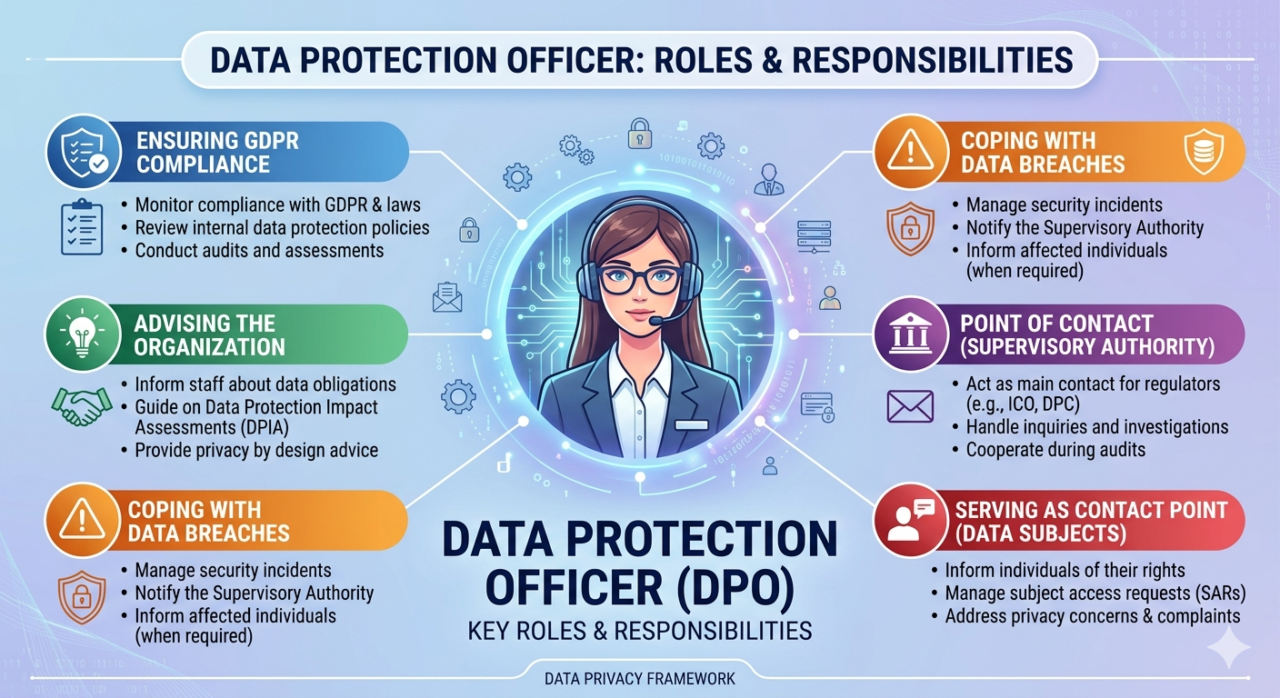
Key functions of a DPO include:
- Ensuring compliance with data protection laws (GDPR, DPDP, etc.)
- Monitoring data processing activities across the organization
- Advising organizations on privacy risks and mitigation strategies
- Acting as a point of contact for regulators and data subjects (customers/employees)
- Conducting Data Protection Impact Assessments (DPIAs) for high-risk processing
- Managing data breach responses and regulatory reporting
2. When is a DPO Mandatory Under GDPR? Legal Requirements
Under GDPR Article 37, appointing a DPO is mandatory in three specific scenarios. Organizations that meet any of these criteria must designate a DPO—failure to do so is a compliance violation.
Scenario 1: Public Authority or Body
Any public authority or body (excluding courts acting in their judicial capacity) must appoint a DPO. This includes government agencies, municipal bodies, and public sector enterprises.
Scenario 2: Large-Scale Monitoring of Individuals
Organizations whose core activities involve large-scale systematic monitoring of data subjects (e.g., online tracking, behavioral advertising, location tracking) must appoint a DPO.
Scenario 3: Large-Scale Processing of Sensitive Data
Organizations that process large volumes of sensitive personal data (health data, biometric data, criminal convictions, etc.) must appoint a DPO.
Beyond mandatory scenarios, appointing a DPO is strongly recommended as a best practice for any organization processing personal data—even when not legally required.
Key GDPR Requirements for DPO Role
- Must operate independently – No instructions on how to perform duties
- Reports to top management – Direct access to highest governance level
- Must have no conflict of interest – Cannot hold conflicting roles (e.g., CEO, CIO)
- Requires expert knowledge of data protection laws and practices
- Protected from dismissal or penalty for performing duties
- Contact details must be published and registered with supervisory authorities
3. Role of a Data Protection Officer: Strategic and Operational
The Data Protection Officer acts as a bridge between three key stakeholders:
- The Organization – Advising on compliance, policies, and risk management
- Regulators – Serving as the official point of contact for data protection authorities
- Data Subjects – Handling inquiries, complaints, and rights requests from customers/employees
Core Objective: Ensure lawful, transparent, and secure data processing while maintaining GDPR compliance and building organizational trust.
The DPO is not personally responsible for compliance (the organization remains accountable) but is responsible for monitoring, advising, and reporting on compliance status.
4. Key Responsibilities of a Data Protection Officer
The DPO’s responsibilities span strategic governance, operational compliance, and regulatory engagement.
| Responsibility Area | Key Activities | Regulatory Reference |
|---|---|---|
| Monitor Compliance | Ensure adherence to GDPR, DPDP, and local data protection laws. Track regulatory changes and assess impact. Maintain records of processing activities.), | GDPR Art. 39(1)(a) |
| Conduct DPIA | Perform Data Protection Impact Assessments for high-risk processing. Identify and mitigate privacy risks. Document findings and remediation.), | GDPR Art. 35-36 |
| Manage Data Breaches | Ensure timely detection, response, and investigation. Coordinate breach notification to regulators within 72 hours. Communicate with affected data subjects.), | GDPR Art. 33-34 |
| Advise on Policies | Support implementation of data protection governance frameworks. Review and update privacy policies. Guide data retention and deletion practices.), | GDPR Art. 39(1)(b) |
| Employee Training & Awareness | Drive organization-wide data privacy awareness programs. Deliver role-based training. Promote a culture of data protection.), | GDPR Art. 39(1)(b) |
| Liaison with Regulators | Act as official contact point for data protection authorities. Respond to regulatory inquiries and investigations. Cooperate with supervisory authorities.), | GDPR Art. 39(1)(e) |
| Data Subject Rights | Manage requests for access, rectification, erasure, and portability. Ensure timely responses (within one month). Maintain request logs.), | GDPR Art. 12-23 |
5. DPO in India: Legal & Regulatory Relevance (2026)
India’s data protection ecosystem is evolving rapidly with multiple regulatory drivers making the DPO role increasingly relevant.
Key Regulatory Frameworks
- Digital Personal Data Protection Act (DPDP Act): India’s first comprehensive data protection law. While it does not explicitly mandate a DPO, it requires a “Consent Manager” and significant data fiduciary obligations. Appointing a DPO is considered best practice for DPDP compliance.
- RBI Guidelines: Banks and financial institutions must have robust data protection frameworks. Many RBI circulars reference data protection officers for specific functions.
- SEBI Regulations: Listed companies and market intermediaries face increasing data protection requirements, including privacy governance roles.
- IRDAI Guidelines: Insurance companies must protect policyholder data, with designated privacy roles becoming standard.
- Sectoral Regulations: Telecom, healthcare, and fintech sectors have additional data protection requirements.
Why DPO is Important in India
- Rising compliance requirements for banks, fintech, SaaS, and digital platforms
- Cross-border data processing obligations with GDPR-equivalent standards
- Alignment with global standards for organizations operating internationally
- Increased regulatory scrutiny from RBI, SEBI, and MeitY
- Customer trust expectations – data protection is a competitive differentiator
Even when not legally mandatory, appointing a Data Protection Officer is becoming a best practice for GDPR-aligned organizations in India and those seeking to demonstrate privacy maturity.
6. DPO vs Compliance Officer vs Security Officer: Key Differences
Organizations often confuse these roles. Understanding the distinctions is essential for clear accountability.
| Role | Primary Focus | Scope | Key Regulations |
|---|---|---|---|
| Data Protection Officer (DPO) | Data protection & privacy compliance | GDPR, DPDP, UK GDPR, privacy laws | Art. 37-39 GDPR |
| Compliance Officer | Legal & regulatory compliance (broad) | Anti-money laundering, conduct, licensing, etc. | Varies by sector |
| Security Officer / CISO | Cybersecurity & technical controls | Network security, access controls, incident response, encryption | ISO 27001, NIST, RBI cybersecurity |
Key takeaway: The DPO focuses on data privacy and lawful processing; the Compliance Officer focuses on broader legal and regulatory obligations; the Security Officer focuses on technical cybersecurity controls. In practice, these roles must collaborate closely.
7. Skills and Qualifications Required for a DPO
A strong Data Protection Officer must possess a blend of legal, technical, and communication skills.
Legal & Regulatory Expertise
- Deep understanding of GDPR, DPDP Act, and applicable privacy laws
- Knowledge of cross-border data transfer mechanisms (SCCs, BCRs)
- Familiarity with data subject rights and breach notification requirements
- Understanding of enforcement trends and regulatory expectations
Cybersecurity & Risk Management
- Understanding of data protection technologies (encryption, pseudonymization)
- Risk assessment and mitigation methodologies
- Incident response and breach management processes
- Knowledge of security controls and their privacy implications
Audit & Compliance Management
- Experience conducting DPIAs and privacy audits
- Ability to maintain Records of Processing Activities (ROPA)
- Knowledge of compliance frameworks and control testing
- Audit-ready documentation and evidence management
Communication & Stakeholder Management
- Ability to communicate complex privacy concepts to non-experts
- Experience engaging with regulators and supervisory authorities
- Strong written and verbal communication skills
- Training and awareness program delivery
Professional certifications such as CIPP/E, CIPM, CDPO, or ISO 27701 Lead Implementer are highly valued for DPO roles.
8. Common Challenges Faced by Data Protection Officers
Even with strong skills, DPOs face significant organizational and operational challenges.
- Lack of visibility into organizational data flows: Unclear what personal data is collected, where it resides, who has access, and how it is processed – making compliance impossible
- Managing multi-jurisdiction compliance requirements: Operating across GDPR, DPDP, CCPA, and other regimes with conflicting requirements
- Handling strict breach reporting timelines: GDPR’s 72-hour notification window is difficult to meet without automated detection and response
- Limited awareness across teams: Business units often unaware of privacy obligations, leading to shadow processing and unauthorized data use
- Resource constraints: Many organizations expect the DPO to manage compliance without adequate tools or staff
- Maintaining independence: Pressure from management to deprioritize privacy concerns for business objectives
- Keeping pace with regulatory changes: Frequent updates to guidance, enforcement priorities, and emerging laws
- Demonstrating compliance to regulators: Inability to produce evidence of compliance when requested
These challenges highlight why structured compliance systems and GRC automation are essential for DPOs to be effective at scale.
9. DPO Program Maturity Model: From Reactive to Privacy-by-Design
Assess your organization’s DPO program maturity using this five-level model.
| Level | Name | Characteristics | DPO Effectiveness |
|---|---|---|---|
| Level 1 | Reactive | No formal DPO or part-time assignment. Privacy managed in silos. Breaches handled ad-hoc. No ROPA. Manual spreadsheets. | Minimal – reactive only |
| Level 2 | Aware | DPO appointed but not fully empowered. Basic ROPA. Annual DPIA for select processes. Inconsistent training. | Limited – compliance gaps |
| Level 3 | Defined | DPO reports to top management. Formal ROPA maintained. Regular DPIAs. Breach response procedure. Privacy policies documented. | Proactive – consistent compliance |
| Level 4 | Managed & Measured | Automated compliance tracking. Real-time breach detection. Privacy-by-design integrated into product development. Regular regulatory engagement. | Optimized – measurable outcomes |
| Level 5 | Privacy-by-Design | Fully integrated GRC platform. Continuous monitoring of data flows. Automated DSAR responses. Predictive privacy risk analytics. Privacy culture embedded organization-wide. | Strategic – privacy as competitive advantage |
Most organizations operate at Level 2 or 3. Advancing to Level 4 and 5 requires automation, GRC integration, and executive commitment to privacy-by-design.
Ready to advance your DPO program maturity?
Learn how ASPIA’s GRC platform empowers DPOs with automated privacy compliance, breach management, and audit-ready reporting.
Request an ASPIA Demo10. How GRC Tools Empower Data Protection Officers
Manual compliance using spreadsheets and email is not scalable for modern organizations. GRC platforms help DPOs manage the complexity of data protection compliance at scale.
Governance-Integrated Privacy Management: GRC platforms link privacy compliance directly to risk management, policy governance, and audit workflows. When a DPIA identifies high residual risk, the system can automatically trigger risk treatment workflows. When a data breach occurs, it automatically notifies the DPO, tracks investigation steps, and generates regulator-ready notifications – creating a closed-loop privacy governance system.
Key GRC Capabilities for DPOs
- Centralized Records of Processing Activities (ROPA): Maintain complete inventory of data processing activities, data flows, legal bases, and retention periods
- Automated DPIA workflows: Template-driven DPIAs, risk scoring, approval routing, and remediation tracking – consistent and auditable
- Data breach management: Detect, log, investigate, and report breaches with automated 72-hour notification timelines and regulator templates
- Data Subject Access Request (DSAR) management: Centralized intake, automated acknowledgment, timeline tracking, and secure response delivery
- Regulatory change management: Track changes to GDPR, DPDP, and other privacy laws – automatically identify affected processing activities
- Vendor / third-party privacy management: Assess vendor data protection practices, track data processing agreements (DPAs), monitor compliance
- Privacy policy management: Version-controlled policies, approval workflows, employee acknowledgment tracking
- Audit-ready reporting: One-click reports for ROPA, DPIA status, breach history, DSAR metrics, and vendor compliance
- Dashboard visibility: Real-time views of privacy compliance status, open risks, breach response timeliness, and DSAR backlog
Platforms like ASPIA enable organizations to manage GDPR compliance, centralize data protection processes, and improve regulatory readiness – allowing DPOs to focus on strategic privacy leadership rather than manual tracking.
11. Frequently Asked Questions (FAQs)
What is the full form of DPO?
Is DPO mandatory under GDPR?
What is the role of a DPO?
Is DPO required in India?
What is DPIA?
What qualifications are required to become a DPO?
Can a company have more than one DPO?
Does a startup need a DPO?
12. Conclusion: From Compliance Burden to Strategic Advantage
The role of a Data Protection Officer is central to modern data governance. With increasing regulatory pressure, rising data breaches, and data-driven business models, organizations cannot afford to treat privacy as an afterthought.
A Data Protection Officer not only ensures compliance but also builds trust, reduces risk, and strengthens organizational resilience. When empowered with the right authority, resources, and tools, DPOs transform privacy from a compliance burden into a competitive advantage.
For enterprises and financial institutions, integrating DPO functions with GRC platforms enables scalable, efficient, and audit-ready compliance management – allowing DPOs to focus on strategic privacy leadership rather than manual tracking and fire drills.
Empower Your DPO with ASPIA’s Privacy Management Platform
ASPIA provides a unified GRC platform that automates data protection compliance – from ROPA and DPIA to breach management and DSARs. Our solution enables DPOs to:
- ✓ Centralize Records of Processing Activities (ROPA)
- ✓ Automate DPIA workflows and risk assessments
- ✓ Manage data breaches with 72-hour notification tracking
- ✓ Process DSARs with automated timeline management
- ✓ Link privacy compliance to risk, policy, and audit frameworks
- ✓ Monitor vendor data protection compliance
- ✓ Generate audit-ready privacy reports with one click
Move from manual privacy tracking to automated, audit-ready compliance.
Request an ASPIA Demo
