Most businesses assume their operations are working fine—until inefficiencies start affecting performance. The problem is: financial numbers may look correct, but operations behind them may be inefficient. This is exactly where an operational audit becomes critical.
Unlike traditional audits that focus on financial accuracy, an operational audit analyzes, challenges, and improves operations. It evaluates efficiency, effectiveness, and economy—helping organizations identify what is slowing the business down and fix it.
This guide provides a complete framework for understanding operational audits—from meaning and objectives to process, checklist, real examples, types, and how GRC tools enhance operational audit effectiveness.
1. Operational Audit Meaning (Direct Answer)
An operational audit is a comprehensive and independent review of an organization’s processes, procedures, and internal controls to evaluate efficiency, effectiveness, and economy.
Operational audit meaning in simple words: It is a way to check how well a business is actually running and where it can improve.
The three E’s of operational audit are:
- Efficiency – Are resources being used optimally? (Minimum input for maximum output)
- Effectiveness – Are objectives being achieved? (Are we doing the right things?)
- Economy – Are costs minimized without sacrificing quality? (Are we spending wisely?)
2. What is an Operational Audit? Practical View
An operational audit goes beyond financial checks and focuses on:
- Business processes – How work actually gets done from start to finish
- Internal controls – Whether controls are designed and operating effectively
- Resource utilization – Whether people, technology, and budget are used optimally
- Department performance – How individual units contribute to organizational goals
Its purpose is simple: Identify what is slowing the business down—and fix it. Unlike compliance audits that ask “Are we following the rules?” operational audits ask “Are we doing things the best way possible?”
3. Key Objectives of Operational Audit
Operational audits are designed to improve performance—not just check compliance. The following objectives drive real business value.
1. Evaluate Efficiency and Effectiveness
Assess whether resources (people, technology, budget) are used optimally and whether business objectives are being achieved. This is the core of operational audit.
2. Identify Process Gaps and Bottlenecks
Detect delays, redundancies, unnecessary steps, and workflow bottlenecks that slow down operations and increase costs.
3. Risk Mitigation and Compliance
Ensure adherence to policies, regulations (SOX, HIPAA, GDPR), and industry standards while identifying operational risks that could cause failures.
4. Provide Actionable Recommendations
Deliver practical, data-driven improvements that management can implement to reduce costs, improve quality, and increase speed.
These objectives make operational audit a performance improvement tool, not just a verification exercise.
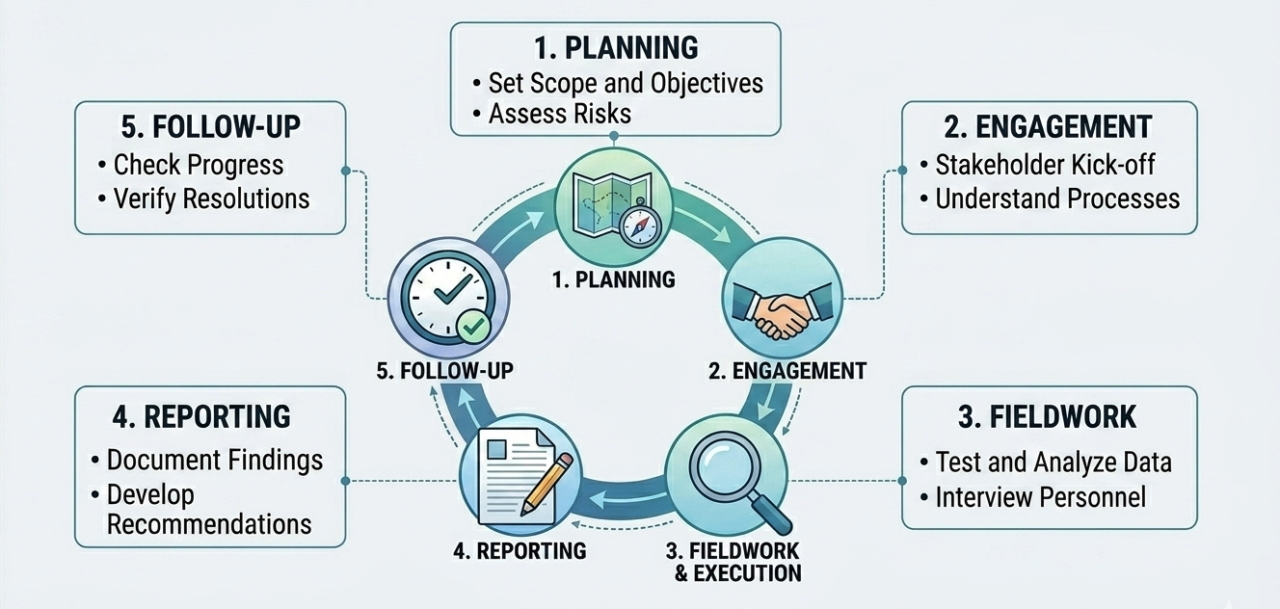
4. Operational Audit Process: Step-by-Step
A structured operational audit process ensures meaningful outcomes. Without a clear process, audits become unfocused and fail to deliver value.
Step 1: Planning
Define scope, objectives, and key performance indicators. Identify key areas (HR, procurement, operations, IT). Develop audit program and allocate resources.
Key outputs: Audit plan, scope document, risk assessment, resource allocation
Step 2: Fieldwork (Execution)
Collect data and documentation. Conduct interviews with process owners. Observe processes in action. Perform testing and sampling.
Key outputs: Evidence, interview notes, process maps, test results
Step 3: Evaluation
Analyze performance against benchmarks and standards. Identify inefficiencies, gaps, and root causes. Assess control effectiveness and risk exposure.
Key outputs: Gap analysis, root cause analysis, preliminary findings
Step 4: Reporting
Present findings, highlight risks and inefficiencies, and recommend improvements. Include cost-benefit analysis where applicable.
Key outputs: Audit report, recommendations, action plan
Step 5: Follow-Up
Ensure recommendations are implemented. Monitor improvements and track results. Conduct follow-up audits as needed.
Key outputs: Remediation status, improvement metrics, closure reports
Without follow-up, even the best audit loses value. The most common failure is identifying issues but never ensuring they are fixed.
5. Operational Audit Checklist: Practical Questions
A practical operational audit checklist ensures consistency and depth in audits. This checklist can be adapted for any department or process.
Operational Audit Checklist
- Are processes clearly defined and documented? – Is there a process map or procedure document?
- Are controls effective and working? – Do controls prevent or detect errors and fraud?
- Are there delays or bottlenecks? – Where do work items wait the longest?
- Are resources being used efficiently? – Is there idle time, overstaffing, or underutilized technology?
- Are risks identified and managed? – Is there a risk register? Are mitigation plans in place?
- Are performance metrics defined and tracked? – Does the department measure what matters?
- Is there duplication of effort? – Are the same tasks being done by multiple people or systems?
- Are employees trained and competent? – Do they understand their roles and responsibilities?
- Is technology supporting or hindering operations? – Are systems up-to-date and user-friendly?
- Are there compliance gaps? – Is the process compliant with laws and internal policies?
6. Key Areas Covered in Operational Audit
Operational audits evaluate multiple business areas to provide a holistic view of business performance.
| Area | What Is Evaluated | Typical Questions |
|---|---|---|
| Internal Controls | Policies, procedures, and systems that protect assets and ensure reliability | Are controls designed effectively? Are they operating as intended? |
| Operational Workflows | Daily business processes from initiation to completion | Are there bottlenecks? Are steps value-adding or waste? |
| Human Resources | Workforce efficiency, training, performance management, staffing levels | Are employees properly trained? Is workload balanced? |
| Technology Utilization | Effectiveness of IT systems in supporting operations | Are systems integrated? Is automation being used effectively? |
| Financial Management | Budgeting, forecasting, cost control, and resource allocation | Are costs controlled? Is budget aligned with priorities? |
7. Operational Audit Example: Inventory Management
The following real-world example illustrates how an operational audit identifies inefficiencies and drives improvement.
Scenario: Inventory Management Audit
Initial situation: Company experiencing excess inventory, stockouts of popular items, and delays in order fulfillment.
Audit Findings:
- Poor demand forecasting (using historical sales only, no seasonality adjustment)
- Manual inventory tracking with spreadsheets (no real-time visibility)
- No reorder point system (inconsistent ordering)
- Excess safety stock due to lack of trust in data
- No vendor performance metrics (late deliveries not tracked)
Recommendations:
- Implement automated inventory management system
- Improve forecasting models using historical data + seasonality + trends
- Establish reorder points and economic order quantity (EOQ)
- Implement vendor scorecards and performance tracking
- Conduct cycle counting instead of annual physical inventory
Results:
- Reduced inventory carrying costs by 25%
- Improved order fulfillment speed by 40%
- Reduced stockouts from 15% to 3%
- Increased inventory turnover from 4x to 6x per year
This example shows how operational audit identifies root causes, not just symptoms, and delivers measurable business results.
8. Types of Operational Audits
Operational audits can be tailored based on focus areas. This flexibility makes operational audit highly adaptable to different organizational needs.
| Audit Type | Focus Area | Example |
|---|---|---|
| IT Audit | Systems, security, data integrity, IT operations | Auditing user access controls and change management |
| Departmental Audit | Specific department (HR, Finance, Procurement, Sales) | Auditing procurement cycle time and vendor selection |
| Process Audit | End-to-end business process (order-to-cash, procure-to-pay) | Auditing the accounts payable process |
| Compliance Operational Audit | Adherence to policies and regulations with operational focus | Auditing GDPR compliance in marketing operations |
| Supply Chain Audit | Logistics, warehousing, vendor management, delivery | Auditing vendor performance and delivery times |
9. Operational Audit vs Internal Audit: Key Differences
While related, operational audit and internal audit have different focuses and objectives.
| Feature | Operational Audit | Internal Audit |
|---|---|---|
| Primary Focus | Efficiency, effectiveness, economy (performance) | Risk management, control, governance (assurance) |
| Goal | Improve future performance | Ensure compliance and control effectiveness |
| Scope | Processes, workflows, resource utilization | Organization-wide (financial, operational, compliance) |
| Time Orientation | Future-focused (how to improve) | Past and present (are controls working?) |
| Relationship | Operational audit is a subset of internal audit | Broader function that includes operational, financial, and compliance audits |
Operational audit is a subset of internal audit—specializing in performance improvement rather than just compliance verification.
10. Why Operational Audits Are Important
Operational audits help organizations achieve tangible business results beyond compliance.
- Improve efficiency – Eliminate waste, reduce cycle times, and optimize resource allocation
- Reduce operational costs – Identify cost-saving opportunities without sacrificing quality
- Strengthen internal controls – Fix control gaps that cause errors, fraud, or inefficiency
- Identify hidden risks – Surface operational risks that could disrupt business
- Enhance decision-making – Provide management with data-driven insights for strategic choices
- Increase customer satisfaction – Faster, more reliable operations improve customer experience
- Drive continuous improvement – Create a culture of ongoing optimization
Operational audits transform operations from functional → optimized. They move organizations from “good enough” to “best in class.”
11. Common Challenges in Operational Auditing
Even well-intentioned operational audits can fail to deliver value due to these common challenges.
- Inaccurate or incomplete data – Audits based on bad data produce misleading conclusions
- Resistance to change – Process owners may feel threatened and withhold cooperation
- Limited resources – Insufficient time, budget, or skilled auditors to conduct thorough reviews
- Lack of follow-up – Recommendations are made but never implemented or tracked
- Narrow scope – Auditing isolated processes without understanding upstream/downstream impacts
- Focus on symptoms, not root causes – Fixing surface issues without addressing underlying problems
- No management buy-in – Without leadership support, recommendations are ignored
The biggest failure is not identifying issues—it’s not implementing solutions. An audit without action is wasted effort.
12. Operational Audit Maturity Model
Assess your organization’s operational audit capability using this five-level maturity model.
| Level | Name | Characteristics | Business Impact |
|---|---|---|---|
| Level 1 | Reactive | No formal operational audits. Issues addressed only after failures occur. | Minimal – crisis-driven |
| Level 2 | Periodic | Annual operational audits. Basic checklists. Limited follow-up. | Low – some improvements |
| Level 3 | Structured | Risk-based audit planning. Documented methodology. Root cause analysis. Formal reporting. | Moderate – measurable improvements |
| Level 4 | Integrated | Continuous monitoring. Automated data collection. Real-time dashboards. Integrated with GRC. | High – proactive optimization |
| Level 5 | Predictive | AI-driven analytics. Predictive insights. Automated remediation. Continuous improvement culture. | Optimal – competitive advantage |
Most organizations operate at Level 2 or 3. Advancing to Level 4 and 5 requires automation, GRC integration, and a commitment to continuous improvement.
Ready to advance your operational audit maturity?
Learn how ASPIA’s GRC platform helps organizations plan, execute, and track operational audits with automated workflows and real-time dashboards.
Request an ASPIA Demo13. How to Perform a Quick and Effective Operational Audit
- Focus on high-risk areas – Prioritize processes that would cause the most damage if they fail
- Use structured checklists – Ensure consistency and completeness across audits
- Analyze real data (not assumptions) – Base conclusions on evidence, not opinions
- Identify root causes – Go beyond symptoms to find underlying issues
- Provide actionable recommendations – Be specific about what to change and how
- Set clear timelines – Define when recommendations should be implemented
- Follow up rigorously – Track remediation to closure and measure results
14. 5 Proven Ways to Improve Operational Audit Performance
- Adopt risk-based auditing – Allocate audit resources to the highest-risk areas, not the easiest areas
- Use automation tools – Automate data collection, sampling, and analysis to increase coverage and reduce errors
- Focus on high-impact areas – Target processes with the greatest potential for cost savings or risk reduction
- Improve documentation – Maintain clear workpapers, evidence trails, and audit programs
- Ensure follow-up and accountability – Track findings to closure and escalate overdue remediation
15. Frequently Asked Questions (FAQs)
What is operational auditing?
How does a process audit go?
What is operational audit meaning in simple words?
What is operational audit checklist?
What is operational audit example?
Is operational audit part of internal audit?
16. Conclusion: From Functioning to Optimized
An operational audit is not just about reviewing operations—it is about improving them. It provides organizations with a clear understanding of:
- What is working – So successful practices can be reinforced
- What is inefficient – So waste can be eliminated
- What needs to change – So resources can be redirected to high-value activities
Businesses that actively use operational audits don’t just operate—they continuously improve and stay competitive. In today’s fast-changing business environment, standing still is falling behind.
By leveraging GRC platforms like ASPIA, organizations can automate operational audit workflows, track findings, measure improvement, and embed continuous optimization into their DNA.
Transform Operational Audits with ASPIA
ASPIA provides a unified GRC platform that transforms operational audits from periodic exercises to continuous performance improvement. Our solution enables organizations to:
- ✓ Plan and schedule risk-based operational audits
- ✓ Execute audits with standardized checklists and procedures
- ✓ Track findings, recommendations, and remediation actions
- ✓ Link operational audit findings to risk, control, and process libraries
- ✓ Generate real-time dashboards on efficiency metrics and improvement trends
- ✓ Automate follow-up and escalation for overdue actions
- ✓ Reduce audit cycle time by up to 40%
Move from periodic audits to continuous operational excellence.
Request an ASPIA Demo