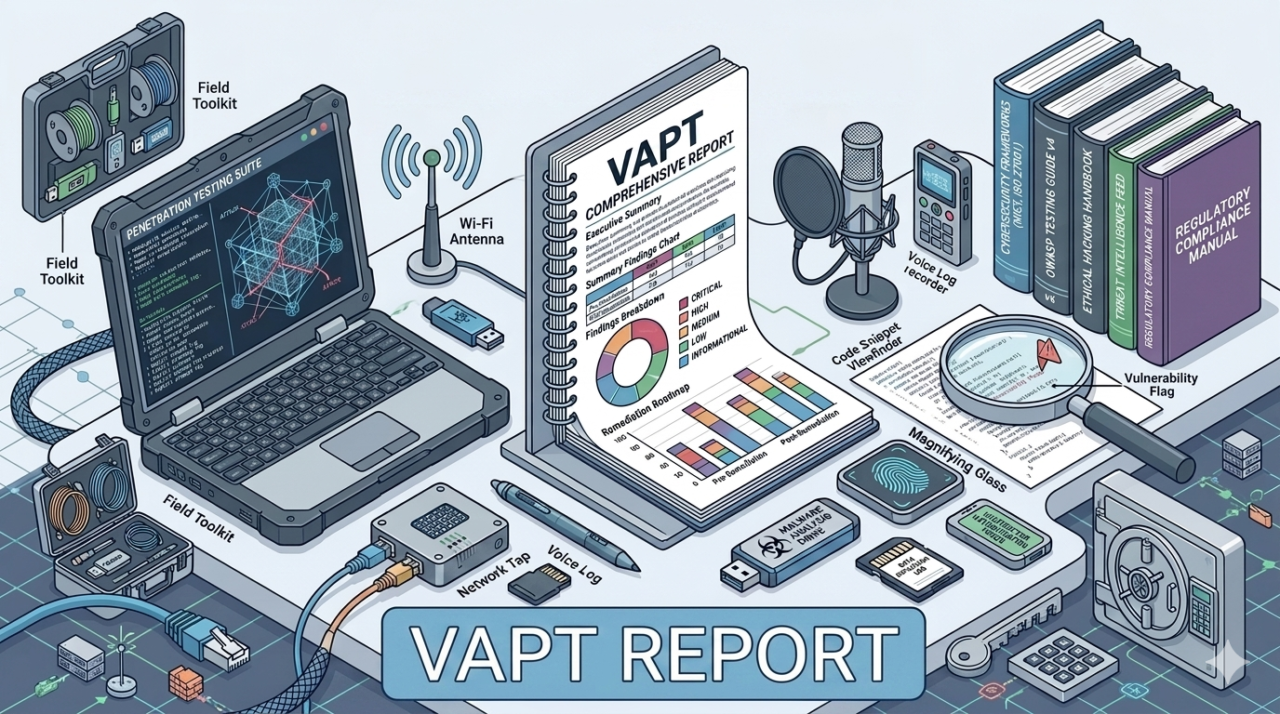
In today’s cybersecurity landscape, identifying vulnerabilities is only half the job. The real value lies in how those vulnerabilities are documented, prioritized, and acted upon. This is where the VAPT report becomes critical.
For banks and enterprises, a VAPT report is not just a technical output—it is a risk, audit, and compliance document used to demonstrate security posture, track remediation, and satisfy regulatory requirements. Yet, many organizations still struggle with what exactly a VAPT report should contain, how it should be structured, and how to generate it efficiently at scale.
This guide provides a complete framework for understanding VAPT reports—from meaning and full form to components, sample findings, templates, common mistakes, and how automated reporting transforms vulnerability management from manual effort to continuous security visibility.
1. VAPT Report: Quick Answer & Definition
A VAPT report is a structured document that presents vulnerabilities identified during Vulnerability Assessment and Penetration Testing, along with risk severity, business impact, and remediation actions.
A VAPT report provides a complete view of an organization’s security posture and risk exposure
Unlike generic security reports that only list technical issues, a professional VAPT report connects technical findings with business risk, making it useful for both technical teams (developers, system administrators) and management (CISO, risk committee, board).
2. What is VAPT Report? Meaning & Full Form
VAPT stands for Vulnerability Assessment and Penetration Testing.
Vulnerability Assessment (VA)
Identifies security weaknesses in systems, applications, and networks using automated scanning tools and manual verification. It answers: “What vulnerabilities exist?”
Penetration Testing (PT)
Exploits those weaknesses to validate real risk and demonstrate impact. It answers: “Can these vulnerabilities actually be exploited, and what would be the consequence?”
A VAPT report combines both activities into a structured output that answers:
- Where are the vulnerabilities? – Specific systems, applications, or components affected
- How critical are they? – Risk severity with CVSS scores and business impact
- What is the business impact? – Potential financial, operational, and reputational consequences
- How should they be fixed? – Clear, actionable remediation steps with prioritization
3. Why VAPT Reports Are Critical for Banks and Enterprises
In regulated industries like banking, VAPT reports are often mandatory and form a key part of audit and compliance processes.
- Regulatory audits and compliance checks – RBI, PCI-DSS, ISO 27001, and other frameworks require regular VAPT and documented reports
- Third-party/vendor risk assessments – Vendors must provide VAPT reports to demonstrate security posture
- Internal security reviews – Track security posture over time and measure improvement
- Pre-production or go-live security validation – Ensure applications are secure before deployment
- Board and management reporting – Translate technical vulnerabilities into business risk language
A well-structured VAPT report ensures that vulnerabilities are not just identified but also prioritized and resolved efficiently. VAPT reports are often used alongside audit reports and risk assessments, making them a key input for enterprise risk visibility.
4. What a Real VAPT Report Contains: Key Components
A professional VAPT report is structured to communicate both technical depth and business impact. A well-structured VAPT report typically includes the following components:
| Section | Purpose | Primary Audience |
|---|---|---|
| Executive Summary | High-level risk overview for management, including key findings and overall security posture | CISO, CIO, Board, Senior Management |
| Scope | Systems, applications, networks, and environments tested (with IP ranges, URLs, etc.) | Auditors, Security Teams |
| Methodology | Testing approach, tools used, and standards followed (OWASP, PTES, NIST) | Auditors, Security Teams |
| Findings | Identified vulnerabilities with details, proof of concept, and affected components | Technical Teams, Developers |
| Risk Rating | Severity classification (Critical/High/Medium/Low) with CVSS scores | Management, Risk Teams |
| Recommendations | Clear, actionable remediation steps for each vulnerability | Technical Teams, Developers |
| Conclusion | Overall security posture assessment and key recommendations for improvement | Management, Auditors |
The core of the report lies in the findings section, where each vulnerability must clearly explain the issue, its impact, and how it can be fixed.
5. VAPT Report Sample: How It Looks in Practice
A strong VAPT report includes multiple findings with clear structure. The following sample illustrates how vulnerabilities should be documented in a professional VAPT report.
Sample Finding 1: SQL Injection
| Severity: | Critical |
| CVSS Score: | 9.8 |
| Affected Asset: | Web Application – Login Module (/login) |
| Vulnerability Type: | Injection (OWASP A03:2021) |
| Observation: | Input fields in the login page accept unsanitized user input, allowing attackers to inject malicious SQL queries. |
| Proof of Concept: | Payload ' OR '1'='1 successfully executed, bypassing authentication and granting unauthorized access. |
| Root Cause: | Lack of input validation and direct execution of dynamic SQL queries without parameterization. |
| Impact: | Unauthorized database access, data leakage (customer credentials, financial data), data manipulation or deletion, full compromise of application integrity. |
| Business Risk: | High risk of regulatory non-compliance, financial loss, and reputational damage. |
| Recommendation: | Use parameterized queries / prepared statements. Implement server-side input validation. Apply least privilege principle for database access. Use Web Application Firewall (WAF). |
| Remediation Priority: | Immediate |
| Status: | Open |
Sample Finding 2: Cross-Site Scripting (XSS)
| Severity: | High |
| CVSS Score: | 7.4 |
| Affected Asset: | Web Application – Search Module (/search) |
| Vulnerability Type: | Cross-Site Scripting (OWASP A07:2021) |
| Observation: | User input in the search field is not properly sanitized, allowing execution of malicious scripts in the browser. |
| Proof of Concept: | Payload <script>alert('XSS')</script> executed successfully in the victim’s browser. |
| Root Cause: | Lack of output encoding and improper handling of user input in frontend rendering. |
| Impact: | Session hijacking, credential theft, unauthorized actions on behalf of users, defacement of application. |
| Business Risk: | Potential customer data compromise and loss of user trust. |
| Recommendation: | Implement output encoding (HTML, JavaScript encoding). Apply input validation and sanitization. Use Content Security Policy (CSP) headers. Secure session cookies (HttpOnly, Secure flags). |
| Remediation Priority: | High |
| Status: | Open |
Sample Finding 3: Weak Password Policy
| Severity: | Medium |
| CVSS Score: | 5.3 |
| Affected Asset: | Authentication System |
| Vulnerability Type: | Security Misconfiguration (OWASP A05:2021) |
| Observation: | The application enforces a weak password policy (minimum length 6 characters, no complexity requirements). |
| Proof of Concept: | Weak passwords such as password123 and admin123 are accepted by the system. |
| Root Cause: | Inadequate password policy configuration and absence of enforcement controls. |
| Impact: | Increased risk of brute-force attacks, credential stuffing attacks, unauthorized access to user accounts. |
| Business Risk: | Account compromise leading to fraud or misuse of services. |
| Recommendation: | Enforce minimum 12-character password length. Require complexity (uppercase, lowercase, numbers, symbols). Implement Multi-Factor Authentication (MFA). Enable account lockout after multiple failed attempts. |
| Remediation Priority: | Medium |
| Status: | Open |
This format ensures that vulnerabilities are clearly understood and actionable. Each finding includes: severity, CVSS score, affected asset, vulnerability type, observation, proof of concept, root cause, impact, business risk, recommendation, remediation priority, and status.
6. VAPT Report Template: Standard Structure for Organizations
Most organizations follow a consistent format for audit and compliance purposes. The following template is recommended for professional VAPT reports.
Standard VAPT Report Template
- Executive Summary – Overview of testing, key findings, overall risk rating, and security posture
- Scope and Objectives – Systems tested, testing boundaries, and objectives of the assessment
- Testing Methodology – Tools used, techniques applied, and standards followed (OWASP, NIST, PTES)
- Summary of Findings – High-level summary of vulnerabilities by severity (Critical/High/Medium/Low count)
- Detailed Vulnerability Analysis – Each finding with full details: observation, proof, impact, risk rating, recommendation
- Risk Ratings Summary – Visual representation of risk distribution (charts, tables)
- Remediation Plan – Prioritized action items with suggested timelines
- Conclusion – Overall assessment and recommendations for improving security posture
- Appendices – Tool outputs, raw scan results, evidence screenshots
Consistency is essential for audits, especially in banking and enterprise environments. Organizations should standardize their VAPT report template to ensure comparability across different testing cycles.
7. When is a VAPT Report Required?
VAPT reports are typically required in the following scenarios:
- Before application or system go-live – Security validation before production deployment
- During regulatory or compliance audits – RBI, PCI-DSS, ISO 27001, SOC 2 require VAPT evidence
- For vendor or third-party assessments – Vendors must provide VAPT reports to demonstrate security
- As part of periodic (annual/quarterly) security testing – Continuous security monitoring
- After significant infrastructure changes – Following major updates or migrations
- Following security incidents – To identify root cause and prevent recurrence
This makes VAPT reporting a continuous requirement rather than a one-time activity. Organizations must have processes to generate reports on demand.
8. The Challenge with Manual VAPT Reporting
Despite its importance, many organizations still rely on manual reporting methods such as spreadsheets or disconnected tools. This leads to significant challenges:
- Inconsistent report formats – Different testers produce differently structured reports, making comparison difficult
- Delays in report generation – Manual compilation of findings takes days or weeks
- Lack of visibility into remediation – No tracking of whether vulnerabilities have been fixed
- Difficulty tracking vulnerabilities over time – No historical view of security posture trends
- Manual errors and omissions – Copy-paste mistakes, missing evidence, inconsistent risk ratings
- No integration with risk and compliance workflows – Findings exist in isolation
As systems scale, manual reporting becomes inefficient and error-prone. Organizations conducting multiple VAPT assessments per year cannot sustain manual approaches.
9. How VAPT Reports Can Be Generated Automatically
To address these challenges, organizations are adopting automated VAPT reporting approaches. Automated systems can:
- Aggregate vulnerabilities from multiple tools – Combine findings from different scanners (Nessus, Burp Suite, Qualys, etc.)
- Standardize report formats – Consistent structure across all assessments for easy comparison
- Assign severity and risk context – Consistent risk ratings based on CVSS and business context
- Track remediation progress – Monitor which vulnerabilities have been fixed and which remain open
- Generate reports on demand – Produce audit-ready reports in minutes, not days
- Integrate with risk and compliance workflows – Link VAPT findings to risk registers and remediation plans
This improves both efficiency and accuracy while reducing manual effort by up to 70%.
10. How ASPIA Helps Automate VAPT Reporting
Instead of manually compiling reports across multiple tools, organizations need a centralized and structured approach. ASPIA helps by:
- Automatically generating standardized VAPT reports – Consistent format aligned with audit requirements
- Centralizing vulnerability data across systems – Single repository for all VAPT findings
- Providing visibility into risk and remediation status – Real-time dashboards on vulnerability trends
- Aligning VAPT findings with audit and compliance workflows – Link vulnerabilities to risk assessments and compliance requirements
- Tracking remediation progress – Monitor fix status, assign owners, track timelines
- Generating executive dashboards – Visualize security posture for management and board
This ensures that VAPT reporting is not a one-time activity but part of a continuous risk management process.
Ready to automate your VAPT reporting?
Learn how ASPIA’s GRC platform helps organizations centralize VAPT findings, generate standardized reports, and track remediation.
Request an ASPIA Demo11. How VAPT Reports Support Real Decision-Making
A well-prepared VAPT report directly impacts business decisions and security investments.
- Risk prioritization – Focus remediation efforts on critical and high-risk vulnerabilities first
- Budget allocation for security controls – Justify security investments based on identified gaps
- Compliance readiness – Demonstrate to auditors that vulnerabilities are identified and managed
- Audit outcomes – Reduce audit findings by showing proactive vulnerability management
- Board reporting – Translate technical vulnerabilities into business risk language
- Vendor risk management – Assess third-party security posture through their VAPT reports
It translates technical vulnerabilities into actionable business decisions, which is critical for management.
12. Common Mistakes in VAPT Reports
Many organizations reduce the effectiveness of VAPT reports due to these common mistakes:
- Overly technical language without business context – Management cannot understand the risk or prioritize actions
- Missing impact analysis – Failing to explain why a vulnerability matters to the business
- Generic remediation steps – “Apply security patches” instead of specific, actionable instructions
- Lack of prioritization – All vulnerabilities presented as equally important, no risk-based ranking
- No tracking of fixes – Report is produced but remediation is never verified or documented
- No evidence or proof-of-concept – Findings cannot be reproduced or verified
- Inconsistent risk ratings – Similar vulnerabilities rated differently across reports
Avoiding these ensures that reports drive real outcomes rather than sitting on a shelf.
13. VAPT Report Maturity Model
Assess your organization’s VAPT reporting capability using this five-level maturity model.
| Level | Name | Characteristics | Security Effectiveness |
|---|---|---|---|
| Level 1 | Ad-Hoc | No formal VAPT reporting. Findings in emails or spreadsheets. No standardization. | Very low – findings not actionable |
| Level 2 | Basic | Basic report template. Findings listed. Limited risk ratings. Manual compilation. | Low – inconsistent and slow |
| Level 3 | Structured | Standardized template. CVSS scores. Business impact. Recommendations. Management summary. | Moderate – actionable findings |
| Level 4 | Automated | Automated report generation. Centralized vulnerability data. Real-time dashboards. Remediation tracking. | High – efficient and consistent |
| Level 5 | Integrated | Integrated with GRC platform. Continuous monitoring. Automated remediation workflows. Board-level dashboards. | Optimal – continuous security visibility |
Most organizations operate at Level 2 or 3. Advancing to Level 4 and 5 requires automation and GRC integration.
14. Frequently Asked Questions (FAQs)
What is the full form of VAPT?
What is a VAPT report?
What should a VAPT report include?
How often should VAPT be performed?
Is a VAPT report required for compliance?
Can VAPT reporting be automated?
15. Conclusion: From Technical Output to Strategic Risk Document
A VAPT report is not just a technical document—it is a critical component of risk management, audit readiness, and regulatory compliance. Organizations that treat VAPT reporting as a structured, continuous process—rather than a one-time activity—are better positioned to identify vulnerabilities early, reduce risk exposure, and respond effectively to evolving threats.
The difference between basic and mature VAPT reporting is simple:
- Basic VAPT reporting – Lists technical vulnerabilities without business context
- Mature VAPT reporting – Connects vulnerabilities to business risk, prioritizes remediation, and tracks progress
Organizations that operationalize VAPT reporting as part of continuous risk management will always stay ahead of evolving cyber threats. By leveraging GRC platforms like Aspia, organizations can automate VAPT reporting, centralize findings, and transform vulnerability data into strategic security decisions.
Transform VAPT Reporting with ASPIA
ASPIA provides a unified GRC platform that automates VAPT reporting, centralizes vulnerability data, and integrates findings with risk and compliance workflows. Our solution enables organizations to:
- ✓ Generate standardized VAPT reports automatically
- ✓ Centralize findings from multiple scanning tools
- ✓ Track remediation progress with real-time dashboards
- ✓ Link VAPT findings to risk registers and compliance frameworks
- ✓ Produce audit-ready reports in minutes, not days
- ✓ Demonstrate security posture to regulators and auditors
- ✓ Reduce reporting effort by up to 70%
Move from manual, inconsistent VAPT reporting to automated, continuous security visibility.
Request an ASPIA Demo