Introduction
An organization can identify hundreds or thousands of problems across internal audits, risk assessments, compliance reviews, control testing, cybersecurity assessments, vendor reviews and regulatory examinations.
Identifying those problems is only the beginning. The harder questions are:
- Who owns the issue?
- How serious is it?
- What caused it?
- What must be fixed?
- When must remediation be completed?
- What evidence proves that the action was completed?
- Who validates the remediation?
- Has the underlying problem actually been resolved?
- Has the issue occurred before?
- Is the organization accumulating overdue or repeat issues?
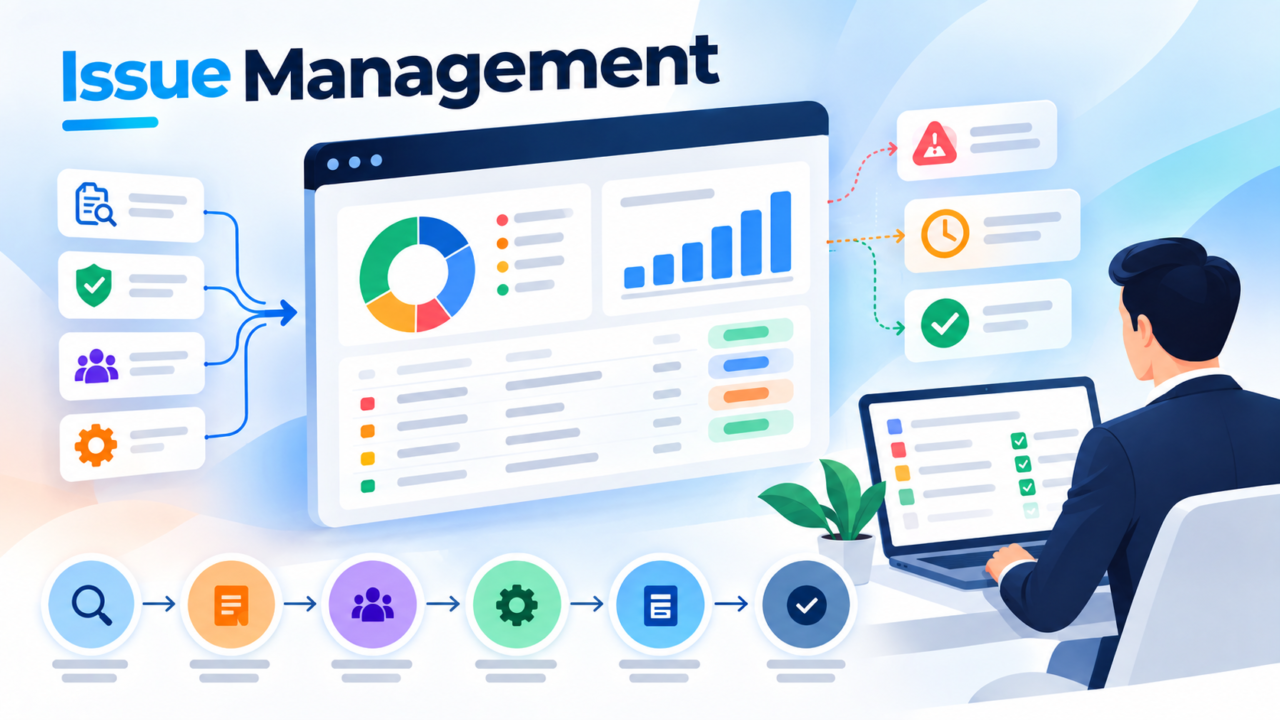
This is the purpose of issue management. Issue management is the structured process of identifying, assessing, assigning, remediating, validating, escalating and closing organizational issues.
In a mature governance environment, issue management connects findings from different sources with the underlying risk, control, business process, owner, remediation action, evidence and closure decision. This is especially important in financial services, where issue management may need to bring together audit findings, regulatory observations, control deficiencies, compliance gaps, risk issues, cybersecurity weaknesses and third-party issues in a controlled lifecycle.
What Is Issue Management?
Issue management is an enterprise process for managing identified problems or deficiencies from initial identification through assessment, ownership, root-cause analysis, remediation, evidence, validation and closure.
An issue can originate from:
The central idea is simple: An issue is not managed merely because it has been recorded. It is managed when the organization can demonstrate ownership, risk treatment, remediation progress and an appropriate basis for closure.
Issue Management vs Issue Tracking
Issue Tracking
Answers: Where does the issue stand?
Records: status, owner, due date, comments, actions, completion.
Issue Management
Answers: Why does the issue exist, what risk does it create, what must be done, and how do we know it is actually resolved?
Covers: risk assessment, root cause, remediation strategy, accountability, evidence, validation, escalation, approvals, closure criteria, recurrence, trend analysis, management reporting.
A spreadsheet with an Open / In Progress / Closed column is issue tracking. A controlled lifecycle that connects risk → owner → root cause → remediation → evidence → validation → closure is issue management.
Issue vs Risk vs Finding vs Observation vs Exception vs Incident
Why Do Organizations Need Issue Management?
The problem is rarely a lack of data. The problem is fragmentation. An organization may have:
The result can be: duplicate issues, unclear ownership, missed deadlines, inconsistent risk ratings, poor escalation, weak evidence, premature closure, recurring findings, and fragmented reporting.
Issue Management Lifecycle
A practical enterprise lifecycle is:
1. Identify the Issue
Issues may be identified through audit, risk assessment, compliance review, control testing, TPRM, cybersecurity assessment, incident investigation, regulatory review, and continuous monitoring. The original source should be preserved.
2. Normalize the Issue
Large enterprises may receive similar issues from different systems. A mature process should determine: is this a new issue, a duplicate, related to an existing issue, a recurrence, or does it represent a broader systemic issue?
3. Triage
Triage determines whether the item should enter the formal issue lifecycle. Typical questions: Is the issue valid? Is sufficient information available? Is the issue already known? Who should assess it? Does it require immediate escalation? What category applies? Is temporary containment required?
4. Categorize the Issue
5. Assess Risk and Severity
Assessment may consider business impact, regulatory impact, financial impact, customer impact, security impact, data sensitivity, operational impact, likelihood, duration of exposure, control effectiveness, number of affected systems/users, and existing compensating controls. Issue risk assessment should align with the organization’s broader enterprise risk management
framework.
6. Assign Ownership
A mature issue record can distinguish: Issue Owner (accountable for resolution), Action Owner (executes a specific remediation action), Reviewer (reviews remediation and evidence), Approver (approves closure where required), and Risk/Compliance/Audit Owner (provides oversight depending on the issue source).
7. Perform Root Cause Analysis
One of the biggest differences between mature and immature remediation is whether the organization addresses the cause or merely the symptom. Common RCA techniques include 5 Whys, Fishbone analysis, cause-and-effect analysis, process analysis, and control analysis.
8. Create a Remediation Plan
A good remediation action is specific, measurable, assigned, time-bound, and verifiable. Avoid vague actions such as “Management will improve the process.” Instead: “Implement quarterly automated privileged-access review with defined ownership, escalation and completion reporting.”
9. Track Remediation
10. Collect Evidence
Evidence may include configuration screenshots, reports, system-generated logs, access review reports, policy documents, procedures, tickets, test results, meeting approvals, vendor attestations, control test results, and retest results. For a deeper look at evidence types, collection methods, validation, and audit-ready evidence management, see our guide to Audit Evidence Collection.
11. Validate the Remediation
This is arguably the most important control point in issue management. Completed action does not automatically equal resolved issue.
Design Effectiveness
Does the redesigned control actually address the identified risk?
Operating Effectiveness
Is the control actually operating as designed over the relevant period?
12. Approve Closure
Possible outcomes: Close, Return for remediation, Request additional evidence, or Reopen.
13. Close the Issue
A defensible closure record should include closure date, closure rationale, completed actions, evidence, validation result, reviewer, approver, residual risk, and related records.
14. Reopen When Necessary
Reopening may be appropriate when the remediation failed, the issue recurred, evidence was insufficient, the root cause was not addressed, a control failed again, new information changes the risk, or the remediation became ineffective.
Issue Management for Financial Services
Financial institutions may have issue sources across multiple lines of business and governance functions. These sources feed into a centralized issue management process for assessment, ownership, remediation, validation, and closure.
Issue Management Across the Enterprise
Internal Audit
Finding → Issue → Action Plan → Evidence → Validation → Closure
Compliance
Requirement → Gap → Issue → Remediation → Evidence → Validation
Risk
Risk → Treatment Gap → Issue → Action → Risk Reassessment
Cybersecurity
Finding → Asset → Risk → Issue → Remediation → Retest → Closure
TPRM
Vendor Assessment → Deficiency → Issue → Vendor Action → Evidence → Review → Closure
Incident Management
Incident → Root Cause → Corrective Action → Issue → Validation
Issue Management and CAPA
CAPA should not be confused with issue management. Issue management manages the overall issue lifecycle: identify → assess → assign → remediate → validate → close. CAPA focuses on corrective and preventive action: problem → correction → root cause → corrective action → preventive action → effectiveness verification. A CAPA process can therefore become the remediation mechanism for an issue.
Issue Management and Exception Management
An issue represents a problem or deficiency. An exception represents a deviation from an established requirement or control that may be formally accepted under an organization’s exception management process.
Requirement: Quarterly access review is mandatory.
Issue: Quarterly review was not performed.
Exception: Management formally approves a temporary deviation under the organization’s exception process.
Issue Management Data Model
Issue Aging and SLA Management
Issue aging measures how long an issue remains unresolved. Typical aging buckets may include: 0–30 days, 31–60 days, 61–90 days, 91–180 days, and 180+ days. But aging should never be viewed independently. A 10-day Critical issue may deserve more attention than a 120-day Low issue. Therefore, useful reporting combines Risk + Age + SLA + Business Impact.
Issue Escalation
Repeat Issues and Systemic Issues
One of the most valuable capabilities of issue management is identifying patterns. If the same issue keeps occurring, the organization should ask: Why does the same issue keep occurring? Possible systemic causes include poor process design, weak control ownership, manual dependency, inadequate automation, training deficiency, resource constraints, and poor monitoring.
This turns issue management from a remediation register into a source of operational risk intelligence.
Issue Management Metrics and KPIs
Portfolio Metrics
- Total open issues
- New issues
- Closed issues
- Critical/high issues
- Overdue issues
Remediation Metrics
- Average remediation time
- Median remediation time
- SLA breach rate
- Aging distribution
- Actions completed on time
Quality Metrics
- Repeat issue rate
- Reopened issue rate
- Issues without RCA
- Issues without evidence
- Issues returned during validation
Governance Metrics
- Issues by business unit
- Issues by source
- Issues by risk
- Issues by owner
- Issues by control
- Issues by regulatory category
The most useful executive question is not “How many issues do we have?” It is “Which unresolved issues represent the greatest current exposure, and what is preventing their resolution?”
Issue Management Dashboard
Executive Summary
- Open Issues
- Critical Issues
- High Issues
- Overdue Issues
- SLA Breaches
Risk View
- Issues by Risk Rating
- Issues by Business Impact
- Issues by Regulatory Impact
Remediation View
- Remediation Status
- Aging
- Due-Date Trends
- Blocked Actions
Source View
- Audit
- Compliance
- Risk
- Cybersecurity
- TPRM
- Regulatory
Issue Management in Excel vs GRC Platform
How to Automate Issue Management
Automation can handle: issue creation, routing, assignment, notifications, due-date reminders, SLA monitoring, escalation, evidence requests, approval workflows, dashboard updates, and management reporting. Human oversight remains important for decisions involving material risk, exceptions, residual risk and formal closure.
What Should Issue Management Software Provide?
Practical Example: From Audit Finding to Issue Closure
Consider a bank’s internal audit identifies: Finding: Quarterly privileged-access reviews were not completed for several critical applications.
Step 1 — Issue Creation
The finding becomes an issue.
Step 2 — Risk Assessment
The organization assesses the potential security and operational impact.
Step 3 — Ownership
IAM becomes the remediation owner.
Step 4 — RCA
The organization identifies: manual review process, no automated reminders, unclear application ownership.
Step 5 — Remediation
Complete outstanding reviews, define application ownership, implement automated reminders, establish escalation, update procedure.
Step 6 — Evidence
Completed review reports, workflow configuration, updated procedure, ownership matrix.
Step 7 — Validation
The control is tested during the subsequent review cycle.
Step 8 — Closure
The reviewer confirms actions completed, evidence sufficient, control operating, root cause addressed.
Issue Management Best Practices
Issue Management Checklist
Identification
- ☐ Source identified
- ☐ Issue clearly documented
- ☐ Supporting evidence available
- ☐ Affected process/business unit identified
Assessment
- ☐ Issue categorized
- ☐ Risk assessed
- ☐ Severity assigned
- ☐ Regulatory/business impact considered
Ownership
- ☐ Issue owner assigned
- ☐ Action owner assigned
- ☐ Reviewer identified
- ☐ Approver identified where required
Root Cause
- ☐ Root cause identified
- ☐ RCA documented
- ☐ Recurrence considered
Remediation
- ☐ Corrective action defined
- ☐ Preventive action considered where appropriate
- ☐ Due date established
- ☐ Dependencies identified
Evidence
- ☐ Evidence requested
- ☐ Evidence submitted
- ☐ Evidence reviewed
- ☐ Evidence linked to remediation
Validation
- ☐ Remediation validated
- ☐ Control effectiveness considered
- ☐ Residual risk considered
- ☐ Recurrence checked
Closure
- ☐ Closure criteria met
- ☐ Closure rationale recorded
- ☐ Required approval obtained
- ☐ Audit trail complete
Monitoring
- ☐ Aging monitored
- ☐ SLA breaches escalated
- ☐ Repeat issues analyzed
- ☐ Management reporting available
Issue Management with ASPIA
ASPIA fits into this model as an enterprise governance and operational workflow platform, rather than as a standalone issue ticketing system.
The important distinction is the relationship between an issue and the surrounding governance context. For example:
Audit
Audit → Finding → Issue → Risk → Remediation → Evidence → Validation → Closure
Compliance
Requirement → Control → Gap → Issue → Remediation → Evidence → Validation
TPRM
Vendor → Assessment → Finding → Issue → Vendor Action → Evidence → Review → Closure
Cybersecurity
Finding → Asset → Risk → Issue → Remediation → Retest → Closure
Incident
Incident → RCA → Corrective Action → Issue → Validation
This connected approach allows an organization to move from “We have 428 open issues” to “We have 428 open issues, including 17 high-risk issues, 6 regulatory issues approaching SLA breach, 9 recurring control deficiencies and 4 issues affecting critical business processes.”
Frequently Asked Questions
Final Takeaway
Issue management is not an issue register. It is the operating mechanism that turns identified problems into accountable, risk-based and verifiable remediation.
And the real measure of maturity is not how quickly an organization changes an issue’s status to Closed. It is whether the organization can demonstrate: What happened, why it happened, who owned it, what was changed, what evidence supports the change, whether the remediation worked, and whether the problem has actually stopped recurring.
For financial institutions and other regulated enterprises, that level of traceability can turn fragmented findings and remediation activities into a connected governance process.
Move from Fragmented Issue Tracking to Connected Governance
ASPIA brings these workflows together across audit, risk, compliance, third-party risk and cybersecurity, helping organizations move from fragmented issue tracking to connected governance and operational visibility.