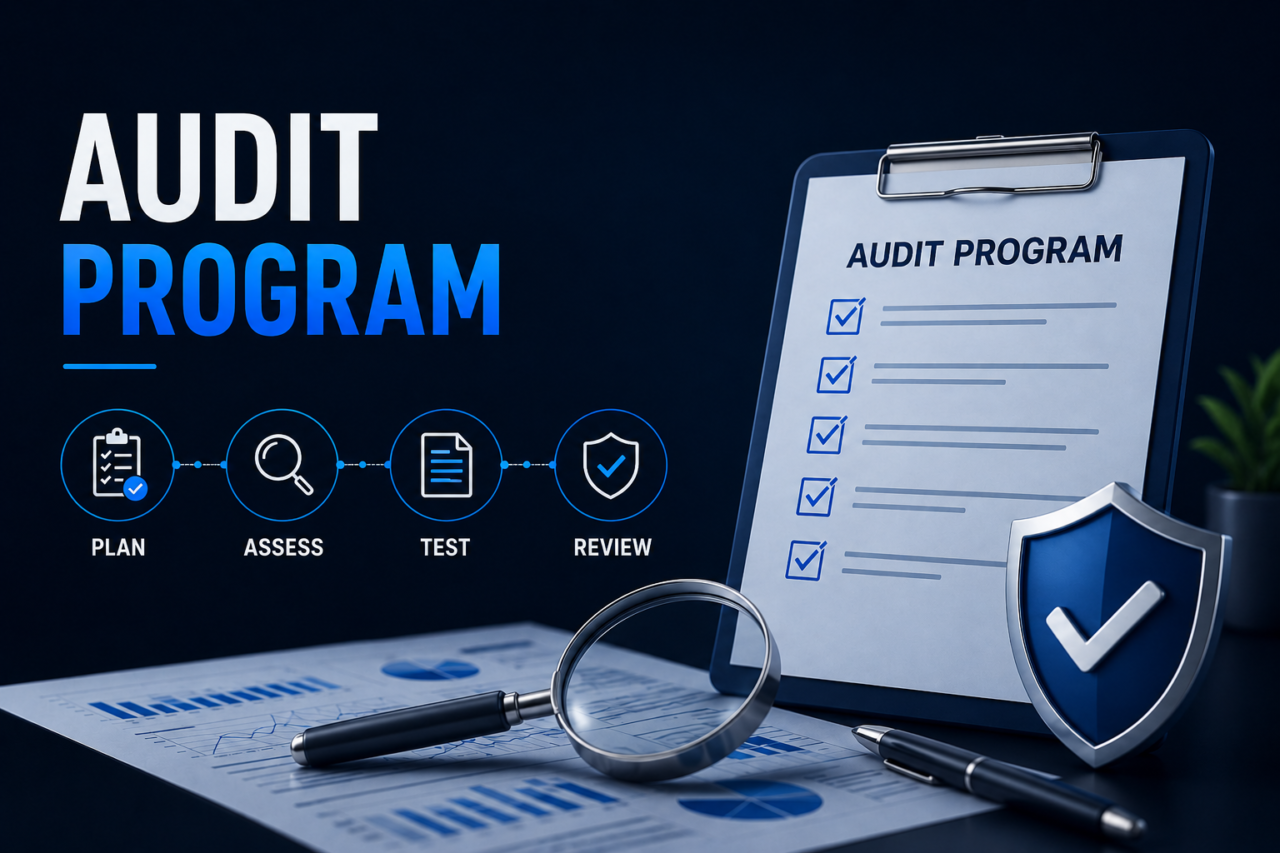
In auditing, one of the most commonly asked questions is: “Audit program should be?” This question is important in exams, interviews, and real-world auditing because the quality of an audit depends entirely on the design of the audit program. A well-designed audit program ensures proper risk coverage, efficiency, and compliance with regulatory standards.
Audit program should be flexible, risk-based, systematic, comprehensive, well-documented, objective, and independent. This is the standard answer used in exams, audits, and professional practice (CIA, CISA, ISO 19011).
This guide provides a complete framework for understanding audit programs—from definition and key characteristics to components, examples, real-world challenges, and how GRC platforms transform audit program management.
1. Audit Program Should Be
The standard, exam-ready answer to the question “Audit program should be?” is:
1. Flexible
2. Risk-Based
3. Systematic
4. Comprehensive
5. Well-Documented
6. Objective
7. Independent
This answer is aligned with ISO 19011 (Guidelines for Auditing Management Systems), IIA Standards, and professional auditing best practices.
2. What is an Audit Program?
An audit program is a structured set of audit procedures, tests, and steps used to conduct an audit. It acts as a roadmap for auditors to evaluate controls, risks, and compliance in a systematic manner.
An audit program typically includes:
- Audit objectives and scope
- Risk assessment results
- Detailed audit procedures and test steps
- Sampling methodologies
- Evidence collection requirements
- Reporting formats and templates
- Resource allocation and timelines
The audit program is the operational plan that translates audit strategy into actionable steps. Without a well-designed audit program, audits become inconsistent, inefficient, and prone to missing critical risks.
3. Key Characteristics of an Audit Program
Each of the seven characteristics is essential for an effective audit program. Below is a detailed explanation of each.
1. Flexible
The audit program should adapt to changes in risk, business processes, regulations, and emerging issues. Rigid programs become obsolete quickly. Flexibility allows auditors to reallocate resources, modify procedures, or expand scope when unexpected risks arise during the audit.
Example: During an audit, a new control weakness is discovered—the audit program allows adding additional test steps without re-approval delays.
2. Risk-Based
It should focus on high-risk areas first, allocating more audit resources where risk exposure is greatest. Risk-based auditing ensures that limited audit resources are directed toward areas that matter most.
Example: Financial reporting controls receive more testing than low-risk administrative processes.
3. Systematic
It must follow a structured and logical sequence—from planning to fieldwork to reporting to follow-up. Systematic approach ensures consistency, completeness, and repeatability across audits.
Example: The audit program follows a defined methodology: risk assessment → control identification → testing → evidence evaluation → reporting.
4. Comprehensive
It should cover all critical processes, controls, and compliance requirements within the audit scope. No significant risk area should be omitted.
Example: An IT audit program covers access control, change management, backup/recovery, and incident response—not just one area.
5. Well-Documented
All audit steps, findings, evidence, and decisions must be recorded. Documentation supports audit quality, defensibility, and regulatory compliance.
Example: Each test step includes documented evidence references, workpaper indexing, and reviewer sign-offs.
6. Objective
It should ensure unbiased evaluation based on facts and evidence, not personal opinions or management pressure. Objectivity is fundamental to audit credibility.
Example: The audit program includes procedures for obtaining independent evidence (e.g., direct system access vs. management-provided reports).
7. Independent
It must avoid conflicts of interest. Auditors should not audit their own work. Independence ensures impartiality and stakeholder trust.
Example: The audit program is executed by auditors who have no operational responsibility for the area being audited.
4. Audit Program Checklist: Essential Components
A proper, audit-ready audit program should include the following components.
Audit Program Checklist
- Audit Scope – Boundaries of the audit (departments, systems, processes, locations)
- Audit Objectives – What the audit aims to achieve (compliance, control effectiveness, risk assessment)
- Risk Assessment – Identification and prioritization of risks within scope
- Audit Procedures – Step-by-step instructions for testing controls and gathering evidence
- Testing Methods – Sampling approach, test types (inquiry, observation, inspection, re-performance)
- Evidence Collection – What evidence is required and how it will be documented
- Reporting Format – Template for findings, recommendations, and final report
- Resource Allocation – Assignments, timelines, and budget
- Follow-Up Process – Procedures for tracking remediation of findings
- Quality Assurance – Review and approval steps for workpapers and reports
5. Audit Program Example: Internal Audit – Access Control
The following example illustrates a sample audit program for an access control review.
| Element | Details |
|---|---|
| Audit Objective | Review access control effectiveness and compliance with least privilege policy |
| Audit Procedure | Check user access logs for the past 90 days. Verify role-based access control (RBAC) assignments against approved access matrices. |
| Test Method | Sample 50 user accounts across 5 departments. Re-perform access approval verification. |
| Finding | Excess access rights identified for 12 terminated employees (access not revoked within required 24-hour SLA). |
| Risk Rating | High – Unauthorized access risk for sensitive systems |
| Recommendation | Apply least privilege principle. Automate access revocation on termination. Implement quarterly access reviews. |
6. Audit Program vs Audit Plan vs Audit Procedure
These terms are often confused. Understanding the distinctions is essential for audit professionals.
| Aspect | Audit Program | Audit Plan | Audit Procedure |
|---|---|---|---|
| Purpose | Execution – detailed steps to conduct audit | Strategy – overall approach and scope | Testing – specific instructions for each test |
| Level of Detail | Detailed (step-by-step) | High-level (scope, objectives, resources) | Very detailed (test scripts, sampling) |
| Audience | Audit team members | Management, audit committee | Audit team (execution level) |
| Example | Complete set of audit procedures for the engagement | “Audit financial reporting controls across Q3” | “Select 25 invoices, verify approval signatures” |
7. Why the Audit Program is Important
A well-designed audit program delivers significant benefits to organizations and audit functions.
- Improves audit efficiency – Reduces redundant work and ensures consistent execution
- Identifies risks early – Structured risk assessment surfaces issues before they escalate
- Ensures compliance – Demonstrates adherence to audit standards (IIA, ISO 19011)
- Strengthens internal controls – Identifies control gaps and drives remediation
- Supports audits and inspections – Provides audit trail for external and regulatory reviews
- Enables knowledge transfer – Documented programs allow new auditors to ramp up quickly
- Reduces audit risk – Comprehensive coverage minimizes the chance of missing material issues
8. Real-World Challenges in Audit Program Management
Audit managers and teams face significant challenges that impact audit quality and efficiency.
Common Challenges
- Limited resources – Too few auditors for the required scope
- Multiple audit methods – Inconsistent approaches across different audit teams
- Lack of expertise – Insufficient technical knowledge for specialized areas (IT, cybersecurity)
- Misplaced audit focus – Spending time on low-risk areas while high-risk areas are under-audited
- Resistance to change – Auditees unwilling to provide evidence or cooperate
- Collusion risks – Management override of controls or falsified evidence
- Poor reporting – Findings not clearly communicated or actionable
- Lack of follow-up – Remediation actions not tracked to closure
- Regulatory complexity – Keeping audit programs aligned with frequent regulatory changes
- Manual processes – Spreadsheet-based audit programs with no version control or audit trail
These challenges highlight why automated audit management through GRC platforms is becoming essential for modern audit functions.
9. Audit Program Maturity Model
Assess your organization’s audit program capability using this five-level maturity model.
| Level | Name | Characteristics | Audit Effectiveness |
|---|---|---|---|
| Level 1 | Ad-Hoc | No formal audit program. Auditors work from memory or informal checklists. Inconsistent execution. | Very low – high risk of missing issues |
| Level 2 | Repeatable | Basic audit program templates exist. Some consistency across audits. Limited documentation. | Low – inconsistent coverage |
| Level 3 | Defined | Standardized audit program methodology. Risk-based scoping. Documented procedures. Version control. | Moderate – baseline effectiveness |
| Level 4 | Managed & Measured | Automated audit program management. Real-time tracking. Dashboards. Continuous improvement metrics. | High – efficient and consistent |
| Level 5 | Optimized | Integrated GRC platform. AI-assisted risk assessment. Continuous auditing. Predictive analytics. Automated evidence collection. | Optimal – proactive and predictive |
Most organizations operate at Level 2 or 3. Advancing to Level 4 and 5 requires automation and GRC integration.
Ready to advance your audit program maturity?
Learn how ASPIA’s GRC platform helps audit teams design, execute, and track audit programs with automated workflows and real-time dashboards.
Request an ASPIA Demo10. Role of Audit Program in GRC (Governance, Risk & Compliance)
In GRC frameworks, the audit program is a critical component that connects governance, risk management, and compliance activities.
- Ensures compliance – Audit programs test adherence to regulations and internal policies
- Supports risk management – Risk-based audit programs focus on the organization’s most significant risks
- Evaluates controls – Audit procedures assess control design and operating effectiveness
- Maintains audit trails – Documented audit programs provide evidence for regulators and external auditors
- Drives continuous improvement – Findings from audit programs feed into corrective action and process improvement
Modern GRC platforms like Aspia integrate audit programs with risk registers, control libraries, policy management, and issue tracking—creating a seamless governance ecosystem.
11. Frequently Asked Questions (FAQs)
What should an audit program include?
Why should an audit program be flexible?
Is an audit program risk-based?
What is the difference between an audit program and an audit plan?
Who prepares the audit program?
Is an audit program mandatory?
12. Conclusion: Building an Effective Audit Program
An effective audit program should be flexible, risk-based, systematic, comprehensive, well-documented, objective, and independent. These seven characteristics are not optional—they are the foundation of professional auditing.
A strong audit program improves audit effectiveness, reduces risks, and ensures compliance with regulatory and professional standards. Conversely, a poorly designed audit program leads to missed risks, inconsistent execution, and audit failures.
By leveraging GRC platforms like ASPIA, audit teams can automate audit program management, ensure consistency, track remediation, and demonstrate compliance—transforming audit programs from static documents into dynamic, value-driven assurance tools.
Transform Audit Program Management with ASPIA
ASPIA provides a unified GRC platform that automates audit program design, execution, and reporting. Our solution enables audit teams to:
- ✓ Design risk-based audit programs with standard templates
- ✓ Automate audit procedures and test steps
- ✓ Track findings, recommendations, and remediation actions
- ✓ Link audit programs to risks, controls, and compliance requirements
- ✓ Generate real-time dashboards and audit-ready reports
- ✓ Maintain complete audit trails and workpaper documentation
- ✓ Reduce audit program administration time by up to 60%
Move from manual audit programs to automated, integrated audit management.
Request an ASPIA Demo