CUSTOMER SUCCESSCase Studies

Discover how organizations across banking, insurance, manufacturing, and technology sectors operationalize governance programs, improve remediation accountability, and strengthen executive visibility with ASPIA.
AllApplication SecurityAuditGRCRisk-Based Internal AuditTPRMVulnerability Management


The client is a large, regulated organization operating across multiple business units and technology environments. The audit function was responsible for managing IT General Controls (ITGC), internal audits, and compliance audits across multiple frameworks and stakeholders. Increasing regulatory scrutiny, expanding audit scope, and dependence on manual processes highlighted the need for a centralized, automated audit management solution to improve efficiency, consistency, and audit readiness.

Financial Services – Regulated Banking Environment

Key Audit & Regulatory Pressures

  • Periodic internal & external audits
  • Documented audit trails and control testing
  • Regulatory compliance reporting requirements

Operational Challenges in Audit

Lack of centralized Audit visibility

  • Audit activities distributed across multiple teams and systems
  • Fragmented compliance documentation
  • Disconnected risk ratings and reporting
  • No consolidated ownership or real-time visibility

Data scattered across spreadsheets, limiting oversight and control.

Manual & Inconsistent Audit Processes

  • Manual audit testing and reviews
  • Email-based approvals and follow-ups
  • Inconsistent audit execution across units
  • Remediation and exception tracking gaps

Manual processes slowed execution and reduced audit consistency.

Audit Readiness & Regulatory Pressure

  • Delayed audit reviews and issue closure
  • Inconsistent risk scoring methodology
  • Limited accountability and ownership
  • High operational and documentation effort

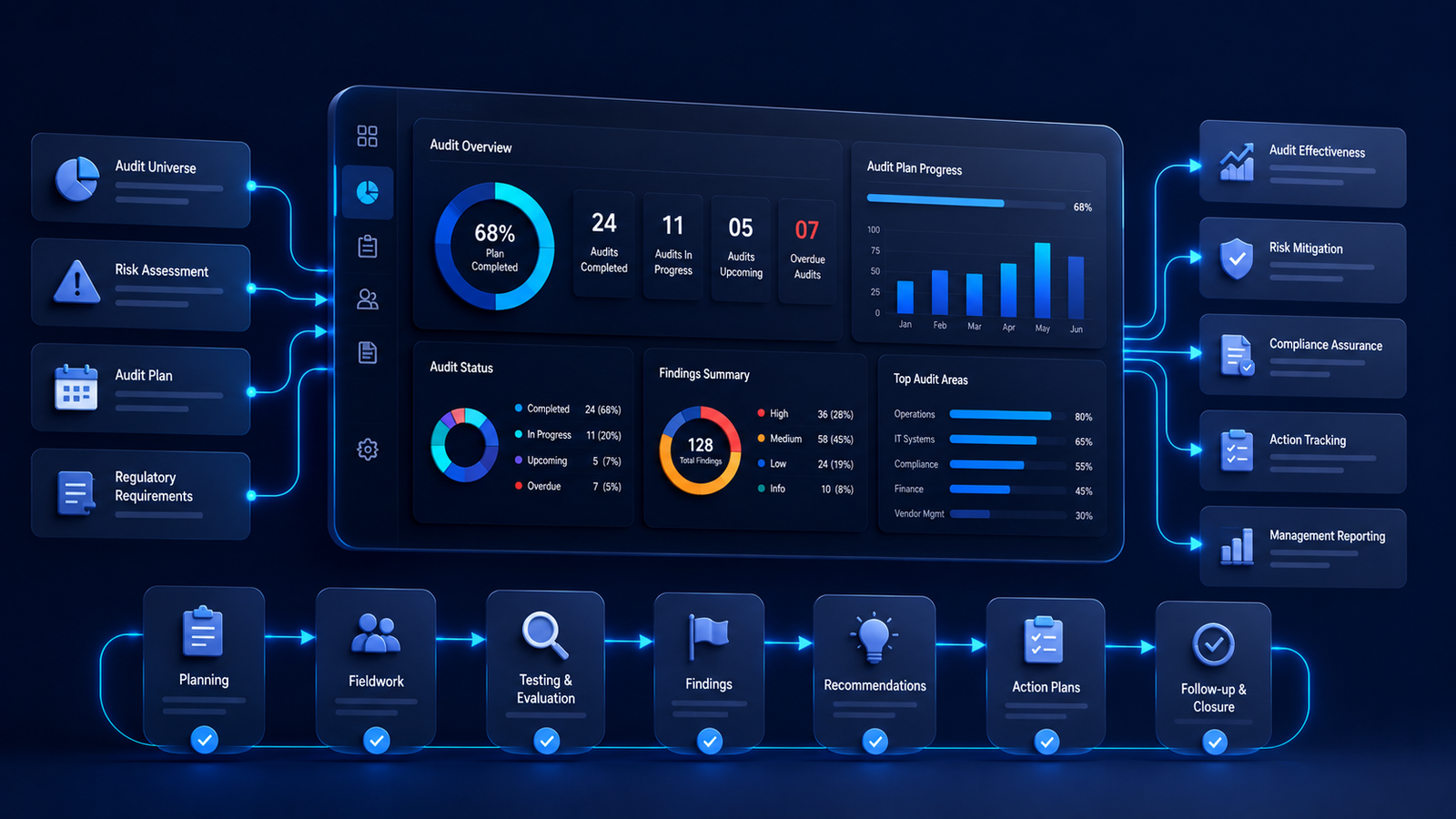
ASPIA implemented its Audit Management capabilities within its Enterprise Governance, Risk & Security Operations Platform to centralize audit execution, establish accountability, coordinate remediation activities, and improve executive visibility across the audit lifecycle.

Centralized Audit Management Platform

  • Single platform for audit planning and execution
  • Centralized evidence repository
  • Real-time audit tracking and dashboards
  • Consolidated ownership and role-based access

Workflow Automation & Standardization

  • Automated task assignments and notifications
  • Structured review and approval workflows
  • Standardized audit templates and checklists
  • Controlled issue and remediation tracking

Risk-Based Audit & Control Mapping

  • Risk-to-control mapping aligned with ITGC
  • Framework-based control alignment
  • Consistent risk scoring methodology
  • Integrated compliance and audit linkage

Business impact & measurable results

Improved Accountability & Audit Oversight

Centralized audit management eliminated scattered data, providing real-time tracking and consolidated ownership across functions.

Faster Remediation Coordination

Workflow automation reduced manual effort and shortened audit timelines by 40–50%, ensuring consistent execution across business units.

Enhanced Audit Readiness & Executive Visibility

 Structured evidence management and complete audit trails strengthened compliance posture and improved       regulatory preparedness.

Why this matters

In highly regulated industries such as banking and financial services, effective Audit Management is critical for maintaining compliance, governance transparency, and operational resilience.

As regulatory scrutiny increases and audit scope expands, manual audit processes create visibility gaps, delays, and documentation risks.

By operationalizing audit activities through structured ownership, remediation tracking, evidence management, and executive reporting, ASPIA helped the organization move from fragmented audit coordination to a connected audit operating model.

This resulted in improved audit readiness, stronger control oversight, and enhanced regulatory confidence.

Looking to improve audit accountability, remediation coordination, and executive visibility?

ASPIA helps organizations operationalize audit activities through structured ownership, remediation tracking, evidence management, and executive reporting.

Automate audit planning, testing, and execution
Maintain structured, regulatory-compliant audit trails
Standardize issue tracking and remediation workflows
Gain real-time audit visibility across business units


Request a Demo

Operationalizing Risk-Based Internal Audit Through Ownership & Accountability

Risk-Based Internal Auditing (RBIA) involves evaluating and improving internal control systems using a risk-based methodology. Assuring the effective management of risks within an organization is the main goal of RBIA.


Customer Profile

A leading financial institution that provides a range of banking and financial services to its customers. The company has a strong reputation for its robust risk management practices and internal controls. However, in light of recent regulatory changes from RBI, the company’s board of directors decided to adopt the Risk-Based Internal Audit (RBIA) framework to further enhance the effectiveness of its internal audit function.


How ASPIA helped drive RBIA:

The customer implemented ASPIA, a unified collaborative tool designed to help organizations drive risk-based internal audit (RBIA) and improve their internal control systems. The company used ASPIA to assess and visualize the risks faced by the organization and prioritize them based on their impact and likelihood.

Using ASPIA, they were able to design and implement controls to mitigate identified risks and set up a contingency plan for unforeseen events. The company also used ASPIA to conduct internal audits to assess the effectiveness of its risk management plan. This involved reviewing documentation, observing processes, and testing controls to ensure that they were functioning as intended.

After conducting the audit, the internal auditors used ASPIA to prepare a report of their findings, including a description of the risks identified and any recommendations for improvement. The organization used ASPIA’s built-in issue tracking and management feature to address the findings and monitor the status of their resolution.

The ASPIA platform also enabled the organization to maintain historical audit reports, evidence, POCs, and fixes in a centralized database, making them readily available when needed. This helped the company to efficiently track and address any issues that arose during the audit process.


Results:

The implementation of the RBIA framework using ASPIA has been a success. The company has been able to effectively identify and assess the risks it faces and implement controls to mitigate those risks. The internal audit function has also been significantly enhanced, providing assurance to the board of directors and senior management about the quality and effectiveness of the organization’s internal controls and risk management practices.


Conclusion:

Overall, the adoption of ASPIA has helped the organization to strengthen its risk management capabilities and comply with regulatory requirements. The company plans to continue using ASPIA to drive its RBIA efforts in the future.

Reach us at contact@aspiainfotech.com for more details on how ASPIA’s unified collaborative platform can be used by financial institutions to implement RBIA in accordance with the RBI mandate.

We look forward to helping you!!

ASPIA helped one of India’s most prominent national banks in revamping audit management. Our team aided the client in enhancing the audit management process with automation, simplification, and suggestion of effective remediation ways.

CHALLENGES

  • Employee duties overlapped during the traditional complex form of auditing
  • Audit processes are time-consuming and driven by distributed tools and resources.
  • Poor visibility due to lack of insights, manual audit tools, and spreadsheets.
  • Managing and tracking multiple rounds of audits in a year is quite difficult.
  • Long and recurring procedures of tracking and taking follow-ups at all audit stages.
  • Difficulty in developing collaboration during audit employees work on separate levels.
  • Difficulty in ensuring thorough completion of audit assignments.

SOLUTION

  • Simplification of audit lifecycle throughout the client’s company.
  • Unified platform to manage the audit and conduct risk analysis.
  • Streamline audit process with manageable audits and granular security insights whenever necessary.
  • Flexible scheduling and assignment of different audit items to respective stakeholders.
  • Implement end-to-end audit management from planning, scheduling, and tracking the process in real-time to reporting.
  • Enhance collaboration by standardizing the entire audit process from a unified dashboard.
  • Store the audit evidence, and reports in the centralized dashboard, and retrieve documents when needed from the ASPIA data store.

RESULTS

  • ASPIA maintained a productive audit lifecycle and ensured uniform distribution of duties amongst employees.
  • Delivered a simplified integrated, automated, and agile approach to audit planning, scheduling, and management.
  • Comprehensive audit reports delivered from the ASPIA dashboard maintain consistent quality by overcoming error-prone manual assembly of critical report data from paper records, and spreadsheets.
  • ASPIA ensures automatic scheduling of recurring audits throughout the year to ensure audit compliance with ease.
  • Improved audit collaboration by connecting employees of all levels via the centralized ASPIA dashboard.
  • A centralized, integrated way to collect and manage audit evidence to make you audit-ready at all times with ASPIA.

ASPIA Infotech helped in revamping audit management process with automation, and simplification, and enabled the client to take immediate actions to resolve the potential issues based on real-time process tracking and insights.

NULL