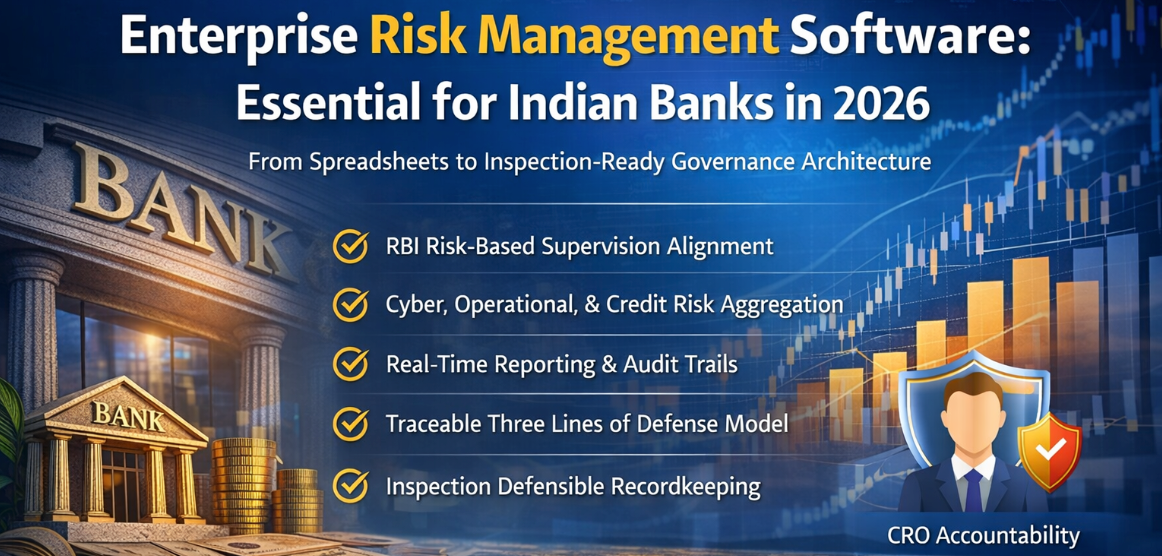
Executive Summary
The landscape of banking risk governance has reached an inflection point. According to the RBI’s December 2023 Financial Stability Report, scheduled commercial banks reported a 72% year-on-year increase in operational risk incidents, while the banking sector’s gross NPA ratio improved but remains sensitive to economic shocks. The RBI’s increasing focus on risk-based supervision, coupled with directives on IT outsourcing and the implementation of the Daksh digital supervision platform, has fundamentally raised the bar for inspection readiness.
For years, Indian banks and NBFCs have relied on spreadsheets and manual processes to manage risk—an approach that struggles to provide consistent, defensible traceability at enterprise scale under the weight of modern supervisory expectations. Cyber incidents alone grew by over 300% in the financial sector between 2020 and 2023, creating documentation and reporting demands that manual systems struggle to consistently meet, particularly when scale, complexity, and cross-functional coordination are involved.
When supervisory inspectors arrive, they are no longer satisfied with policy documents alone. They examine whether capital adequacy metrics are consistently monitored, whether the three lines of defense operate with genuine independence, and whether risk decisions leave an auditable footprint. Spreadsheet-based processes often struggle to reliably deliver the level of traceability and data integrity now expected under risk-based supervision.
Enterprise Risk Management (ERM) software has evolved from a convenience to a governance necessity. It is not merely a tool but the foundational infrastructure for modern risk governance—a system of record that embeds risk accountability into daily operations, enables board-level oversight, and transforms compliance from a periodic exercise into continuous assurance.
Risk Management in Banking – Quick Definition: Risk management in banking is the structured governance framework that enables banks to identify, measure, monitor, and control financial and operational risks in alignment with global Basel III standards and local regulations like those of the Reserve Bank of India.
What This Means for Chief Risk Officers
| Accountability | You are now personally accountable for traceable governance—every risk decision, control test, and remediation action must leave an auditable footprint. |
| Risk Appetite | You must demonstrate that RAF limits are monitored in practice, not merely documented in policy. Breach identification and escalation must be systematic, not manual. |
| Three Lines of Defense | You must evidence independent oversight—data flows from first-line operations to second-line monitoring without manual filtering or manipulation. |
| Data Aggregation | You must aggregate risk data across silos—credit, market, operational, cyber—to present the enterprise view that regulators now expect. |
| Inspection Readiness | You must produce complete, auditable evidence within hours, not weeks, when supervisory inspections commence. |
2. The Structural Shift in Banking Risk Governance
To understand why ERM software has become essential, we must first understand how banking risk governance has transformed over the past decade.
Post-2008 Capital Reforms
The global financial crisis exposed fundamental weaknesses in risk data aggregation and reporting. Banks that appeared well-capitalized on paper collapsed because they could not see their true risk exposures across the enterprise. This led to the Basel Committee’s BCBS 239 principles on risk data aggregation, which require accuracy, completeness, and timeliness of risk data—expectations that manual systems struggle to consistently meet at enterprise scale.
Post-Yes Bank & NBFC Stress
The Indian banking sector’s recent stress events—from the Yes Bank reconstruction to NBFC liquidity challenges—prompted the prudential oversight framework to substantially tighten supervisory oversight. The introduction of the Prompt Corrective Action framework and enhanced scrutiny of large exposures created new demands for real-time risk visibility.
Cyber and IT Outsourcing Circulars
The supervisory authority’s Cyber Security Framework and IT outsourcing guidelines mandate specific controls for vendor risk management and cyber resilience. Banks must now demonstrate active monitoring of third-party concentrations and immediate breach reporting—requirements that demand automated oversight.
Daksh Digital Supervision
The regulator’s Daksh platform enables real-time data sharing between banks and supervisors. This digital supervision infrastructure requires banks to maintain data in formats that can be seamlessly reported—a capability that spreadsheet-based processes often struggle to reliably deliver.
3. What Is Enterprise Risk Management Software?
Enterprise Risk Management software is a centralized, integrated platform that enables financial institutions to identify, assess, monitor, mitigate, and report risks across the entire organization. Unlike basic GRC tools that address isolated compliance functions or spreadsheet-based risk registers that fragment data across departments, modern ERM platforms provide a single source of truth for all risk-related information.
What distinguishes ERM software from manual methods:
- Centralized Risk Register: A unified repository where all risks—credit, market, operational, liquidity, and cyber—are documented, owned, and tracked in real-time.
- Control Library: A structured database of controls mapped to specific risks, with automated testing and evidence collection.
- Complete Audit Trails: Every action, from risk assessment updates to control testing results, is timestamped and attributed, creating an immutable record for regulators.
- Role-Based Accountability: Clear assignment of risk ownership across the first, second, and third lines of defense, with automated escalation when actions are overdue.
For Indian banks, this means moving from fragmented Excel sheets maintained by different departments to an integrated view where a credit officer in Mumbai, a risk manager in Delhi, and a board member reviewing materials all work from the same, current data.
In modern banking, risk governance is no longer a reporting function—it is an architectural discipline. ERM software provides the architecture within which defensible risk governance is constructed.
4. Why Banks Need Enterprise Risk Management Software in 2026
The convergence of regulatory expectations, risk complexity, and technological capability makes ERM software essential for banks of all sizes. While smaller NBFCs may initially adopt phased ERM deployment based on complexity and scale, supervisory expectations are converging across institution types—what begins as a recommendation for small lenders becomes an implicit requirement as they grow.
The Cost of Manual Fragmentation
Banks without integrated ERM platforms typically maintain multiple disconnected systems: credit risk in one department, operational risk in another, cyber risk managed separately by IT. This fragmentation creates blind spots where correlated risks—a cyber incident triggering liquidity pressures, for example—go undetected until they crystallize.
The Speed of Regulatory Change
RBI circulars now emerge with increasing frequency. Between 2020 and 2024, the regulator issued over 40 circulars directly impacting risk management and reporting. Manually tracking and implementing these changes across departments creates compliance gaps that ERM platforms address through centralized content updates.
The Expectation of Real-Time Visibility
Board members now expect to see risk exposures updated continuously, not in monthly reports. When a question arises about concentration in a particular sector or exposure to a stressed counterparty, the answer must be immediate—not “we’ll run a report and get back to you.”
5. Why ERM Software Is Now a Regulatory Expectation (India Focus)
The supervisory approach has undergone a fundamental transformation. The introduction of risk-based supervision, the enforcement of the three lines of defense model, and the increasing emphasis on cyber resilience have created explicit expectations that manual processes struggle to consistently satisfy, particularly when multiple departments and complex reporting chains are involved.
RBI Inspection Readiness Requirements
- Documentation Traceability: Inspectors expect to see a clear line of sight from risk identification through mitigation to closure. Spreadsheet-based processes often struggle to provide this level of traceability across time and departments.
- Three Lines of Defense Enforcement: The regulator explicitly requires clear demarcation of roles—first line risk owners, second line oversight, and third line independent assurance. ERM software embeds this model into workflows, ensuring that business units own risks while risk teams maintain independent oversight without manual chasing.
- Concentration Risk Tracking: With increasing regulatory focus on IT outsourcing and cloud vendor arrangements, banks must demonstrate active monitoring of concentration risks. ERM platforms enable real-time visibility into vendor concentrations and automated breach alerts.
- Board-Level Reporting: The supervisory authority expects boards to receive comprehensive, timely risk information. ERM software provides configurable dashboards that transform raw data into board-ready insights, replacing static monthly reports with dynamic visibility.
- ICAAP Data Consolidation: The Internal Capital Adequacy Assessment Process requires banks to aggregate risk data across the enterprise for stress testing and capital planning. ERM platforms automate this consolidation, enabling robust scenario analysis that manual methods struggle to support at the required scale and frequency.
Global Alignment: BCBS 239
Beyond domestic requirements, global regulators have emphasized risk data aggregation and reporting principles through BCBS 239. These principles require banks to demonstrate accuracy, completeness, and timeliness of risk data—expectations that align directly with the RBI’s supervisory direction. ERM platforms provide structural alignment with these principles, positioning Indian banks for both domestic and global regulatory preparedness.
6. Core Capabilities of Modern ERM Platforms
Risk Identification & Register Management
A structured repository where all risks are documented with consistent taxonomies aligned to RBI categories. Banks can maintain risk libraries with predefined risk statements, categories, and ownership assignments, ensuring that no risk falls through departmental cracks.
Risk Assessment & Scoring Models
Built-in assessment frameworks that support multiple methodologies—inherent risk, residual risk, target risk—with configurable scoring matrices. Quantitative models for Expected Loss (PD × LGD × EAD), Value at Risk (VaR), and stress testing scenarios enable rigorous risk measurement.
Control Mapping & Testing
Automated mapping of controls to risks with scheduled testing workflows. Control owners receive notifications when testing is due, evidence is collected systematically, and results flow directly into risk dashboards—eliminating the manual chase for control test results.
Automated Workflow & Escalation
When risk limits are breached or actions become overdue, automated workflows trigger escalations to the appropriate level—from risk owners to committee chairs. This ensures that emerging issues receive attention before they become regulatory findings.
KRI Monitoring & Dashboards
Real-time monitoring of Key Risk Indicators with visual dashboards that show risk levels against approved tolerances. When a KRI approaches its threshold, colour-coded alerts enable proactive intervention.
Audit Trail & Evidence Repository
Every action within the system generates an immutable audit record. When supervisory inspectors request evidence of risk reviews or control testing, banks can produce complete, timestamped documentation within minutes, not weeks.
Regulatory Reporting Alignment
Pre-configured reporting aligned to Basel III metrics—CET1, LCR, NSFR—and RBI-specific requirements including IRAC norms, cyber security returns, and ICAAP submissions.
7. ERM Software vs Spreadsheets: A Compliance Perspective
| Capability | Spreadsheet-Based Risk Management | Enterprise Risk Management Software |
|---|---|---|
| Audit Trail | Invisible or manually tracked; determining who changed a number and when is typically difficult | Complete, immutable audit trail of every action with timestamps and user attribution |
| Version Control | Multiple versions proliferate; “Final_Final_v3_Updated.xlsx” complexity | Single source of truth; everyone accesses current, approved data |
| Board Reporting | Static reports that may be outdated by the time they reach directors | Real-time dashboards with drill-down capabilities for board members |
| Risk Aggregation | Siloed by department; enterprise view requires time-consuming manual consolidation | Automated aggregation across all risk types and business units |
| Control Testing | Manual tracking with reminder emails; tests can be missed or delayed | Automated workflows with notifications; testing completion rates improve substantially |
| Scalability | Becomes unwieldy under complexity; macros can fail; files become difficult to manage | Built for enterprise scale; handles thousands of risks and controls across multi-entity groups |
| Inspection Response | Days or weeks to locate and compile evidence | Minutes to generate complete, auditable reports |
| Breach Escalation | Manual identification and email alerts; risk of oversight in busy environments | Automated alerts when limits breached; guaranteed escalation to responsible parties |
| BCBS 239 Alignment | Meets risk data aggregation principles with difficulty | Provides structural alignment with global standards |
8. How ERM Software Strengthens the Three Lines of Defense
First Line: Operational Management (Risk Owners)
Business units responsible for originating and managing risk receive intuitive interfaces to document risk decisions at the point of origination. A relationship manager assessing a corporate loan can access customer risk profiles, document credit decisions, and flag early warning signals—all within workflows that embed risk accountability into daily operations. When control testing is required, first-line owners receive automated notifications with clear instructions, reducing the likelihood of missed or delayed testing.
Second Line: Risk & Compliance Oversight
The risk management department gains configurable dashboards to monitor the entire risk landscape. Rather than chasing departments for updates, risk teams see real-time status of risk assessments, control testing, and incident remediation. When KRIs approach thresholds, automated alerts enable proactive intervention. The independence of the second line is preserved because data flows directly from first-line systems without manual filtering or manipulation.
Third Line: Internal Audit Automation
Internal audit transforms from periodic sampling to more continuous monitoring approaches. Auditors can analyze entire populations of control tests, identify patterns of control failures, and focus fieldwork on genuine risk areas rather than random samples. Audit findings are tracked through to closure with automated reminders, and evidence of remediation is collected systematically—addressing the common supervisory observation of “audit findings pending beyond committed timelines.”
CRO Independence Support
The Chief Risk Officer’s independence—a critical regulatory requirement—is reinforced when risk data flows directly from operational systems to board-level dashboards without passing through business unit filters. The CRO can present the true risk picture to the board, supported by data that is difficult to manipulate or selectively report.
9. Common Gaps Observed in Indian Banks Without ERM
- RAF Limits Not Monitored Consistently: Risk appetite frameworks with board-approved statements may be documented, but actual risk-taking against those limits can be challenging to monitor systematically. When inspectors ask for breach reports, the response may reveal gaps in tracking.
- Manual Stress Testing Error Risk: ICAAP submissions prepared through spreadsheet-based calculations carry inherent risk of formula errors that can undermine regulatory confidence. A single misplaced cell reference can misstate capital adequacy.
- Incomplete Documentation During Inspections: When the regulator requests evidence of risk committee reviews or control testing, banks may need to search through email archives and shared drives. Documents can be missing, approvals may be undocumented, and inspectors may note “inadequate record-keeping.”
- Fragmented IT Risk Visibility: Cyber risk managed by IT, operational risk by operations, and vendor risk by procurement—with no consolidated view of the bank’s overall risk posture. The RBI’s Cyber Security Framework explicitly requires integrated oversight that fragmented tools struggle to provide.
- Delayed Incident Reporting: Operational risk incidents—frauds, system outages, customer complaints—may be reported through email chains, with potential gaps in assurance that material incidents reach the board or regulator within mandated timelines.
10. Benefits of Enterprise Risk Management Software for Banks
Regulatory Compliance Enhancement
ERM software enables more consistent alignment with RBI guidelines, Basel III requirements, and emerging supervisory expectations. Automated updates to regulatory content help banks stay current without extensive manual policy reviews.
Operational Efficiency
By reducing manual tracking, chasing, and reporting, ERM platforms can free risk professionals to focus more on analysis and strategic oversight rather than administrative tasks. Institutions report 40-60% reductions in time spent on risk reporting.
Enhanced Decision-Making
Real-time visibility into risk exposures enables faster, more informed decisions. When a new risk emerges—a geopolitical event, a market shock, a cyber threat—leadership can assess more quickly how it may impact the enterprise.
Inspection Defensibility
When supervisory inspections commence, banks with ERM platforms can respond with greater confidence. Complete, auditable records are more readily available, demonstrating control effectiveness and regulatory commitment.
11. Best Enterprise Risk Management Software for Banks in India: Evaluation Framework
Regulatory Alignment (RBI/Basel Support)
Does the platform include pre-configured content aligned to RBI guidelines—IRAC norms, cyber security framework, Basel III capital calculations? Generic tools may require extensive configuration; purpose-built solutions can accelerate time-to-value.
Configurable Risk Taxonomy
Can the platform adapt to your specific risk categories and assessment methodologies? Banks have unique risk structures; the software should accommodate your framework rather than requiring you to adapt to a vendor’s rigid model.
Role-Based Access Controls
Does the system enforce segregation of duties effectively? First-line users should see only their risks; second-line should have oversight without modification rights; third-line should have read-only audit access. These controls must be granular and configurable.
API Integrations
Can the platform connect to your core banking system, loan origination system, and HRMS? Manual data entry reduces automation benefits. Look for robust APIs that can pull data directly from source systems.
Comprehensive Audit Logging
Is every action logged with user, timestamp, and before/after values? When inspectors ask “who approved this exception and when,” the system should be able to provide an immediate, incontrovertible answer.
Scalability for Multi-Entity Banks
Does the platform handle group structures with multiple banking entities, NBFCs, and subsidiaries? Consolidated risk reporting across the group requires architecture designed for enterprise complexity.
12. A Critical Clarification
Enterprise Risk Management software alone does not guarantee sound risk governance. Technology can enforce workflows, maintain audit trails, and aggregate data—but effective risk management ultimately depends on strong leadership, an independent second line of defense, active board oversight, and a culture that prioritizes transparency over short-term performance.
ERM platforms enable defensible governance. They do not replace accountability—they reinforce it.
This distinction matters. Boards and CROs considering ERM investments should view them as infrastructure that supports governance, not as a substitute for the judgment, independence, and oversight that regulators expect. The most sophisticated platform cannot compensate for a weak risk culture or compromised second-line independence. Conversely, even the strongest governance culture requires robust infrastructure to operate efficiently at scale.
13. The Future of ERM in Banking (2026 and Beyond)
AI for Anomaly Detection in Operational Risk
Machine learning models will increasingly analyze transaction patterns to identify potential fraud, process deviations, and control failures before they materialize as losses. Rather than detecting fraud after the fact, systems may flag anomalous patterns in real-time for immediate intervention.
Scenario-Based Capital Planning Automation
ICAAP and stress testing are evolving from annual exercises toward more continuous scenario modeling. Banks can run thousands of scenarios simultaneously, understanding capital impacts across a spectrum of economic conditions and adjusting strategies more dynamically.
Climate Risk Stress Modeling
As the regulatory framework moves toward climate risk disclosure requirements, ERM platforms are beginning to integrate climate scenario analysis—assessing how physical and transition risks may impact loan portfolios, collateral values, and overall capital adequacy over longer time horizons.
Integrated Third-Party Risk Quantification
Vendor risk management is moving beyond questionnaires toward more continuous monitoring of third-party control effectiveness, with automated risk scoring based on data from vendor systems and external threat intelligence where available.
Continuous Control Monitoring
The industry is shifting from periodic testing toward more continuous assurance approaches. Rather than testing a control quarterly, continuous monitoring can validate control effectiveness more frequently, providing earlier visibility into control failures and enabling faster remediation.
14. Conclusion: From Compliance to Risk Orchestration
For Indian banks and NBFCs preparing for their next supervisory inspection, the message is clear: spreadsheets and manual processes struggle to provide the consistent, defensible traceability that modern regulation increasingly demands. The regulatory framework’s expectations for traceability, accountability, and timely oversight require infrastructure that manual tools struggle to deliver at enterprise scale.
Enterprise Risk Management software has become:
- A System of Record for Risk Accountability: Every risk can have an owner, every action a timestamp, and every decision an auditable footprint. Modern banks require a system of record for risk accountability—not just another dashboard.
- A Governance Infrastructure: The three lines of defense can operate with greater clarity and independence, supported by workflows that reinforce roles without requiring constant manual oversight.
- A Board-Enabling Technology: Directors can gain more timely visibility into the institution’s risk profile, enabling strategic decisions based on more current data.
- A Regulatory Defensibility Mechanism: When inspectors arrive, evidence is more readily available—complete, documented, and auditable.
In modern banking, risk governance is no longer a reporting function—it is an architectural discipline. ERM software provides one element of the architecture within which defensible risk governance can be constructed.
15. Frequently Asked Questions
What is ERM software in banking?
Enterprise Risk Management software in banking is a centralized platform that enables financial institutions to identify, assess, monitor, and report all risk types—credit, market, operational, liquidity, and cyber—while maintaining complete audit trails and regulatory alignment.
How does ERM software help with RBI inspections?
ERM software can provide more immediate access to documentation of risk assessments, control testing, incident remediation, and committee reviews. When inspectors request evidence, banks can often respond more quickly, demonstrating control effectiveness with timestamped, attributed records.
Is ERM software mandatory for banks in India?
While not explicitly mandatory, ERM software has become increasingly relevant given the RBI’s focus on data integrity, timely reporting, and demonstrable controls. The regulator’s Daksh platform and emphasis on risk-based supervision make automated risk management infrastructure valuable for inspection readiness.
What features should banks look for in ERM software?
Key features to evaluate include: regulatory content aligned to RBI and Basel requirements, configurable risk taxonomies, role-based access controls, comprehensive audit logging, API integrations with core banking systems, and scalability for multi-entity group structures.
What is BCBS 239 and why does it matter for Indian banks?
BCBS 239 is the Basel Committee’s principles for effective risk data aggregation and risk reporting. While formally applicable to global systemically important banks, its principles of accuracy, completeness, and timeliness of risk data align with the RBI’s supervisory expectations and represent global best practice for banks of all sizes.
Why do banks need ERM software in 2026?
The convergence of increasing regulatory complexity, significant growth in cyber incidents since 2020, and the regulator’s push toward more real-time supervision through Daksh makes purely manual risk management increasingly challenging to sustain at scale. ERM software provides infrastructure that supports defensible, scalable governance.
Assess Your Risk Governance Maturity
How prepared is your institution for risk-based supervision?
Assess your current risk governance maturity against RBI supervisory expectations—across three lines of defense independence, RAF monitoring, data aggregation integrity, and inspection defensibility.
Structured ERM automation is not about digitizing spreadsheets. It is about building a governance architecture that can withstand supervisory scrutiny.