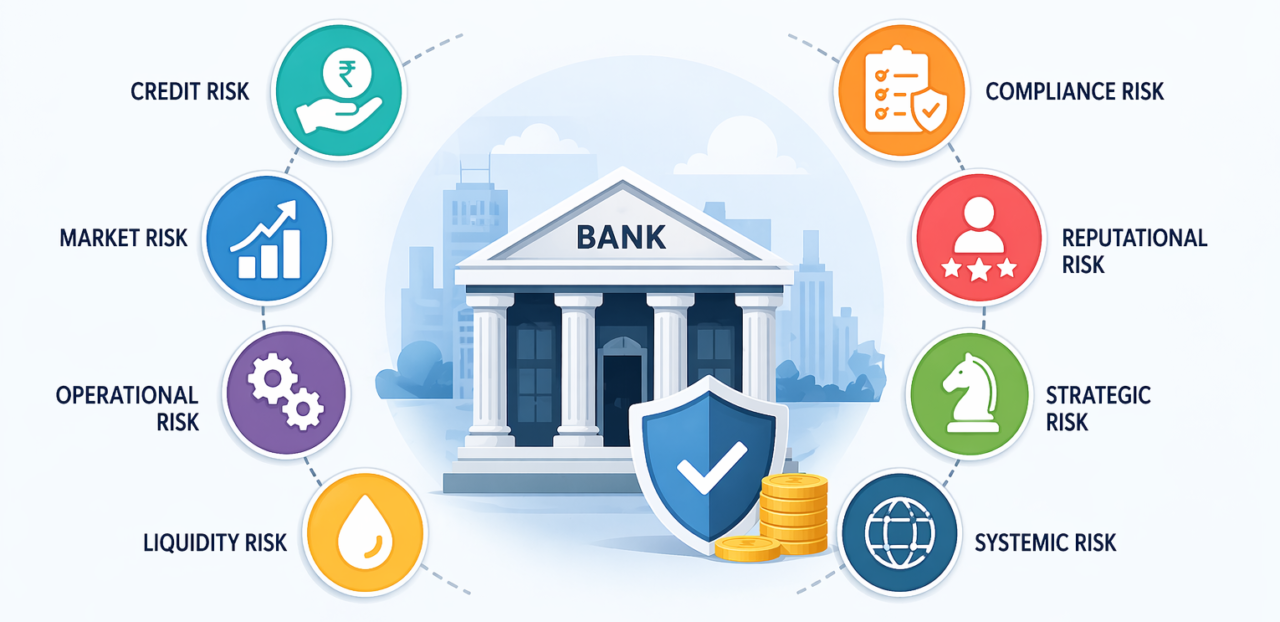
Banks do not treat risk as a static list—they embed it into capital planning, governance, and daily operations. Banking risks are measurable exposures that affect a bank’s capital adequacy, liquidity position, operational stability, and regulatory compliance.
Core types of risk in banking include: Credit Risk, Market Risk, Operational Risk, Liquidity Risk, Compliance Risk, Cybersecurity Risk, and Reputational Risk. These risks are actively measured, controlled, and reported across business units—not just identified.
This guide provides a complete framework for understanding banking risks—from categories and measurement models to real examples, governance structures, and how GRC platforms enable integrated risk management.
1. Types of Risk in Banking: Quick Answer & Overview
Banking risks are measurable exposures that affect a bank’s capital adequacy, liquidity position, operational stability, and regulatory compliance.
Core Types of Risk in Banking: Credit | Market | Operational | Liquidity | Compliance | Cybersecurity | Reputational
These risks are actively measured, controlled, and reported across business units—not just identified. Banks follow Basel III, RBI risk management guidelines, and internal Risk Appetite Frameworks (RAF) to manage these exposures.
2. How Risk is Structured in the Banking Sector
Banks do not treat risk as a static list—they embed it into capital planning, governance, and daily operations. They follow:
- Basel III – Capital adequacy + risk weighting
- RBI risk management guidelines – Regulatory expectations for Indian banks
- Internal Risk Appetite Framework (RAF) – Defines acceptable risk levels
Risk Categories Used in Practice
Financial Risks (Capital Impact)
- Credit → loan portfolio losses
- Market → trading & valuation losses
- Liquidity → funding stress
Non-Financial Risks (Operational Impact)
- Operational → process/system failures
- Compliance → regulatory breaches
- Cyber → digital threats
- Reputational → trust erosion
Strategic Risks (Long-Term Impact)
- Business model risk
- Concentration exposure
These categories are mapped to risk-weighted assets (RWA) and capital requirements.
3. Interconnection of Risks: Why Banking Risk is Complex
In real banking environments, risks amplify each other:
- A spike in credit defaults reduces incoming cash → creates liquidity stress
- Market losses reduce capital buffers → impact lending capacity
- Operational incidents (fraud/system failure) → trigger reputational damage
- Cyber breaches → create compliance violations + financial loss
Because of this, banks implement Enterprise Risk Management (ERM) where all risks are tracked in a unified system. Platforms like ASPIA GRC enable this integration.
4. Detailed Types of Risk in Banking: Execution-Level View
Credit Risk
Credit risk is the probability of financial loss due to borrower default or credit downgrade.
How It Is Measured (Actual Models Used):
- PD (Probability of Default)
- LGD (Loss Given Default)
- EAD (Exposure at Default)
Expected Loss = PD × LGD × EAD
How It Works Operationally:
- Credit team approves loans using scoring models
- Risk team monitors exposure concentration
- Early warning signals track deterioration (missed payments, rating changes)
Control Layer: Collateral valuation, exposure limits per borrower/sector, credit policies aligned with risk appetite
Output: feeds into capital provisioning and RWA calculation
Market Risk
Market risk arises from adverse movements in interest rates, FX rates, and asset prices.
Measurement (Used Daily in Banks):
- Value at Risk (VaR)
- Stress testing scenarios
- Sensitivity (duration, delta)
Operational Flow:
- Treasury desk holds positions
- Risk systems calculate VaR daily
- Breaches trigger escalation to risk committees
Control Layer: Trading limits, hedging using derivatives, stop-loss thresholds
Output: impacts profit & loss (P&L) and capital buffers
Operational Risk
Operational risk is loss resulting from failures in processes, systems, people, or external events.
Where It Happens in Reality:
- Payment processing failures
- Core banking outages
- Internal fraud or control bypass
- Vendor/service disruptions
Measurement Framework: Loss event database (historical losses), Key Risk Indicators (KRIs), Scenario analysis
Basel Approaches (Capital Calculation): Basic Indicator Approach (BIA), Standardized Approach (TSA), Advanced Measurement Approach (AMA)
Control Layer: SOP enforcement, maker-checker controls, internal audit, incident tracking systems
Output: frequent losses → impacts operational efficiency + audit findings
Liquidity Risk
Liquidity risk is the inability to meet obligations without incurring losses.
Measurement Metrics: LCR (Liquidity Coverage Ratio), NSFR (Net Stable Funding Ratio)
Real Banking Scenario: Deposit outflows increase → insufficient liquid assets → forced asset selling
Management Layer: ALM (Asset-Liability Management), Liquidity buffers (cash, government securities), Stress testing (bank run scenarios)
Output: determines bank survival under stress
Compliance Risk
Compliance risk is failure to adhere to regulatory requirements.
Where It Occurs: AML/KYC failures, reporting gaps, policy non-adherence
Measurement: Number of audit findings, Regulatory breaches, AML alert volumes
Control Layer: Automated monitoring systems, Regulatory reporting workflows, Audit trails
Output: impacts penalties, license, and regulatory standing
Cybersecurity Risk
Cyber risk is the risk of unauthorized access, data breaches, or system compromise.
Real Threat Landscape: Phishing targeting customers/employees, Ransomware attacks, API vulnerabilities in digital banking
Measurement: MTTD (Mean Time to Detect), MTTR (Mean Time to Respond), Incident frequency
Control Layer: MFA, SIEM monitoring, VAPT assessments
Output: impacts customer trust + financial loss + compliance
Reputational Risk
Reputational risk is the loss of market confidence due to negative events.
Trigger Sources: Fraud incidents, Data breaches, Regulatory penalties
Not measured directly, but reflected in customer churn and deposit outflows. This risk is usually a secondary impact of other risks.
Concentration Risk
Exposure to a single borrower, sector, or geography.
Example: Heavy lending to real estate → market downturn → portfolio loss
Managed through exposure limits and diversification.
Strategic Risk
Risk arising from incorrect business decisions or external changes.
Example: Investing heavily in a failing digital product
Impacts long-term profitability and positioning.
5. Risk Governance in Banking: Decision Layer
Risk is controlled through governance—not just processes.
Governance Structure
- Board of Directors → defines risk appetite
- Chief Risk Officer (CRO) → owns risk framework
- Risk Committees → monitor exposure and breaches
- Business Units → manage day-to-day risks
Risk Appetite Framework (RAF)
Defines:
- Acceptable risk levels
- Exposure limits
- Escalation triggers
This ensures risk-taking is aligned with strategy and capital.
6. How Risk Management Works in Banking: System View
Banks follow a continuous lifecycle:
Identify risks → Assess likelihood & impact → Quantify using models → Apply controls → Monitor through dashboards
Systems Used: Risk registers, Risk engines (scoring + alerts), GRC platforms
Platforms like Aspia enable centralized risk visibility, risk-control linkage, real-time monitoring, and audit-ready reporting.
7. Types of Risk in Banking Operations: Execution Layer
At operations level, risks manifest as:
- Failed transactions
- Settlement mismatches
- Reconciliation errors
- Fraud attempts
These directly impact customer experience and service reliability.
8. Key Challenges in Banking Risk Management
- Interconnected risks across systems
- Increasing regulatory complexity
- Legacy infrastructure
- Lack of real-time visibility
Solved through automation + integrated GRC systems.
9. Banking Risk Maturity Model
Assess your bank’s risk management capability using this five-level maturity model.
| Level | Name | Characteristics | Risk Posture |
|---|---|---|---|
| Level 1 | Ad-Hoc | No formal risk management. Risks managed reactively. Siloed systems. | Very high – blind to risks |
| Level 2 | Basic | Basic risk registers. Annual assessments. Limited integration. | High – significant blind spots |
| Level 3 | Defined | Formal framework. Risk appetite defined. Regular reporting. Control mapping. | Moderate – known risks managed |
| Level 4 | Managed | Automated workflows. Real-time dashboards. Integrated risk systems. Continuous monitoring. | Low – proactive risk management |
| Level 5 | Optimized | Integrated GRC platform. Predictive analytics. AI-driven risk detection. Enterprise-wide visibility. | Optimal – resilient by design |
Most banks operate at Level 2 or 3. Advancing to Level 4 and 5 requires automation and GRC integration.
Ready to advance your banking risk maturity?
Learn how ASPIA’s GRC platform helps banks integrate risk management, automate workflows, and achieve real-time visibility.
Request an ASPIA Demo10. Best Practices Used by Mature Banks
- Define clear risk appetite – Board-approved risk tolerance levels
- Use quantitative + qualitative models – Combine statistical models with expert judgment
- Integrate risk with business strategy – Risk management drives strategic decisions
- Automate workflows – Reduce manual errors and delays
- Continuous monitoring – Real-time dashboards and automated alerts
- Integrate risk, control, and compliance – Unified GRC platform
11. Frequently Asked Questions (FAQs)
What are the main types of risk in banking?
How is credit risk measured in banks?
What is the difference between liquidity risk and market risk?
What is operational risk in banking?
What is a Risk Appetite Framework (RAF) in banking?
Why do banking risks interconnect?
12. Conclusion: From Risk Avoidance to Strategic Advantage
Banking risk is not about avoiding risk—it is about managing it within acceptable limits while enabling growth. Banks that quantify risk accurately, integrate systems and controls, and use structured frameworks achieve stronger resilience, compliance, and long-term stability.
The difference between reactive and proactive risk management is simple:
- Reactive banks discover risks when failures occur
- Proactive banks anticipate and manage risks before they materialize
By leveraging GRC platforms like ASPIA, banks can integrate risk, control, and compliance—transforming risk management from a regulatory burden into a strategic advantage.
Transform Banking Risk Management with ASPIA
ASPIA provides a unified GRC platform that integrates all banking risk types—credit, market, operational, liquidity, compliance, and cyber—into a single, auditable system. Our solution enables banks to:
- ✓ Centralize all banking risks in a single risk register
- ✓ Quantify risk using PD, LGD, EAD, VaR, and KRIs
- ✓ Link risks directly to controls and compliance frameworks
- ✓ Automate risk scoring, reporting, and escalation workflows
- ✓ Generate audit-ready reports for RBI, Basel, and board reviews
- ✓ Achieve real-time visibility with risk dashboards
- ✓ Reduce manual risk management effort by up to 60%
Move from siloed, manual risk management to integrated, continuous banking risk intelligence.
Request an ASPIA Demo