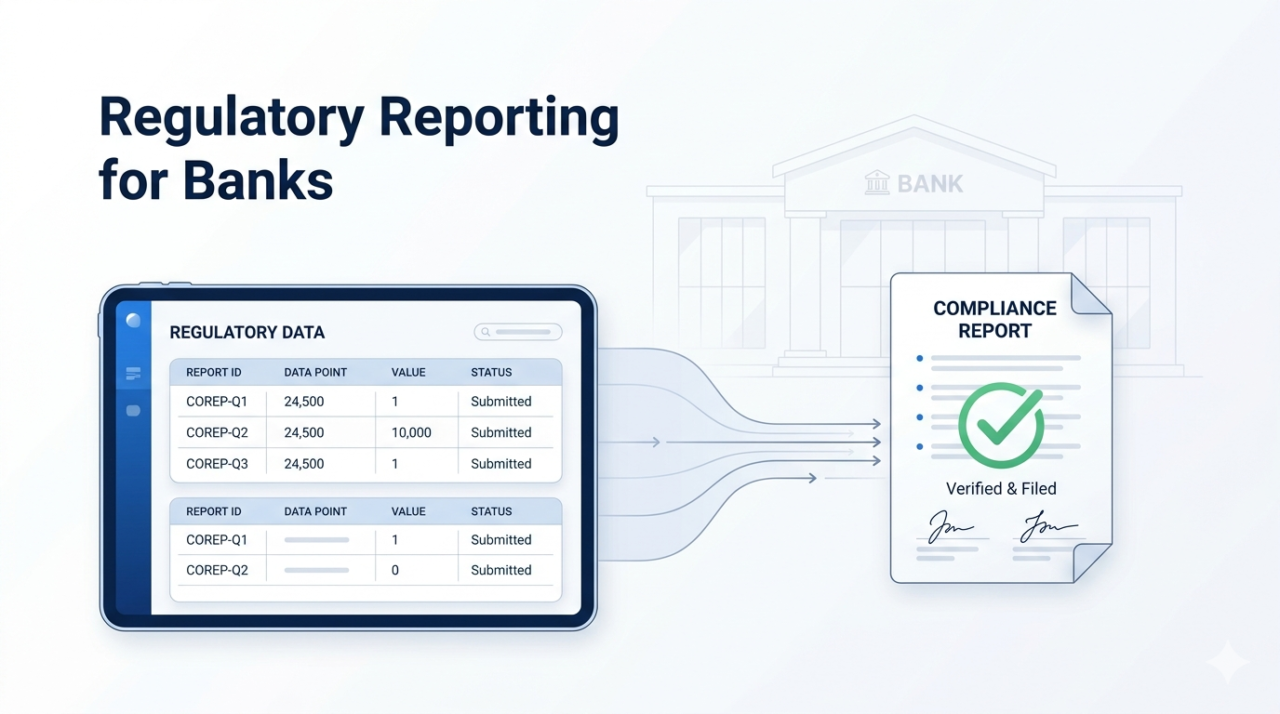
Most banks still rely on Excel-based regulatory reporting, leading to reconciliation delays of 3–7 days, repeated audit observations, and increased scrutiny from the Reserve Bank of India. If your team is manually consolidating data across systems, responding to audit queries over email, or struggling to trace reported numbers—your bank’s regulatory reporting process is already a control failure, not just an operational issue.
Regulatory reporting for banks is the structured process of collecting, validating, and submitting financial, risk, and compliance data to regulators like the Reserve Bank of India to ensure stability, transparency, and compliance with frameworks such as Basel III.
This guide provides a complete framework for understanding regulatory reporting—from RBI requirements and process flows to architecture, audit evidence, common failures, and how GRC automation transforms reporting from manual risk to audit-ready control.
TL;DR
- Regulatory reporting for banks = structured submission of financial, risk, and compliance data to regulators
- Driven by Reserve Bank of India + Basel III
- Core requirement: accuracy + traceability + auditability
- Most failures are due to control gaps, not data gaps
- The future is automated regulatory reporting via GRC platforms
1. What is Regulatory Reporting for Banks?
Regulatory reporting for banks is the structured process of collecting, validating, and submitting financial, risk, and compliance data to regulators like the Reserve Bank of India to ensure stability, transparency, and compliance with frameworks such as Basel III.
Regulatory reporting = structured submission of financial, risk, and compliance data to regulators
Core requirements are accuracy, traceability, and auditability. Regulatory reporting is a license-to-operate control system, not just a compliance obligation.
2. Why Regulatory Reporting Fails (The Real Insight)
Banks don’t fail regulatory reporting because of bad data—they fail because they cannot prove control over that data.
- Data exists—but isn’t governed
- Reports exist—but aren’t validated
- Numbers exist—but aren’t traceable
From an audit perspective, traceability matters more than correctness. A number can be correct, but if you cannot prove where it came from, how it was calculated, and who approved it—it will fail audit scrutiny.
Real Audit Scenario
In one RBI audit, a bank failed to reconcile CRAR (Capital to Risk-Weighted Assets Ratio) values across submissions due to Excel overrides. Outcome: Compliance observation, increased scrutiny from the Reserve Bank of India, and mandatory corrective reporting.
3. Why Regulatory Reporting is Critical in Banking
Regulatory reporting is a license-to-operate control system. It serves multiple critical objectives:
- Financial stability monitoring – Regulators track systemic risk across the banking sector
- Risk visibility – Credit, market, and liquidity risk exposures are reported regularly
- Fraud and AML detection – Suspicious transaction reporting (STR) is mandatory
- Compliance with Basel III and RBI – Capital adequacy, leverage ratio, and liquidity requirements
Without accurate regulatory reporting, banks risk penalties, increased scrutiny, and even restrictions on business activities.
4. Types of Regulatory Reporting for Banks (RBI + Basel III Requirements)
Financial Reporting
- Balance sheet, Profit & Loss (P&L)
- Capital adequacy (CRAR – Capital to Risk-Weighted Assets Ratio)
Risk Reporting
- Credit exposure (large exposures, NPA data)
- Market risk (trading book, interest rate risk)
- Operational risk (loss events, KRIs)
Liquidity Reporting
- LCR (Liquidity Coverage Ratio)
- NSFR (Net Stable Funding Ratio)
Compliance Reporting
- AML / KYC
- STR (Suspicious Transaction Reports)
RBI Regulatory Reporting Formats
- XBRL (eXtensible Business Reporting Language)
- OSS (Online Submission System)
- CRILC (Credit Risk Information and Loan Collection)
5. Bank Regulatory Reporting Process: Step-by-Step (RBI-Aligned)
- Data extraction – Pull data from CBS (Core Banking System), risk systems, and treasury
- Aggregation and normalization – Consolidate data into a common format
- Validation (reconciliation + checks) – Verify data integrity and cross-system consistency
- Report preparation – Generate reports in RBI-specified formats (XBRL, OSS)
- Approval (maker-checker) – Segregated duties for preparation and approval
- Submission – Upload to RBI systems within deadlines
- Audit trail storage – Maintain complete history of all changes and approvals
6. Regulatory Reporting Flow: Simplified Mental Model
Source Systems → Data Integration → Validation Engine → Reporting Layer → Approval → RBI Submission → Audit Trail
This flow defines whether your reporting is: Controlled (audit-ready) or Manual (audit-risk)
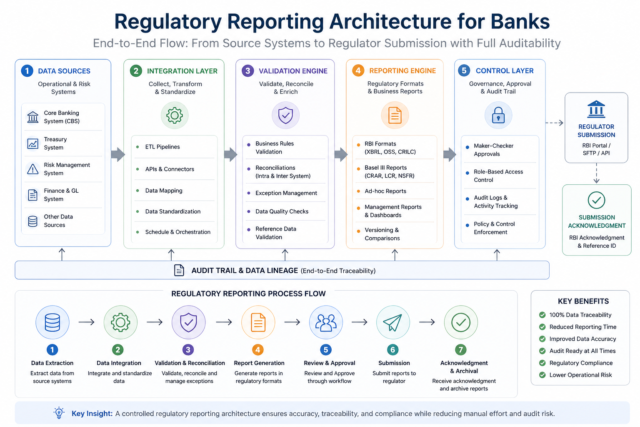
7. Regulatory Reporting Architecture (Modern Banks)
1. Data Sources
Core banking, treasury, risk systems, loan origination systems, AML systems
2. Integration Layer
ETL pipelines, APIs, middleware for data extraction and transformation
3. Validation Engine
Rules + reconciliation logic to ensure data quality and consistency
4. Reporting Engine
XBRL generation, RBI format mapping, report scheduling
5. Control Layer
Maker-checker, audit logs, access controls, version management
This architecture ensures end-to-end traceability from source to submission.
Regulatory Reporting Architecture
8. RBI Regulatory Reporting Requirements for Banks
Under the Reserve Bank of India, banks must comply with:
- XBRL submissions – Financial statements in XBRL format
- OSS returns – Online Submission System for various regulatory returns
- CRILC reporting – Credit Risk Information and Loan Collection data
RBI Focus Areas
- Data consistency across submissions
- Financial reconciliation (no unexplained variances)
- Timeliness (adherence to submission deadlines)
- Exception handling (proper documentation of discrepancies)
Regulatory reporting is driven by Reserve Bank of India, Basel III, SOC 2, and ISO 27001 frameworks. It is tightly linked with risk management, internal audit, and third-party risk management (TPRM).
9. Regulatory Reporting Controls and Audit Evidence (Bank Audit Checklist)
| Control Area | Evidence Required | Source |
|---|---|---|
| Data reconciliation | Signed reconciliation reports | Finance team |
| Data accuracy | System extracts with timestamps | CBS / Risk systems |
| Approval workflow | Maker-checker logs | GRC platform |
| Data lineage | Source-to-report mapping | Data pipeline / ETL |
| Submission proof | RBI acknowledgment / portal logs | RBI portal |
Failure Patterns
- No lineage → audit failure
- No approvals → control breakdown
- Excel overrides → integrity risk
10. Common Challenges in Regulatory Compliance Reporting
- Manual bank reporting (Excel dependency) – Spreadsheets cause version control issues and manual errors
- Data silos – Data scattered across CBS, treasury, risk, and loan systems
- Lack of lineage – Cannot trace reported numbers back to source systems
- Frequent regulatory changes – RBI updates reporting formats and requirements regularly
- Audit pressure – External and internal audits demand traceability and evidence
11. Automated Regulatory Reporting for Banks (GRC Approach)
If your process involves manual reconciliation, email-based approvals, and repeated audit queries, then your reporting is not scalable and not audit-resilient.
Automation Enables
- Data integration – Automated extraction from source systems
- Rule-based validation – Automated reconciliation and exception detection
- Workflow approvals – Maker-checker with audit trails
- Real-time audit trails – Complete history of changes and approvals
| Metric | Manual | Automated |
|---|---|---|
| Time | 5–7 days | 1–2 days |
| Errors | High | Low |
| Audit readiness | Weak | Strong |
| Traceability | Limited | Full |
12. Regulatory Reporting Maturity Model
Assess your bank’s regulatory reporting capability using this five-level maturity model.
| Level | Name | Characteristics | Audit Risk |
|---|---|---|---|
| Level 1 | Manual / Spreadsheet | Excel-based, email approvals, no lineage, manual reconciliation | Very High |
| Level 2 | Basic Automated | Some automation, basic validation, inconsistent workflows | High |
| Level 3 | Structured | Defined workflows, maker-checker, basic traceability, scheduled reporting | Moderate |
| Level 4 | Integrated | Integrated with source systems, automated validation, full lineage, real-time dashboards | Low |
| Level 5 | Continuous / Predictive | Real-time reporting, API-based submissions, AI validation, integrated GRC platform | Minimal |
Most banks operate at Level 2 or 3. Advancing to Level 4 and 5 requires automation and GRC integration.
Ready to advance your regulatory reporting maturity?
Learn how ASPIA’s GRC platform automates regulatory reporting, ensures traceability, and provides audit-ready evidence.
Request an ASPIA Demo13. Common Mistakes Banks Make in Regulatory Reporting
- Treating reporting as finance-only – Regulatory reporting requires risk, compliance, and IT collaboration
- Over-reliance on Excel – Excel lacks version control, audit trails, and data lineage
- Weak validation controls – No automated reconciliation between source systems and reports
- Poor documentation – Violates SOC 2 and audit expectations for evidence retention
14. Regulatory Reporting vs Regulatory Compliance Reporting
| Aspect | Regulatory Reporting | Regulatory Compliance Reporting |
|---|---|---|
| Focus | Data submission to regulators | Demonstrating compliance with regulations |
| Frequency | Periodic (monthly, quarterly, annual) | Continuous |
| Output | XBRL, OSS returns, CRILC | Compliance certificates, audit evidence |
15. Future of Regulatory Reporting for Banks
- Real-time reporting – Moving from periodic to event-driven submissions
- API-based submissions – Direct system-to-system integration with regulators
- AI validation – Automated anomaly detection and data quality checks
- Integrated GRC ecosystems – Unified platforms for risk, compliance, and reporting
16. Frequently Asked Questions (FAQs)
What is regulatory reporting for banks?
What is RBI regulatory reporting?
Why do banks fail regulatory reporting?
What is automated regulatory reporting?
What do auditors check in regulatory reporting?
17. Final Takeaway
Regulatory reporting is not a reporting function—it is a control system. If your reporting cannot demonstrate traceability, validation, and approval, it will fail under audit scrutiny—regardless of data accuracy.
If your regulatory reporting cannot provide instant traceability from source systems to submitted reports, it will fail under audit scrutiny—regardless of data accuracy.
Eliminate Reconciliation Delays with ASPIA
Aspia’s GRC platform ensures every reported number is controlled, validated, and audit-ready by design—eliminating reconciliation delays and ensuring complete traceability from source to submission.
- ✓ Automate data extraction from CBS, risk, and treasury systems
- ✓ Rule-based validation and reconciliation
- ✓ Maker-checker approval workflows with audit trails
- ✓ Full data lineage from source to RBI submission
- ✓ Audit-ready reports with complete traceability
- ✓ Reduce reporting time from 5-7 days to 1-2 days
If your regulatory reporting cannot provide instant traceability, it will fail under audit scrutiny—regardless of data accuracy. Aspia ensures it doesn’t.
Request an ASPIA Demo