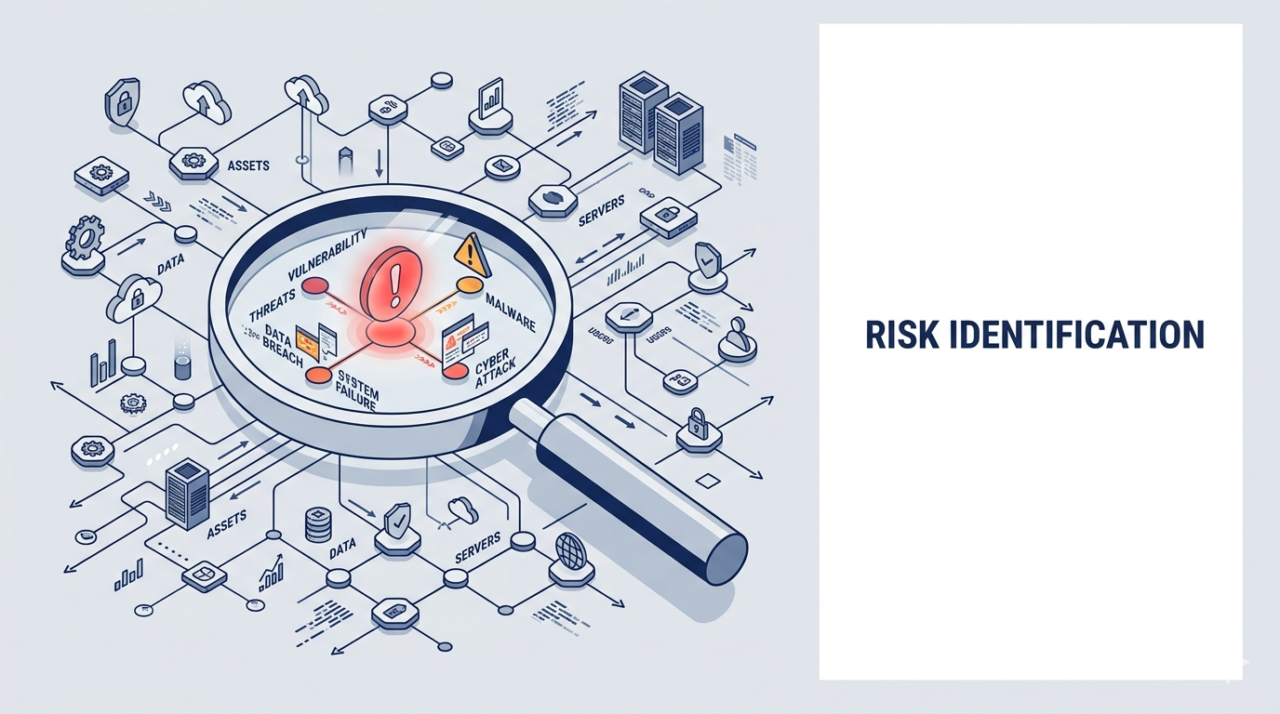
Risk identification is the foundation of the entire risk management process. If a risk is not identified, it cannot be assessed, mitigated, or monitored. It is not just about listing risks—it is about understanding where risks originate, how they impact the business, and how they connect to controls, compliance requirements, and decision-making.
Risk identification is a structured and continuous process of discovering, analyzing, and documenting potential risks that could impact an organization’s objectives, operations, or compliance posture. In simple terms, it helps organizations find risks early so they can be controlled before they cause damage.
This guide provides a complete framework for understanding risk identification—from definition and process to techniques, examples, root cause analysis, challenges, and how GRC automation transforms manual risk spotting into continuous risk intelligence.
1. Risk Identification: Quick Answer & Definition
Risk identification is a structured and continuous process of discovering, analyzing, and documenting potential risks that could impact an organization’s objectives, operations, or compliance posture.
Risk identification helps organizations find risks early so they can be controlled before they cause damage.
A mature risk identification process provides visibility into: risk sources (internal and external), risk triggers (events that cause risk), potential impact on business objectives, and interdependencies between risks.
Risk identification is not a one-time activity but a continuous lifecycle that evolves with changing business environments and emerging risks. This makes it the most critical step in governance, risk, and compliance (GRC).
2. Risk Identification in Risk Management
Risk identification is tightly integrated with the broader risk management lifecycle:
Identification → What can go wrong
Assessment → How severe is the risk
Mitigation → What should be done
Monitoring → Is the risk under control
This ensures that risk identification directly drives decision-making and control design. Without proper identification, subsequent steps in the risk management process cannot function effectively.
3. Risk Identification Process: How It Actually Works
In real organizations, risk identification is not a theoretical step—it follows a structured and repeatable workflow.
Step 1: Define Scope and Objectives
Identify business units, systems, or processes being assessed. Clear scope prevents missing relevant risks.
Step 2: Identify Risk Sources
Map internal and external sources:
- Internal: systems, processes, people, infrastructure
- External: vendors, regulations, market changes, competitors
Step 3: Detect Risk Events
Identify what could go wrong: system failure, data breach, regulatory violation, supply chain disruption, etc.
Step 4: Analyze Root Causes
Go beyond symptoms and identify why the risk exists.
Example: Event: Data breach → Root cause: Weak access controls
Without root cause identification, risk management becomes reactive and ineffective.
Step 5: Document in Risk Register
Record risks in a structured format for tracking and ownership. This ensures consistency and audit readiness.
In modern organizations, this process is often automated using GRC platforms, where risks are identified, recorded, and tracked centrally across teams.
4. Root Cause Approach: Critical for Effective Risk Identification
Most organizations fail because they identify symptoms, not causes. The root cause approach ensures risks are identified at their origin.
Example: Symptom vs Root Cause
Symptom: Frequent system downtime
Root cause: Lack of infrastructure redundancy
Why this matters:
- Enables effective mitigation – Fixing the cause, not the symptom
- Prevents recurring risks – Addresses underlying issues
- Improves control design – Controls are designed for actual root causes
Without root cause identification, risk management becomes reactive and ineffective—treating symptoms while the underlying problem persists.
5. Risk Identification Techniques
Organizations use multiple techniques to ensure comprehensive risk identification. While these techniques are effective, manual execution often leads to inconsistency. Modern organizations combine these methods with automated tools.
| Technique | Description | Best For |
|---|---|---|
| Brainstorming | Gathering diverse perspectives across teams to surface potential risks.最好 | Initial identification, workshops |
| Documentation Review | Reviewing policies, contracts, and system architecture to identify gaps. | Compliance, contractual risks |
| Checklists | Using predefined risk lists based on historical data and industry standards. | Consistent coverage, repeatable assessments |
| SWOT Analysis | Identifies risks from weaknesses and threats (Strengths, Weaknesses, Opportunities, Threats). | Strategic risk identification |
| Assumption Analysis | Challenges planning assumptions to uncover hidden risks. | Project and strategic planning |
| Expert Interviews | Provides domain-level insights into complex risk areas. | Specialized domains (IT, legal, finance) |
| Risk Library | Centralized database of risks used for standardization and scalability. | Mature GRC programs, automation |
6. Risk Identification vs Risk Assessment
These two terms are often confused, but they serve different purposes in the risk management lifecycle. Both are interdependent but serve different roles.
| Aspect | Risk Identification | Risk Assessment |
|---|---|---|
| Purpose | Find risks | Evaluate risks |
| Focus | What can go wrong | How severe is it |
| Output | Risk list / Risk register | Risk scores / Risk matrix |
| Timing | First step in risk management | Follows identification |
Key takeaway: You cannot assess what you haven’t identified. Risk identification must come first.
7. Types of Risks Identified
Organizations identify multiple categories of risks. A mature organization integrates all risk types into a unified risk management framework.
| Risk Type | Description | Examples |
|---|---|---|
| Operational Risk | Failures in processes, people, or systems | System outage, human error, process breakdown |
| Financial Risk | Market, credit, or liquidity risks | Currency fluctuation, loan default, cash flow shortage |
| Cybersecurity Risk | Data breaches and cyber threats | Ransomware, phishing, unauthorized access |
| Compliance Risk | Regulatory violations | GDPR fine, PCI-DSS non-compliance, SOX violation |
| Strategic Risk | Poor business decisions | Failed acquisition, brand damage, competitive pressure |
8. Risk Register: The Central System of Record
A risk register is the central system of record for all identified risks. It is used to:
- Track risks from identification to closure – Complete lifecycle visibility
- Assign ownership – Clear accountability for each risk
- Monitor mitigation progress – Track action plans and status
- Support audit and compliance – Provide evidence of risk management
Example: A risk is identified → logged in the risk register → assigned to an owner → mitigated → tracked until closure.
Mature organizations use automated systems for real-time visibility. In platforms like Aspia, the risk register is dynamically updated, linked with controls, and monitored through dashboards, enabling real-time risk visibility and faster decision-making.
9. Who is Responsible for Risk Identification
Risk identification is a shared responsibility across the organization. It cannot be delegated to a single department.
Key Stakeholders
- Risk management teams – Oversee the process and methodology
- Business unit owners – Identify operational and process risks
- IT and security teams – Identify technology and cybersecurity risks
- Compliance and audit teams – Identify regulatory and compliance risks
- Senior management – Review and approve identified risks
In mature organizations, risk ownership is clearly defined to ensure accountability and effective risk management.
10. Risk Identification in Different Contexts
Risk Identification in Software Engineering
In software environments, risk identification focuses on:
- Security vulnerabilities (OWASP Top 10)
- Code defects and technical debt
- Deployment failures and release risks
- Integration risks with third-party APIs
Example: Identifying risk of production outage during deployment.
Risk Identification in Project Management
In project management, risk identification ensures project success:
- Schedule delays
- Budget overruns
- Resource constraints
- Scope creep
Early identification is critical for project control.
11. End-to-End Risk Identification Workflow
In practice, risk identification operates as part of a continuous workflow:
- Risks are identified (using multiple techniques)
- Root causes are analyzed
- Risks are documented in the risk register
- Ownership is assigned
- Risks are passed to assessment for scoring
This ensures seamless integration with the overall risk management process.
12. Common Challenges in Risk Identification
Organizations often face significant challenges that result in incomplete risk coverage:
- Missing hidden risks – Focusing only on obvious risks while ignoring emerging or indirect risks
- Lack of structured approach – Ad-hoc identification leads to inconsistent coverage
- Over-reliance on experience – Subject matter experts may have blind spots
- Poor documentation – Risks identified but not recorded systematically
- Siloed identification – Different departments identify risks in isolation
- Confirmation bias – Identifying only risks that confirm existing beliefs
These challenges result in incomplete risk coverage and expose organizations to unexpected failures.
13. Risk Identification Maturity Model
Assess your organization’s risk identification capability using this five-level maturity model.
| Level | Name | Characteristics | Risk Coverage |
|---|---|---|---|
| Level 1 | Ad-Hoc | No formal process. Risks identified only after incidents. No documentation. | Very low – reactive only |
| Level 2 | Basic | Annual identification workshops. Basic checklists. Spreadsheet-based risk register. | Low – significant blind spots |
| Level 3 | Structured | Multiple identification techniques. Root cause analysis. Standardized risk register. Defined ownership. | Moderate – known risks captured |
| Level 4 | Managed | Automated risk identification. Centralized risk register. Real-time dashboards. Integration with controls. | High – comprehensive coverage |
| Level 5 | Optimized | Integrated GRC platform. Predictive risk detection. Continuous monitoring. AI-driven identification. | Optimal – continuous and predictive |
Most organizations operate at Level 2 or 3. Advancing to Level 4 and 5 requires automation and GRC integration.
Ready to advance your risk identification maturity?
Learn how ASPIA’s GRC platform helps organizations identify, centralize, and track risks with automated workflows and real-time dashboards.
Request an ASPIA Demo14. How GRC Tools Improve Risk Identification
In real-world enterprise environments, risk identification is not managed through spreadsheets—it is handled through structured GRC systems.
- Centralized risk identification across departments – Single platform for all risk data
- Use of predefined risk libraries – Standardized risk taxonomies and industry templates
- Automated risk logging into risk registers – Eliminate manual data entry
- Assignment of risk owners – Clear accountability with automated notifications
- Integration with controls, audits, and compliance – Connect risks to the broader GRC framework
- Real-time dashboards – Visualize risk landscape across the organization
This ensures that risk identification is consistent, scalable, and audit-ready. It also eliminates manual tracking and improves visibility across the organization.
Platforms like Aspia help organizations implement a structured, scalable, and audit-ready risk identification process.
15. Why Manual Risk Identification Fails
Many organizations rely on spreadsheets and ad-hoc processes, which leads to significant failures:
- Incomplete risk visibility – Risks are missed because spreadsheets are not comprehensive
- Lack of accountability – No clear ownership; risks remain unresolved
- Delayed mitigation – Manual tracking means actions are not followed up
- Poor audit readiness – Spreadsheets lack audit trails and version control
- Inconsistent risk ratings – Different people interpret risks differently
- No historical tracking – Cannot see how risks have evolved over time
This is why organizations are shifting toward automated, centralized risk identification systems.
16. Best Practices for Risk Identification
- Focus on root causes, not symptoms – Identify why risks exist, not just what happened
- Use multiple identification techniques – Combine brainstorming, checklists, interviews, and data analysis
- Maintain a centralized risk register – Single source of truth for all risks
- Continuously update risk data – Risk identification is ongoing, not annual
- Standardize processes across teams – Consistent methodology across business units
- Involve diverse stakeholders – Different perspectives surface different risks
- Link risks to business objectives – Focus on risks that matter to the organization
- Use technology and automation – GRC platforms eliminate manual inefficiencies
Leading organizations operationalize these best practices through GRC platforms, ensuring that risk identification is continuous, measurable, and integrated with overall risk management.
17. Risk Identification and Decision-Making
Risk identification directly supports decision-making by helping organizations:
- Prioritize critical risks – Focus resources on the most significant threats
- Allocate resources effectively – Direct budget and personnel to high-risk areas
- Design appropriate controls – Controls are based on actual identified risks
- Plan mitigation strategies – Action plans address specific identified risks
- Avoid surprises – Management is aware of risks before they materialize
This ensures that risk management is aligned with business objectives.
18. Frequently Asked Questions (FAQs)
What is risk identification with example?
What are the steps in risk identification?
What is the difference between risk identification and risk assessment?
Why is root cause analysis important in risk identification?
Who is responsible for risk identification?
What are common risk identification techniques?
19. Conclusion: From Uncertainty to Controlled Risk
Risk identification is not just the first step—it is the most critical step in risk management. If a risk is not identified, it cannot be assessed, mitigated, or monitored. Organizations that implement structured and continuous risk identification detect risks early, improve decision-making, reduce risk exposure, and strengthen compliance.
The difference between reactive and proactive risk management is simple:
- Reactive organizations discover risks when incidents occur
- Proactive organizations identify risks before they materialize
Strong risk identification transforms uncertainty into controlled and manageable risk. Organizations that move from manual processes to structured, technology-driven risk identification gain a significant advantage in visibility, compliance, and decision-making.
By leveraging GRC platforms like Aspia, organizations can automate risk identification, centralize risk registers, and integrate identification with assessment, mitigation, and monitoring—building a foundation for enterprise resilience.
Transform Risk Identification with ASPIA
ASPIA provides a unified GRC platform that automates risk identification, centralizes risk registers, and integrates with assessment and mitigation workflows. Our solution enables organizations to:
- ✓ Identify risks using structured techniques and root cause analysis
- ✓ Centralize all risks in a single, auditable risk register
- ✓ Use predefined risk libraries for consistency and coverage
- ✓ Link identified risks directly to controls, policies, and compliance frameworks
- ✓ Assign risk owners and automate workflows
- ✓ Generate real-time risk dashboards and reports
- ✓ Eliminate manual spreadsheets and reduce risk identification effort
Move from manual spreadsheets to automated, continuous risk identification.
Request an ASPIA Demo