Every organization faces uncertainty. Without a structured approach to managing risks, even minor disruptions can escalate into major failures. The risk management process provides that structure—enabling organizations to anticipate, assess, and address risks before they cause damage.
In regulated industries such as banking, fintech, and large enterprises, the risk management process is essential for regulatory compliance, audit readiness, operational stability, and strategic decision-making. A mature risk management process connects risk, control, audit, and compliance into a unified framework.
This guide provides a complete framework for understanding the risk management process—from definition and steps to lifecycle, examples, risk registers, and how GRC automation transforms manual risk tracking into continuous risk intelligence.
1. Risk Management Process: Quick Answer & Definition
The risk management process is a structured approach used to identify, assess, prioritize, and mitigate risks to minimize their impact on business objectives.
The risk management process helps organizations anticipate risks and take action before they cause damage.
The risk management process is a continuous and structured cycle that enables organizations to manage uncertainty, protect assets, and ensure business continuity. It ensures that risks are identified early, assessed based on likelihood and impact, controlled through mitigation strategies, and continuously monitored and updated.
This makes the risk management process a fundamental requirement for organizations operating in regulated and high-risk environments.
2. Why Risk Management Process is Important
A well-defined risk management process helps organizations move from reactive to proactive risk handling. It enables:
- Reduction in financial and operational losses – Proactive identification prevents incidents
- Better decision-making based on risk insights – Informed choices about resource allocation
- Stronger compliance with regulatory requirements – Demonstrates due diligence to regulators
- Improved resilience against disruptions – Faster recovery from incidents
- Increased stakeholder and customer confidence – Trust in organizational governance
The risk management process is closely linked with audit processes, compliance reporting, and mitigation planning. Without a structured process, organizations operate blindly—reacting to problems rather than preventing them.
3. Risk Management Process Steps Explained: The 5 Core Steps
The risk management process consists of five core steps, forming a continuous lifecycle. This is the standard framework used across ISO 31000, COSO ERM, and other global standards.
Step 1: Risk Identification
Risk identification is the foundation of the risk management process. It involves identifying all potential risks that could impact business operations, systems, or compliance requirements.
Methods: Workshops with stakeholders, historical incident analysis, internal audits, regulatory assessments
Sources of risk: Internal (system failures, human errors, process gaps) and External (cyber threats, regulatory changes, vendor failures)
Example: A bank identifies the risk of unauthorized access due to weak authentication mechanisms.
Effective risk identification ensures that no critical risk is overlooked at an early stage.
Step 2: Risk Assessment
Once risks are identified, they are assessed to determine their severity and priority. Risk assessment focuses on:
- Likelihood of occurrence – How probable is the risk?
- Impact on business – What would be the consequence?
Example: A data breach risk may be classified as high likelihood and high impact, making it critical.
Proper assessment ensures resources are focused on the most significant risks.
Step 3: Risk Evaluation & Prioritization
After assessment, risks are evaluated and prioritized. This ensures that organizations address the most critical risks first.
Techniques: Risk scoring models, risk matrices, business impact analysis
High-priority risks: Require immediate action, assigned risk owners, actively monitored
Low-priority risks: May be accepted, periodically reviewed
This step aligns risk management with business priorities and resource allocation.
Step 4: Risk Mitigation (Treatment)
Risk mitigation involves defining strategies to manage or reduce risks.
Common strategies:
- Risk Avoidance – Eliminate the risk entirely
- Risk Reduction – Implement controls to reduce likelihood or impact
- Risk Transfer – Shift risk to third parties (insurance/vendors)
- Risk Acceptance – Accept the risk with monitoring
Example: Implementing multi-factor authentication (MFA) reduces the risk of unauthorized access.
A strong mitigation plan includes: defined actions, assigned ownership, clear timelines, and monitoring mechanisms. Without mitigation planning, risks remain unresolved and increase over time.
Step 5: Risk Monitoring & Review
Risk management is a continuous process requiring ongoing monitoring. Organizations must:
- Track risk status regularly
- Monitor mitigation effectiveness
- Identify emerging risks
- Update risk assessments
Monitoring tools: Risk dashboards, periodic reviews, automated alerts
Continuous monitoring ensures adaptability to changing risk environments.
4. Risk Management Lifecycle: Continuous Loop
The risk management process is often referred to as a risk management lifecycle, as it operates continuously rather than as a one-time activity.
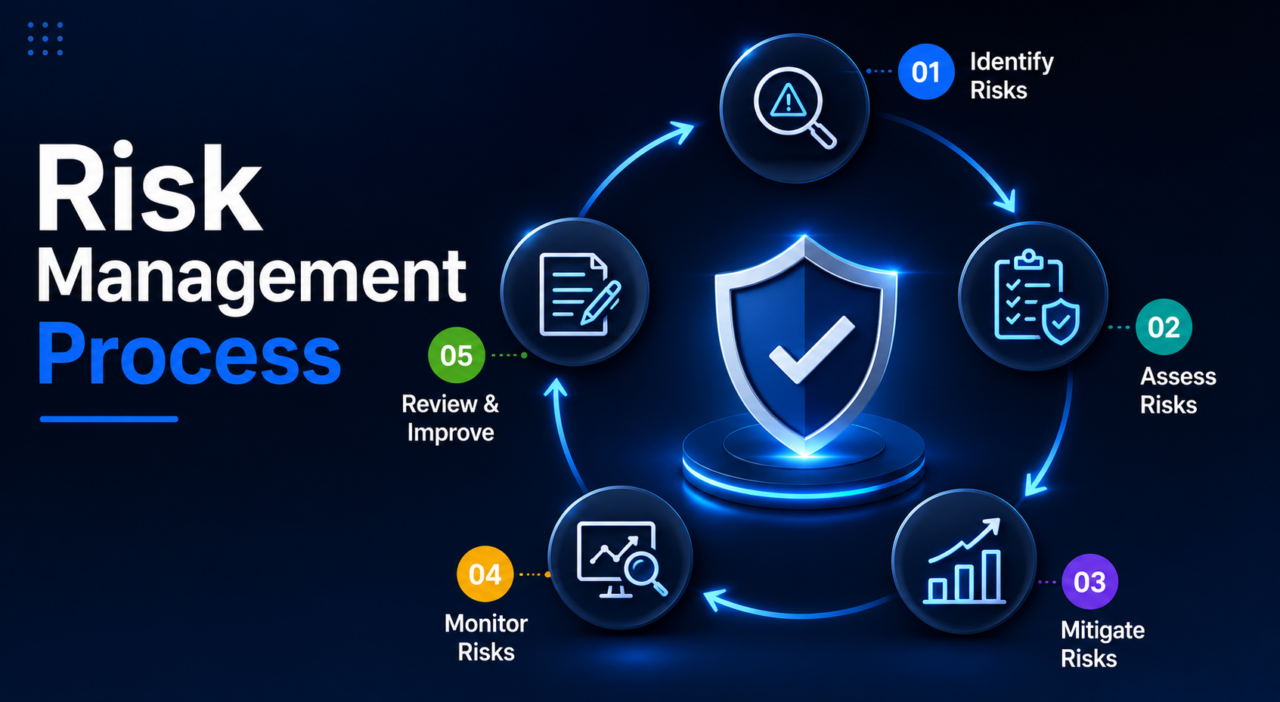
Risk Identification → Risk Assessment → Risk Evaluation → Risk Mitigation → Risk Monitoring → (back to Risk Identification)
This continuous loop ensures that risks are dynamically managed as business conditions evolve.
Organizations with mature risk management processes move from manual tracking to automated, data-driven systems with real-time visibility. The lifecycle approach ensures that risk management is never “complete”—it evolves with the organization.
Risk Management Process Diagram
The risk management lifecycle can be better understood through a visual representation.
The diagram below illustrates how the risk management process operates as a continuous loop:
Identify → Assess → Evaluate → Mitigate → Monitor → Repeat
This diagram highlights that risk management is not a linear process but a continuous cycle where each stage feeds into the next.

It also helps organizations standardize risk handling and improve decision-making across teams.
5. Qualitative vs Quantitative Risk Assessment
Organizations use two primary approaches to assess risks. The choice depends on data availability and decision-making needs.
| Type | Approach | Use Case | Example |
|---|---|---|---|
| Qualitative Assessment | Expert judgment, High/Medium/Low classification | Quick prioritization, initial screening, limited data | “Unauthorized access risk is High” |
| Quantitative Assessment | Data-driven, financial impact calculations, statistical models | Financial analysis, insurance, investment decisions | “Expected annual loss: $2.5M” |
Advanced organizations use quantitative techniques such as risk scoring models, expected loss calculations, and risk-adjusted return on capital (RAROC) to enable data-driven decision-making in risk management.
6. Risk Matrix: How Risks Are Prioritized
A risk matrix is a decision-making framework used to prioritize risks. It evaluates risks based on likelihood and impact, helping classify risks into categories.
Risk Matrix (3×3 Example)
| Low Impact | Medium Impact | High Impact | |
|---|---|---|---|
| High Likelihood | Medium | High | Critical |
| Medium Likelihood | Low | Medium | High |
| Low Likelihood | Accept | Low | Medium |
The risk matrix ensures organizations focus on high-impact risks first and standardizes risk evaluation across teams. Critical risks require immediate action; high risks require senior management attention; medium risks require planned mitigation; low risks may be accepted with monitoring.
7. Risk Register: The Central System of Record
A risk register is the central system of record used to manage risks across the organization. It is the primary tool for operationalizing the risk management process.
| Field | Description | Example |
|---|---|---|
| Risk ID | Unique identifier for tracking | RISK-001 |
| Risk Description | Clear statement of the risk | “Unauthorized access to customer data” |
| Risk Owner | Person accountable for the risk | CISO / IT Security Manager |
| Likelihood | Probability of occurrence | High / Medium / Low |
| Impact | Severity of consequence | High / Medium / Low |
| Risk Score | Likelihood × Impact | Critical / High / Medium / Low |
| Mitigation Plan | Actions to reduce risk | “Implement MFA by Q2” |
| Status | Current state of the risk | Open / Mitigated / Closed / Monitoring |
In practice, the risk register is used for: tracking risks from identification to closure, assigning accountability, monitoring mitigation progress, and supporting audit and compliance reporting.
Example: A cybersecurity risk is logged, assigned, mitigated, and tracked until closure. This ensures risks are actively managed, not just documented.
8. Types of Risk Management
Organizations manage multiple categories of risks. A mature risk management process integrates all risk types into a unified framework.
| Risk Type | Description | Example |
|---|---|---|
| Operational Risk | Failures in processes, people, or systems | System outage, human error, process breakdown |
| Financial Risk | Market, credit, or liquidity risks | Currency fluctuation, loan default, cash flow shortage |
| Cybersecurity Risk | Data breaches and cyber threats | Ransomware, phishing, unauthorized access |
| Compliance Risk | Regulatory violations | GDPR fine, PCI-DSS non-compliance, SOX violation |
| Strategic Risk | Poor business decisions | Failed acquisition, brand damage, competitive pressure |
9. Risk Ownership and Accountability
Each risk must have a clearly defined owner. Risk ownership is critical for accountability and execution.
- Accountability for mitigation – Owner ensures action plans are defined and executed
- Continuous monitoring – Owner tracks risk status and reports changes
- Accurate reporting – Owner provides updates to risk committees and management
Without ownership, risks remain unresolved and increase over time. Risk ownership should be assigned at the time of risk identification and documented in the risk register.
10. End-to-End Risk Management Workflow
In practice, the risk management process works as a continuous workflow:
- Risks are identified and logged into the risk register
- Risks are assessed and scored (likelihood × impact)
- Risk owners are assigned
- Mitigation plans are defined and implemented
- Risks are continuously monitored and reported
- Risk status is updated as mitigation progresses
- Closed risks are archived with lessons learned
This ensures that risk management is operational and measurable, not just a theoretical exercise.
11. Risk Management Process Example: Online Banking System
The following example illustrates how the risk management process works in a real banking scenario.
Scenario: Online Banking System
| Risk: | Unauthorized access to customer accounts |
| Identification: | Identified during security risk assessment workshop |
| Assessment: | Likelihood: Medium, Impact: High → Risk Score: High |
| Evaluation: | Prioritized as critical due to regulatory impact |
| Mitigation: | Implement Multi-Factor Authentication (MFA) + real-time monitoring |
| Ownership: | CISO / IT Security Manager |
| Monitoring: | Quarterly access reviews, continuous monitoring dashboard |
| Outcome: | Reduced risk exposure, compliant with RBI guidelines |
This demonstrates the real-world application of the risk management process from identification to monitoring.
12. Risk Management Framework Alignment
The risk management process aligns with global frameworks that provide structured guidance for implementation:
- ISO 31000 – International standard for risk management (principles, framework, process)
- COSO ERM – Enterprise Risk Management framework (strategy and performance integration)
- Basel Guidelines – Banking-specific risk management (operational, credit, market risk)
- NIST Risk Management Framework (RMF) – Cybersecurity risk management for US federal systems
Organizations should align their risk management process with the framework most relevant to their industry and regulatory requirements.
13. Common Challenges in Risk Management Process
Organizations often face significant challenges that reduce effectiveness and increase risk exposure:
- Lack of centralized visibility – Risk data scattered across spreadsheets and departments
- Manual tracking – Spreadsheets break, version control fails, updates are missed
- Poor prioritization – All risks treated equally; critical risks not escalated
- Delayed mitigation – No automated follow-up; actions remain open indefinitely
- No integration with controls – Risks managed separately from control testing
- Inconsistent risk ratings – Different business units use different scales
- Lack of management visibility – No dashboards for leadership to see risk posture
These challenges make manual risk management inefficient and high-risk for organizations at scale.
14. Risk Management Process Maturity Model
Assess your organization’s risk management capability using this five-level maturity model.
| Level | Name | Characteristics | Risk Posture |
|---|---|---|---|
| Level 1 | Ad-Hoc | No formal process. Risks managed reactively. No risk register. No accountability. | Very high – blind to risks |
| Level 2 | Basic | Basic risk register. Annual assessments. Manual tracking. Limited ownership. | High – significant blind spots |
| Level 3 | Defined | Formal process. Risk scoring methodology. Defined ownership. Mitigation plans tracked. | Moderate – known risks managed |
| Level 4 | Managed | Automated workflows. Real-time dashboards. Continuous monitoring. Integration with controls. | Low – proactive risk management |
| Level 5 | Optimized | Integrated GRC platform. Predictive analytics. Automated remediation. Board-level dashboards. | Optimal – risk-informed strategy |
Most organizations operate at Level 2 or 3. Advancing to Level 4 and 5 requires automation and GRC integration.
Ready to advance your risk management maturity?
Learn how ASPIA’s GRC platform helps organizations automate risk assessments, centralize risk registers, and track mitigation in real-time.
Request an ASPIA Demo15. How GRC Tools Help in Risk Management
Modern GRC (Governance, Risk, and Compliance) platforms enable organizations to implement a scalable, automated, and audit-ready risk management process.
- Centralize risk data – Single risk register accessible across the organization
- Automate assessments – Schedule and track risk assessments with automated scoring
- Track mitigation – Assign action plans, monitor status, escalate overdue items
- Provide dashboards – Real-time risk heat maps and management reporting
- Link to controls and compliance – Connect risks to control testing and regulatory requirements
- Generate audit-ready reports – One-click reports for risk committees and regulators
- Continuous monitoring – Automated KRIs and alerts for risk threshold breaches
Platforms like Aspia help organizations move from manual spreadsheets to automated risk management, reducing effort and improving visibility.
16. Frequently Asked Questions (FAQs)
What is the risk management process?
What are the 5 steps of the risk management process?
What is a risk register?
What is the difference between qualitative and quantitative risk assessment?
What are the four risk mitigation strategies?
How often should risk assessments be performed?
17. Conclusion: From Reactive to Strategic Advantage
The risk management process is a critical function that enables organizations to proactively manage risks rather than react to failures. Organizations that implement a structured and continuous process can reduce risk exposure, ensure compliance, improve resilience, and support business growth.
The difference between reactive and proactive risk management is simple:
- Reactive organizations discover risks when incidents occur
- Proactive organizations anticipate and mitigate risks before they materialize
A strong risk management process transforms risk into a strategic advantage. By leveraging GRC platforms like Aspia, organizations can automate risk assessments, centralize risk registers, and integrate risk management with audit, compliance, and control processes—building resilience that drives business success.
Transform Risk Management with ASPIA
ASPIA provides a unified GRC platform that automates the entire risk management process—from identification to mitigation to monitoring. Our solution enables organizations to:
- ✓ Centralize all risks in a single, auditable risk register
- ✓ Automate risk assessments with configurable scoring models
- ✓ Assign risk owners and track mitigation progress
- ✓ Link risks directly to controls, policies, and compliance requirements
- ✓ Generate real-time risk heat maps and dashboards
- ✓ Automate risk reporting for management and board
- ✓ Reduce manual risk management effort by up to 60%
Move from manual spreadsheets to automated, continuous risk management.
Request an ASPIA Demo