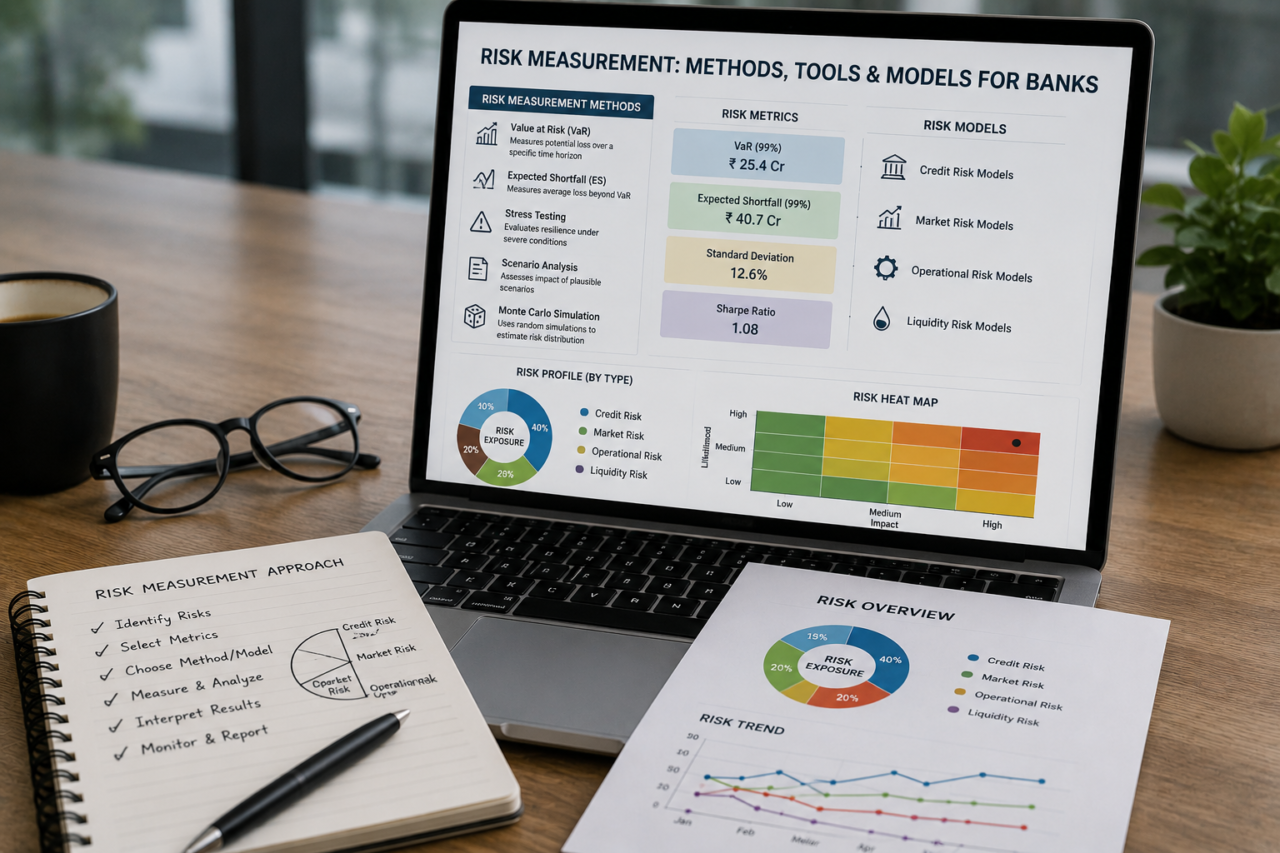
Risk measurement is the process of quantifying risk based on impact and likelihood. It helps organizations prioritize risks, evaluate control effectiveness, and determine residual risk. In banking and regulated industries, risk measurement is not optional—it is a core regulatory requirement.
The formula Risk Score = Impact × Likelihood is the foundation, but mature organizations go further—using Value at Risk (VaR), Key Risk Indicators (KRIs), expected loss models, and scenario analysis. When risks exceed 100+, multiple teams assess risks, audits require traceability, and real-time visibility is needed, risk measurement becomes a system problem—not a spreadsheet problem.
This guide provides a complete framework for understanding risk measurement—from basic scoring to advanced banking models, tools, heat maps, and how GRC platforms transform measurement at scale.
1. What is Risk Measurement? Definition & Purpose
Risk measurement is the process of quantifying risk based on impact and likelihood. It helps organizations prioritize risks, evaluate control effectiveness, and determine residual risk.
Risk measurement answers: “How severe is this risk, and what priority should it receive?”
Without risk measurement, organizations cannot compare risks across different business units, allocate resources effectively, or demonstrate risk reduction to auditors and regulators. It is the bridge between risk identification (finding risks) and risk management (acting on risks).
2. Risk Measurement vs Risk Assessment vs Risk Management
These terms are often confused. Understanding the distinction is critical for implementing effective GRC processes.
| Process | Purpose | Output | Question Answered |
|---|---|---|---|
| Risk Assessment | Identifies risks | Risk list / Risk register | “What can go wrong?” |
| Risk Measurement | Quantifies risks | Risk scores, heat maps, KRIs | “How severe is it?” |
| Risk Management | Mitigates risks | Controls, action plans, residual risk | “What should we do about it?” |
Risk assessment identifies risks, risk measurement quantifies risks, and risk management mitigates risks. All three are necessary for a mature risk program.
3. The Core Formula: Risk Score = Impact × Likelihood
The foundation of risk measurement is the formula:
Risk Score = Impact × Likelihood
This formula is widely used in banking, ISO 27001, internal audit frameworks, and enterprise risk management (ERM). Both Impact and Likelihood are typically scored on a scale of 1 to 5 (or 1 to 10), producing a risk score between 1 and 25 (or 1 and 100).
Impact Scale (Example)
- 1 – Insignificant (minor inconvenience)
- 2 – Minor (limited impact)
- 3 – Moderate (operational disruption)
- 4 – Major (significant financial loss)
- 5 – Catastrophic (business failure)
Likelihood Scale (Example)
- 1 – Rare (once in 10+ years)
- 2 – Unlikely (once in 5-10 years)
- 3 – Moderate (once in 2-5 years)
- 4 – Likely (once per year)
- 5 – Almost Certain (multiple times per year)
Risk Score Interpretation
- 1-5 → Low → Accept / monitor
- 6-10 → Medium → Plan mitigation
- 11-15 → High → Prioritize remediation
- 16-25 → Critical → Immediate action
Example: A cybersecurity threat with Impact = 5 (catastrophic) and Likelihood = 4 (likely) → Risk Score = 20 → Critical → requires immediate action.
4. Risk Heat Map: Visual Risk Measurement
A risk heat map is a visual representation of risk using a matrix of impact vs likelihood. It helps prioritize and communicate risk severity to leadership and board members.
Risk Heat Map (5×5 Example)
| Likelihood \ Impact | 1 | 2 | 3 | 4 | 5 |
|---|---|---|---|---|---|
| 5 | M | H | C | C | C |
| 4 | L | M | H | C | C |
| 3 | L | L | M | H | C |
| 2 | L | L | L | M | H |
| 1 | L | L | L | L | M |
L = Low | M = Medium | H = High | C = Critical
Heat maps are essential for board reporting because they translate complex risk data into an intuitive visual format. However, they require consistent scoring across the organization to be meaningful.
5. Advanced Risk Measurement Techniques
Beyond basic scoring, mature organizations use advanced techniques for more precise risk measurement.
Key Risk Indicators (KRIs)
KRIs are measurable metrics that signal increasing risk exposure before incidents occur. Examples include: number of failed transactions, system downtime minutes, number of overdue audit findings, and employee training completion rates. KRIs enable predictive risk measurement rather than reactive.
Scenario Analysis
Scenario analysis measures risk by modeling “what if” events. Examples include: cyber breach scenario, market crash scenario, or bank run scenario. Each scenario estimates potential financial and operational impact, providing a forward-looking risk measurement.
Expected Loss (EL) Model
Used primarily for credit risk, but applicable across domains. Expected Loss = PD × LGD × EAD where PD is Probability of Default, LGD is Loss Given Default, and EAD is Exposure at Default. This quantifies risk in monetary terms, enabling ROI-based decisions on controls.
Value at Risk (VaR)
VaR measures the maximum loss expected over a specific time period at a given confidence level. Example: “Daily VaR of $1M at 99% confidence” means there is a 1% chance of losing more than $1M in a day. Widely used for market risk in trading banks.
6. Risk Measurement in Banking: Real-World Application
Banks measure risks using a combination of regulatory models and internal frameworks. When risks exceed 100+, multiple teams assess risks, and audits require traceability, risk measurement becomes a system problem—not a spreadsheet problem.
Credit Risk Measurement
PD, LGD, EAD models → Expected Loss calculation → Risk-Weighted Assets (RWA) → Capital adequacy (Basel III)
Market Risk Measurement
Value at Risk (VaR) → Stress testing → Sensitivity analysis (duration, delta) → Trading limits
Liquidity Risk Measurement
LCR (Liquidity Coverage Ratio) → NSFR (Net Stable Funding Ratio) → Stress testing (bank run scenarios)
Operational Risk Measurement
Loss event database → KRIs (failed transactions, system uptime) → Scenario analysis → Risk score = Impact × Likelihood
7. Risk Measurement Tools: From Spreadsheets to GRC Platforms
Risk measurement is commonly performed using different tools depending on organizational maturity.
| Tool | Capabilities | Limitations | Best For |
|---|---|---|---|
| Excel | Basic scoring, formulas, conditional formatting | No traceability, version issues, manual updates, limited scalability | Small organizations, initial risk measurement |
| Risk Engines (SAS, RiskWatch) | Advanced analytics, VaR, scenario modeling | Expensive, complex, siloed from GRC | Large banks, quantitative risk measurement |
| GRC Platforms (Aspia) | Centralized risk registers, automated scoring, heat maps, KRI tracking, audit trails | Requires implementation | Enterprise-wide, integrated risk measurement |
When risks exceed 100+, multiple teams assess risks, and audits require traceability, organizations move from Excel to GRC platforms for scalable, auditable risk measurement. Platforms like Aspia enable real-time risk visibility, automated scoring, and complete audit trails.
8. The Challenge: When Risk Measurement Becomes a System Problem
At scale, risk measurement breaks down in spreadsheets:
- Risks exceed 100+ – Manual tracking becomes impossible
- Multiple teams assess risks – Inconsistent scoring, no standardization
- Audits require traceability – Spreadsheets lack version control and audit trails
- Real-time visibility is needed – Static reports become outdated immediately
At this point, risk measurement becomes a system problem—not a spreadsheet problem. Organizations must adopt GRC platforms to automate risk measurement, enforce consistent scoring, provide real-time dashboards, and maintain audit-ready documentation.
9. How GRC Platforms Transform Risk Measurement
Modern GRC platforms like Aspia address the limitations of spreadsheets by providing:
- Centralized risk measurement – All risks in a single, auditable register
- Automated scoring – Risk scores calculated automatically based on impact and likelihood
- Consistent methodology – Standardized scales across all business units
- Real-time risk heat maps – Always current, dynamic visualizations
- KRI tracking and alerts – Monitor risk indicators and receive automated alerts for threshold breaches
- Audit-ready reporting – One-click reports with complete traceability
- Residual risk calculation – Measure risk reduction after control implementation
This transforms risk measurement from a periodic, manual exercise into continuous, automated risk intelligence.
10. Best Practices for Effective Risk Measurement
- Standardize impact and likelihood scales – Ensure consistent definitions across the organization
- Use both qualitative and quantitative measures – Combine expert judgment with data
- Track residual risk – Measure risk after controls, not just inherent risk
- Monitor KRIs continuously – Detect risk increases before incidents occur
- Validate risk scores periodically – Ensure scores remain accurate over time
- Automate where possible – Reduce manual effort and errors
- Link risk measurement to decision-making – Use scores to prioritize actions and allocate budgets
11. Risk Measurement Maturity Model
Assess your organization’s risk measurement capability using this five-level maturity model.
| Level | Name | Characteristics | Risk Visibility |
|---|---|---|---|
| Level 1 | Ad-Hoc | No formal measurement. Risks not scored. Spreadsheets. Limited consistency.), | Very low – cannot prioritize)、 |
| Level 2 | Basic Scoring)、 | Impact × Likelihood scoring. Basic risk matrix. Manual calculation. Spreadsheet-based.)、 | Low – limited comparability)、 |
| Level 3 | Structured)、 | Standardized scales. Risk heat maps. KRI definition. Regular reporting.)、 | Moderate – comparable across units)、 |
| Level 4 | Automated)、 | Automated scoring. Real-time dashboards. KRI alerts. Integrated with GRC.), | High – real-time visibility)、 |
| Level 5 | Predictive)、 | Machine learning models. Predictive analytics. Continuous monitoring. Automated risk intelligence.), | Optimal – predictive insight)、 |
Most organizations operate at Level 2 or 3. Advancing to Level 4 and 5 requires automation and GRC integration.
Ready to advance your risk measurement maturity?
Learn how ASPIA’s GRC platform automates risk measurement, provides real-time risk heat maps, and enables continuous monitoring at scale.
Request an ASPIA Demo12. Frequently Asked Questions (FAQs)
What is risk measurement in GRC?
What is the formula for risk measurement?
What are risk measurement techniques?
What is the difference between risk measurement and risk assessment?
What tools are used for risk measurement?
What is a risk heat map?
13. Conclusion: From Spreadsheets to Strategic Risk Intelligence
Risk measurement is not just about assigning numbers to risks—it is about enabling decision-making, prioritizing actions, and demonstrating control effectiveness. The basic formula Risk Score = Impact × Likelihood is where most organizations start, but mature organizations go further—using KRIs, scenario analysis, and quantitative models to measure risk with precision and foresight.
When risks exceed 100+, multiple teams are involved, and audits require traceability, spreadsheets fail. At that scale, risk measurement becomes a system problem—not a spreadsheet problem. Organizations that adopt GRC platforms like Aspia transform risk measurement from manual, periodic exercises into continuous, automated risk intelligence—enabling real-time visibility, audit-ready reporting, and strategic decision-making.
Transform Risk Measurement with ASPIA
ASPIA provides a unified GRC platform that automates risk measurement, provides real-time heat maps, and scales to thousands of risks across multiple teams. Our solution enables organizations to:
- ✓ Automate risk scoring (Impact × Likelihood) across all business units
- ✓ Generate real-time risk heat maps and dashboards
- ✓ Track Key Risk Indicators (KRIs) with automated alerts
- ✓ Link risk measurement to controls, audits, and compliance frameworks
- ✓ Calculate residual risk after control implementation
- ✓ Produce audit-ready risk reports with complete traceability
- ✓ Scale from hundreds to thousands of risks without breaking
Move from spreadsheets to continuous, automated risk measurement.
Request an ASPIA Demo