
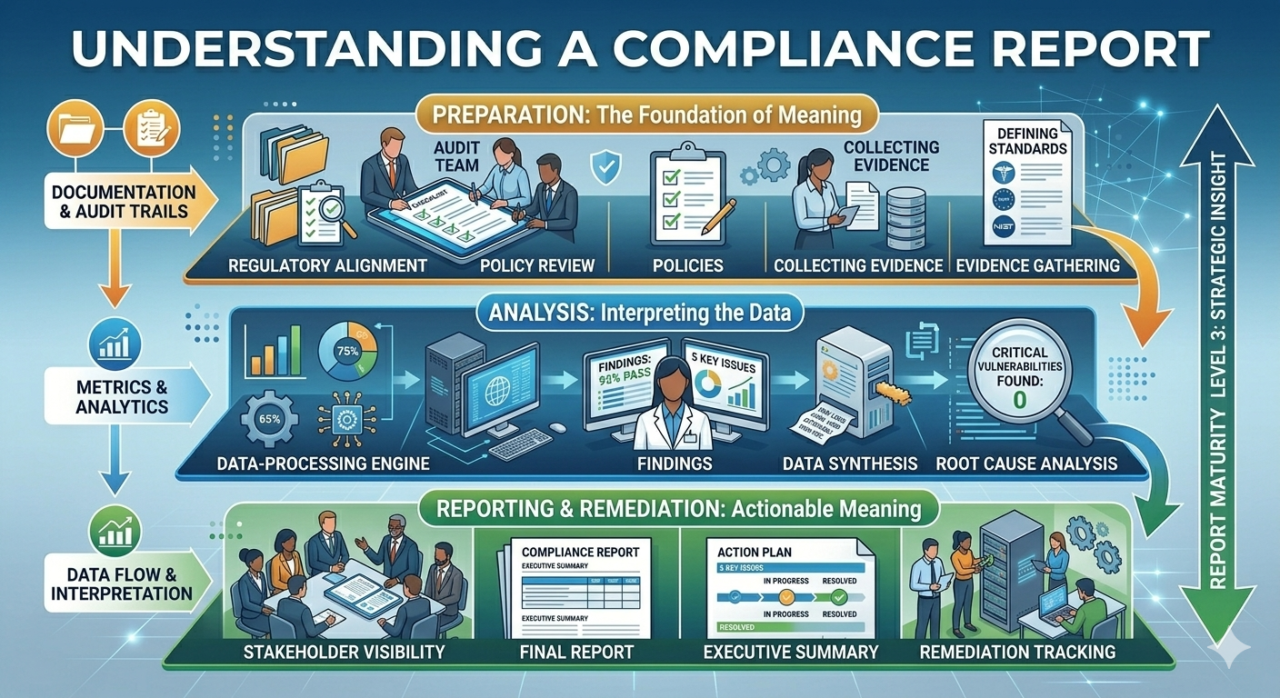
Businesses today operate in a highly regulated environment governed by laws, industry standards, and regulatory bodies. Failure to comply can result in financial penalties, reputational damage, legal consequences, and even business shutdown. To manage this, organizations rely on compliance reporting.
A compliance report provides a structured view of whether an organization is adhering to regulatory requirements, internal policies, and industry standards. With regulatory fines reaching millions of dollars and enforcement actions increasing globally, organizations cannot afford to treat compliance reporting as an afterthought.
This guide provides a complete framework for understanding compliance reports—from definition and types to format, step-by-step creation, real examples, and how GRC automation transforms manual reporting into continuous compliance visibility.
1. What is a Compliance Report? (Direct Answer)
A compliance report is a formal document that evaluates and demonstrates whether an organization is complying with applicable laws, regulations, standards, and internal policies.
A comprehensive compliance report includes:
- Compliance status – Clear indication of compliant, partially compliant, or non-compliant areas
- Identified gaps or violations – Documentation of control weaknesses and compliance failures
- Risk exposure – Assessment of impact and likelihood of non-compliance
- Corrective actions – Recommendations and action plans to address issues
In simple terms: A compliance report answers: “Are we compliant, where are the gaps, and what needs to be fixed?”
2. What is Compliance Reporting?
Compliance reporting is the process of collecting, analyzing, and presenting data to demonstrate adherence to regulatory, legal, and internal standards.
It ensures transparency, supports risk management, and helps organizations maintain accountability. Unlike a one-time compliance report, compliance reporting is an ongoing process that includes:
- Continuous monitoring of compliance status
- Periodic assessments and testing
- Regular reporting to management and regulators
- Tracking of remediation actions
3. Why Compliance Reports Are Important
Compliance reporting is critical for governance, risk management, and business continuity.
Key Benefits of Compliance Reporting
- Ensures adherence to laws and regulations – Demonstrates compliance and avoids penalties
- Identifies risks and control gaps – Proactively surfaces weaknesses before they lead to incidents
- Prevents penalties and legal exposure – Early identification enables remediation before enforcement
- Supports audits and certifications – Provides structured evidence for auditors and certifiers
- Improves transparency and accountability – Creates clear visibility into compliance status
The cost of non-compliance can be staggering—GDPR fines up to €20 million or 4% of global turnover, PCI-DSS fines up to $100,000 per month, and reputational damage that lasts years. Compliance reports are the first line of defense against these outcomes.
4. Who Uses Compliance Reports?
Compliance reports are used by both internal and external stakeholders to assess risk, compliance posture, and governance effectiveness.
Internal Users
- Compliance officers – Monitor and manage compliance programs
- Risk managers – Assess and mitigate compliance risks
- Internal auditors – Evaluate control effectiveness
- Senior management and board members – Oversee governance and risk
External Users
- Regulatory authorities – Assess compliance with laws (RBI, SEC, etc.)
- External auditors – Verify financial and operational compliance
- Investors and stakeholders – Evaluate governance and risk posture
- Customers and partners – Assess vendor compliance (e.g., SOC 2 reports)
5. Types of Compliance Reports
Compliance reports vary based on industry, regulatory requirements, and organizational needs.
| Report Type | Focus Area | Examples |
|---|---|---|
| Regulatory Compliance Report | Adherence to laws and government regulations | GDPR compliance report, RBI annual return, SEC filing |
| Financial Compliance Report | Financial transparency and accounting standards | SOX compliance report, audit committee report |
| IT & Security Compliance Report | Cybersecurity, data protection, and IT governance | ISO 27001 internal audit, SOC 2 Type II report, PCI-DSS report |
| Operational Compliance Report | Business processes following internal and regulatory standards | Process audit report, operational risk assessment |
| Data Privacy Compliance Report | Protection of personal and sensitive data | DPIA report, DSAR metrics, privacy impact assessment |
6. Key Components of a Compliance Report
A comprehensive, audit-ready compliance report includes the following essential components.
1. Executive Summary
High-level overview of findings, key risks, and overall compliance status for leadership audiences.
2. Scope and Objectives
Defines what is being assessed (departments, systems, processes), why, and the time period covered.
3. Compliance Status
Shows compliant, partially compliant, or non-compliant areas. Often includes a dashboard or heat map for executive visibility.
4. Findings and Observations
Lists gaps, violations, and issues identified during the assessment with supporting evidence.
5. Risk Assessment
Evaluates impact and likelihood of non-compliance. Findings are typically rated as High, Medium, or Low risk.
6. Action Plan
Defines corrective actions, owners, timelines, and tracking mechanisms for each finding.
7. Supporting Evidence
Includes data, logs, policy documents, and other evidence that substantiates findings and compliance status.
7. Compliance Report Format: Best Practice Template
A standard compliance report format ensures consistency, completeness, and audit-readiness. This format is widely used in audits and GRC frameworks.
Compliance Report Template Structure
- Executive Summary – High-level overview of compliance status and key risks
- Scope and Objectives – What was assessed and why
- Applicable Regulations – List of laws, standards, or policies assessed
- Methodology – How the assessment was conducted (interviews, testing, sampling)
- Findings – Detailed description of each gap or issue
- Risk Ratings – High/Medium/Low classification with impact assessment
- Recommendations – Specific corrective actions for each finding
- Action Plan – Owners, due dates, and status tracking
- Conclusion – Summary and next steps
Organizations using GRC platforms can automate this template, pulling data directly from risk assessments, control testing, and policy management modules.
8. How to Create a Compliance Report: Step-by-Step Process
Follow these eight steps to create a professional, audit-ready compliance report.
Step 1: Define Purpose and Audience
Understand regulatory requirements, stakeholder expectations, and the intended use of the report.
Step 2: Collect and Organize Data
Gather policies, audit logs, compliance records, and evidence from relevant systems.
Step 3: Analyze Compliance Status
Evaluate adherence to requirements and identify gaps or non-compliance.
Step 4: Document Findings
Highlight risks, issues, and non-compliance with supporting evidence.
Step 5: Assign Risk Levels
Classify findings as High, Medium, or Low based on potential impact and likelihood.
Step 6: Provide Recommendations
Suggest specific, actionable corrective actions for each finding.
Step 7: Review and Distribute
Validate accuracy, obtain approvals, and share with stakeholders.
Step 8: Monitor and Update
Continuously update based on regulatory changes, remediation progress, and new assessments.
9. Real Compliance Report Example: Banking Compliance Report
The following example illustrates a compliance report for a banking institution, covering key regulatory areas.
| Area | Assessment | Status |
|---|---|---|
| Financial Reporting | Verified accuracy of financial statements against GAAP/IFRS standards | Compliant |
| Internal Controls | Documented fraud prevention mechanisms; tested segregation of duties | Partially Compliant |
| Risk Management | Assessed credit and operational risks; risk register maintained | Compliant |
| Regulatory Updates | Adjusted policies for new RBI and Basel guidelines | Compliant |
| Employee Training | Conducted compliance training for all staff; 92% completion rate | Compliant |
This ensures full regulatory compliance and transparency while identifying areas requiring attention (internal controls).
10. Purpose of a Compliance Report
Compliance reports serve multiple strategic purposes beyond mere documentation.
- Demonstrate adherence to regulations – Provide evidence of compliance to regulators and auditors
- Identify improvement areas – Surface control gaps and process weaknesses for remediation
- Mitigate risk exposure – Prioritize actions based on risk levels to reduce exposure
- Support decision-making – Enable leadership to allocate resources based on compliance priorities
- Ensure accountability – Assign ownership for findings and track remediation progress
- Build stakeholder trust – Demonstrate governance maturity to customers, investors, and partners
11. Common Challenges in Compliance Reporting
Organizations commonly face significant challenges that make manual compliance reporting inefficient and risky.
- Data silos across departments – Evidence scattered across different systems, making collection difficult
- Lack of executive buy-in – Without leadership support, compliance reporting becomes under-resourced
- Resource constraints – Manual data gathering consumes 60-70% of compliance team time
- Frequent regulatory changes – Keeping up with evolving requirements is challenging without automation
- Limited risk awareness – Inability to see real-time compliance status and emerging risks
- Inconsistent reporting formats – Different reports for different stakeholders create confusion and rework
These challenges make manual compliance reporting inefficient and high-risk—which is why automation and GRC tools are critical.
12. Key Benefits of Compliance Reporting
- Reduces legal and regulatory risks – Proactive identification prevents violations and penalties
- Builds trust with stakeholders – Demonstrates governance maturity to regulators, customers, and investors
- Improves operational efficiency – Structured reporting reduces audit preparation time
- Strengthens governance and controls – Identifies gaps for continuous improvement
- Enhances financial transparency – Supports accurate financial reporting and SOX compliance
- Supports certifications and bids – Compliance reports are often required for ISO certification and customer contracts
13. Compliance Report vs Audit Report: Key Differences
| Aspect | Compliance Report | Audit Report |
|---|---|---|
| Primary Purpose | Verify adherence to regulations and policies | Evaluate controls, processes, and performance |
| Frequency | Continuous or periodic reporting | Periodic (annual, quarterly, or project-based) |
| Primary Focus | Regulations, laws, policies | Processes, controls, financial accuracy |
| Prepared By | Compliance team, risk management | Internal or external auditors |
Key takeaway: Compliance reports focus on rule adherence; audit reports focus on control evaluation. Both are essential but serve different purposes.
14. Role of Compliance Reports in GRC Frameworks
In GRC (Governance, Risk, and Compliance) frameworks, compliance reports are essential for:
- Tracking regulatory compliance – Mapping controls to requirements and monitoring status
- Monitoring control effectiveness – Assessing whether controls are designed and operating effectively
- Maintaining audit trails – Documenting evidence for internal and external audits
- Supporting certifications – Providing evidence for ISO 27001, SOC 2, and other certifications
- Enabling risk-based decision-making – Prioritizing remediation based on compliance risk levels
Modern platforms like Aspia enable automated compliance reporting, real-time monitoring, and improved audit readiness—transforming manual, periodic reporting into continuous compliance visibility.
Ready to automate your compliance reporting?
Learn how ASPIA’s GRC platform generates real-time compliance reports, tracks remediation, and maintains audit-ready documentation.
Request an ASPIA Demo15. Frequently Asked Questions (FAQs)
What is a compliance report?
What does a compliance report include?
Why is compliance reporting important?
Is a compliance report mandatory?
Who prepares compliance reports?
How often should compliance reports be created?
16. Conclusion: From Manual Reporting to Continuous Compliance
A compliance report is a critical tool for ensuring regulatory adherence, managing risks, and maintaining strong governance. It provides organizations with visibility into compliance status, highlights gaps, and enables corrective action before issues escalate.
As regulatory environments become more complex and enforcement actions increase, adopting structured and automated compliance reporting is essential for long-term success. Organizations that rely on manual spreadsheets and disconnected systems will struggle to keep pace.
By leveraging GRC platforms like Aspia, organizations can transform compliance reporting from a periodic, manual burden into a continuous, automated capability—providing real-time visibility, reducing risk, and building stakeholder trust.
Transform Compliance Reporting with ASPIA
ASPIA provides a unified GRC platform that automates compliance reporting—from data collection to report generation to action tracking. Our solution enables organizations to:
- ✓ Generate real-time compliance reports with one click
- ✓ Track compliance status across all regulations and frameworks
- ✓ Automate evidence collection and audit trails
- ✓ Link findings to risk assessments and action plans
- ✓ Maintain continuous audit readiness
- ✓ Reduce reporting effort by up to 70%
Move from manual spreadsheets to automated, continuous compliance reporting.
Request an ASPIA Demo
