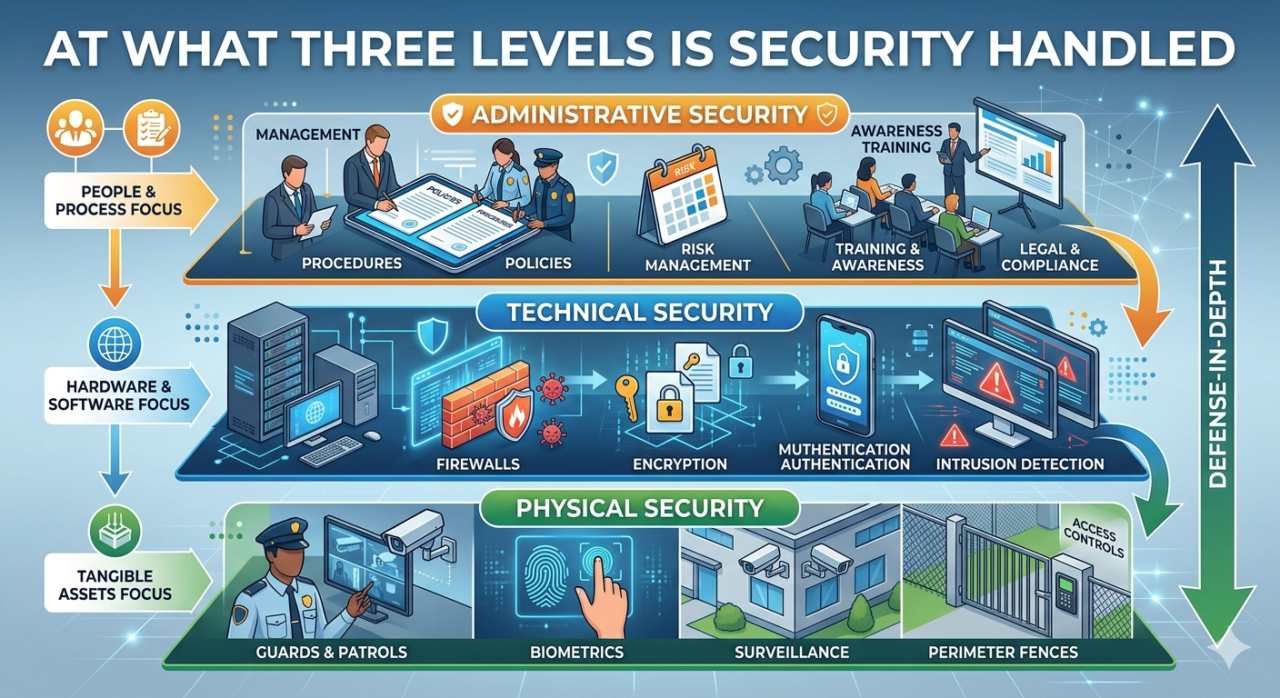
Security in organizations is implemented across multiple layers to protect assets, systems, and data. No single control can address all threats—which is why a layered, defense-in-depth approach is essential.
The three levels of security are physical, technical (logical), and administrative (managerial). These layers work together to create a complete security framework and are widely used in cybersecurity, risk management, and compliance standards such as ISO 27001, NIST, and GRC frameworks.
This guide explains each security level in detail—with definitions, examples, importance, comparisons, and real-world applications. This concept is commonly asked in exams, interviews, and certifications related to cybersecurity, governance, and risk management.
1. At What Three Levels is Security Handled? (Direct Answer)
Security is handled at three distinct levels that together form a complete defense-in-depth framework:
1. Physical Security
2. Technical (Logical) Security
3. Administrative (Managerial) Security
These are also known as the three layers of security in cybersecurity, risk management, and GRC (Governance, Risk, and Compliance) frameworks. Each layer addresses different types of threats and vulnerabilities, and they must work together for comprehensive protection.
2. Physical Security: Protecting Infrastructure and Assets
Physical security focuses on protecting an organization’s infrastructure, facilities, hardware, and personnel from unauthorized physical access, damage, theft, or harm.
Physical security is the foundation layer—if physical access is compromised, attackers can bypass all digital controls and directly access systems, data, and equipment.
Examples of Physical Security Controls
- CCTV surveillance systems – Monitor and record activity in and around facilities
- Security guards – Provide human presence and response capability
- Biometric and RFID access controls – Restrict entry to authorized personnel only
- Locked server rooms and data centers – Protect critical IT infrastructure
- Entry and exit monitoring systems – Track personnel movement and detect unauthorized access
- Perimeter fencing and barriers – Deter and delay unauthorized entry
- Mantraps and security vestibules – Control and verify entry of individuals
- Laptop locks and equipment tethers – Prevent theft of portable devices
- Secure disposal and shredding – Destroy sensitive documents and media
Why Physical Security is Important
- Prevents unauthorized individuals from entering facilities
- Protects against theft of hardware and sensitive equipment
- Prevents physical tampering with servers, network devices, and systems
- Protects personnel from workplace violence or threats
- Often a regulatory requirement for data centers and financial institutions
Key principle: If an attacker gains physical access, all technical and administrative controls become irrelevant because they can directly access, copy, or destroy systems and data.
3. Technical (Logical) Security: Protecting Systems and Data
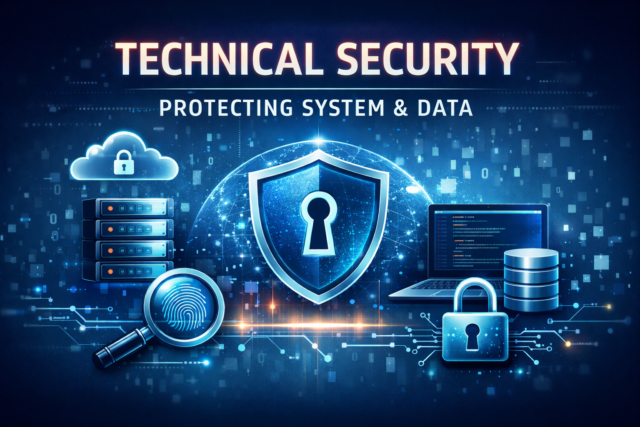
Technical security (also called logical security) protects systems, networks, applications, and data using technological controls. This is the layer most people think of as “cybersecurity.”
Technical security controls are designed to prevent, detect, and respond to cyber threats such as hacking, malware, ransomware, phishing, and data breaches.
Examples of Technical Security Controls
- Firewalls and intrusion detection/prevention systems (IDS/IPS) – Monitor and control network traffic
- Data encryption – Protect data at rest, in transit, and in use
- Antivirus and endpoint security – Detect and block malware on devices
- Identity and Access Management (IAM) – Control user access to systems and data
- Multi-Factor Authentication (MFA) – Add an extra layer of authentication beyond passwords
- Network segmentation and zero trust – Limit lateral movement of attackers
- Data Loss Prevention (DLP) – Prevent unauthorized data exfiltration
- Security Information and Event Management (SIEM) – Aggregate and analyze security logs
- Vulnerability scanners and penetration testing – Identify and remediate weaknesses
- Backup and disaster recovery systems – Restore data after ransomware or system failure
Why Technical Security is Important
- Protects against remote cyberattacks from anywhere in the world
- Prevents unauthorized access to systems and sensitive data
- Detects and blocks malware, ransomware, and other malicious code
- Ensures data confidentiality, integrity, and availability (CIA triad)
- Provides audit trails for forensic investigation and compliance
Key principle: Technical controls are the primary defense against digital threats, but they must be supported by physical and administrative controls to be fully effective.
4. Administrative (Managerial) Security: Policies, Processes & Governance
Administrative security (also called managerial security) defines the policies, processes, standards, and governance structures that control how security is implemented, managed, and enforced across the organization.
This layer is often called the “people and process” layer because it establishes rules of behavior, assigns responsibilities, and creates accountability.
Examples of Administrative Security Controls
- Information security policies – Documented rules for protecting information assets
- Risk management frameworks – Structured approach to identifying and mitigating risks
- Employee training and awareness programs – Educate staff on security best practices
- Incident response procedures – Documented steps for responding to security incidents
- Compliance with standards (ISO 27001, NIST, SOC 2) – Align with industry best practices
- Security governance committees – Oversight and decision-making bodies
- Background checks and hiring procedures – Screen employees before granting access
- Acceptable Use Policies (AUP) – Define acceptable behavior on company systems
- Change management processes – Control changes to systems and configurations
- Business continuity and disaster recovery plans – Prepare for disruptions
Why Administrative Security is Important
- Without policies, security controls are implemented inconsistently or not at all
- Defines roles, responsibilities, and accountability for security
- Ensures compliance with legal and regulatory requirements
- Creates a security-aware culture through training and awareness
- Provides governance oversight and continuous improvement mechanisms
- Documents evidence for audits and regulatory inspections
Key principle: Administrative controls are the foundation that enables physical and technical controls to function effectively. Without governance, even the best technology will fail due to human error or lack of process.
5. Comparison of the Three Security Levels
Understanding how the three levels differ helps organizations allocate resources and design comprehensive security programs.
| Security Level | Focus Area | Primary Threats | Purpose |
|---|---|---|---|
| Physical Security | Infrastructure, facilities, hardware | Theft, vandalism, unauthorized entry, natural disasters | Prevent unauthorized physical access and protect assets |
| Technical Security | Systems, networks, applications, data | Hacking, malware, ransomware, phishing, data breaches | Protect against cyber threats and ensure data security |
| Administrative Security | Policies, processes, people, governance | Human error, policy violations, lack of awareness, insider threats | Ensure compliance, governance, and consistent implementation |
Key takeaway: Each level addresses different threats and vulnerabilities. No single level is sufficient—all three are required for comprehensive security.
6. Why All Three Levels Are Important: Defense in Depth
Organizations must implement all three levels of security to achieve layered security (defense-in-depth). Defense-in-depth is a strategy that uses multiple layers of controls so that if one layer fails, others remain effective.
Physical Security → Protects infrastructure and hardware
+ Technical Security → Protects systems and data from cyber threats
+ Administrative Security → Ensures governance, compliance, and proper implementation
= Complete Security Framework
Why Layered Security Matters
- Redundancy: If one control fails, others still provide protection
- Comprehensive coverage: Addresses physical, cyber, and human threats
- Regulatory compliance: Most frameworks require all three levels
- Risk reduction: Significantly lowers overall organizational risk
- Defense against sophisticated attacks: Attackers must bypass multiple controls
If any one layer is missing, the entire security framework becomes weak. For example:
- Strong technical controls + weak physical security → Attacker can walk into server room and steal hard drives
- Strong physical controls + weak administrative controls → Employees may unknowingly violate policies, creating risk
- Strong administrative controls + weak technical controls → Policies exist but technology cannot enforce them
7. Real-World Example: Three Levels of Security in Banking
In a banking environment, all three security levels work together to protect customer assets, data, and trust.
Physical Security in Banking
Secured bank branches, vaults, and data centers. CCTV surveillance, security guards, biometric access to restricted areas, locked server rooms.
Technical Security in Banking
Data encryption for transactions and customer data. Firewalls and intrusion detection. Multi-factor authentication for online banking. Fraud detection systems. Endpoint security on bank workstations.
Administrative Security in Banking
Regulatory compliance (RBI, PCI-DSS). Information security policies. Employee training on phishing and data protection. Incident response procedures. Risk management frameworks.
This layered approach ensures protection against both physical and cyber risks, maintaining customer trust and regulatory compliance.
8. Role in ISO 27001 and GRC Frameworks
In ISO 27001 (Information Security Management System) and GRC (Governance, Risk, and Compliance) frameworks, the three security levels map directly to control categories.
| Security Level | ISO 27001:2022 Annex A Reference | Example Controls |
|---|---|---|
| Physical Security | Clause 7 (Physical Controls) – A.7.1 to A.7.8 | Physical security perimeter, access controls, secure areas, equipment security |
| Technical Security | Clause 8 (Technological Controls) – A.8.1 to A.8.34 | Access control, cryptography, network security, malware protection, monitoring |
| Administrative Security | Clause 5 (Organizational Controls) – A.5.1 to A.5.37 | Policies, roles and responsibilities, training, incident management, compliance |
This alignment ensures end-to-end security and regulatory compliance. Organizations implementing ISO 27001 must address all three control categories to achieve certification.
9. Security Maturity Model: How Organizations Evolve Across All Three Levels
Assess your organization’s security maturity across all three levels using this five-level model.
| Level | Name | Characteristics | Security Posture |
|---|---|---|---|
| Level 1 | Initial / Ad-Hoc | No formal security controls. Reactive responses. Physical security may exist but technical and administrative are missing. | Very weak – high risk |
| Level 2 | Repeatable | Basic controls in one or two layers. Inconsistent implementation. Limited documentation. | Weak – significant gaps |
| Level 3 | Defined | All three layers implemented. Documented policies. Standard technical controls. Physical security in place. | Moderate – baseline security |
| Level 4 | Managed & Measured | Integrated security across all layers. Regular testing and monitoring. Metrics and dashboards. Continuous improvement. | Strong – proactive defense |
| Level 5 | Optimized / Resilient | Automated, adaptive security. Zero trust architecture. GRC platform integration. Continuous compliance. Security culture embedded. | Resilient – defense in depth |
Most organizations operate at Level 2 or 3. Advancing to Level 4 and 5 requires integration across all three security layers and automation through GRC platforms.
Ready to strengthen all three layers of security?
Learn how ASPIA’s GRC platform helps organizations implement administrative security controls, manage compliance, and integrate with physical and technical security layers.
Request an ASPIA Demo10. How GRC Tools Support All Three Security Levels
While physical and technical controls require specialized systems, GRC (Governance, Risk, and Compliance) platforms provide the administrative layer that integrates and governs all three security levels.
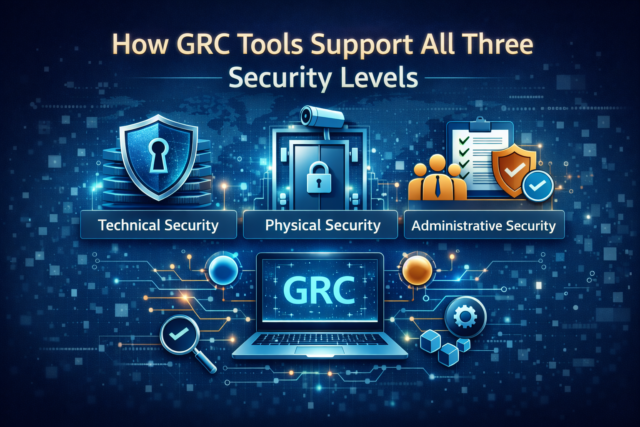
Governance-Integrated Security: GRC platforms link administrative security (policies, risk assessments, compliance) directly to physical and technical control evidence. When a technical control fails, the system automatically triggers risk remediation workflows. When a policy is updated, it notifies relevant technical control owners. This creates a closed-loop security governance system across all three layers.
How GRC Platforms Support Each Layer
- Administrative Security: Policy management, risk assessments, compliance tracking, audit management, training records, incident management
- Technical Security (via integration): Link to vulnerability scan results, technical control testing, evidence collection from security tools (firewalls, EDR, SIEM)
- Physical Security (via integration): Track physical access controls, maintenance records, incident reports from physical security systems
- Unified reporting: Dashboards and audit reports that show evidence across all three layers
Platforms like Aspia help organizations implement administrative security controls, manage compliance, and integrate evidence from physical and technical security systems – creating a complete, auditable security framework.
11. Frequently Asked Questions (FAQs)
What are the three levels of security?
What are the layers of security in cybersecurity?
Why is layered security important?
What is physical security?
What is technical security?
What is administrative security?
How do the three security levels relate to ISO 27001?
12. Conclusion: Building a Complete Security Framework
Security is not a single-layer function—it is a structured approach implemented across three distinct levels: physical, technical, and administrative. These layers together form the foundation of cybersecurity, risk management, and compliance frameworks.
Organizations that effectively implement all three levels can significantly reduce risks, improve compliance, and build a strong security posture. Conversely, organizations that neglect any one layer leave themselves vulnerable to attacks that exploit that gap.
Whether you are preparing for a certification exam (CISSP, CISM, ISO 27001 Lead Implementer), designing a security program, or responding to an audit question, remember: complete security requires physical protection, technical controls, and administrative governance working together as an integrated system.
Strengthen All Three Security Layers with ASPIA
ASPIA provides a unified GRC platform that strengthens the administrative security layer and integrates with physical and technical controls. Our solution enables organizations to:
- ✓ Implement and manage information security policies
- ✓ Conduct risk assessments and track remediation
- ✓ Manage compliance with ISO 27001, SOC 2, and other standards
- ✓ Integrate evidence from physical and technical security systems
- ✓ Track security incidents and response activities
- ✓ Generate audit-ready reports across all three security layers
- ✓ Demonstrate complete defense-in-depth to auditors and regulators
Move from fragmented security to integrated, governance-driven protection.
Request an ASPIA Demo