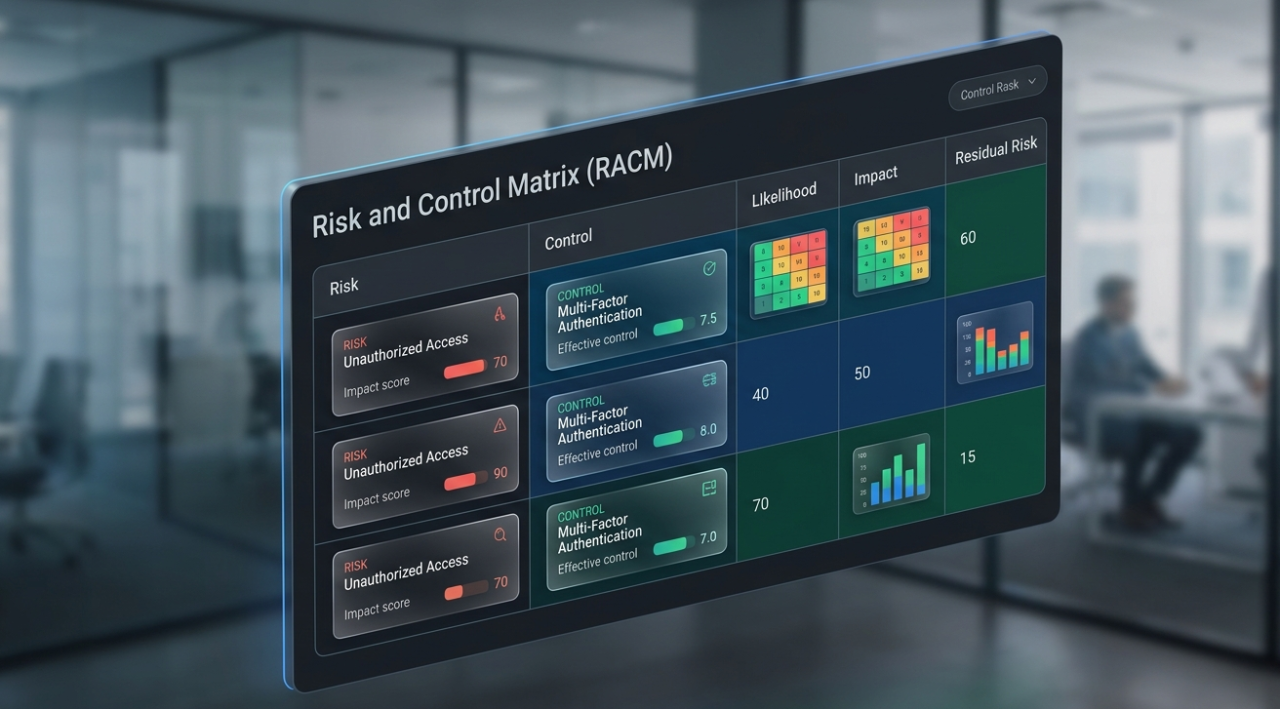
A Risk and Control Matrix (RCM) maps risks to controls, ownership, testing, and evidence.
Most audit findings in banks are not due to missing controls. They happen because controls are not mapped to risks, testing is not defined, and evidence is missing. This is not just a compliance issue—it is a Risk and Control Matrix (RCM) problem.
This guide provides a complete, audit-ready structure used by banks—including definition, example, template, audit checklist, comparison with risk register, and how to avoid common RCM failures.
1. What is a Risk and Control Matrix (RCM)?
A Risk and Control Matrix (RCM) is a structured framework that maps business risks to controls, along with ownership, testing procedures, and evidence.
RCM = Risk Identification + Control Mapping + Ownership + Testing Procedures + Evidence Tracking
This ensures every risk is measurable, testable, and auditable. Without an RCM, organizations cannot demonstrate that controls are effective or that risks are properly managed.
2. Why RCM is Critical in Banking
Banks operate under continuous regulatory scrutiny, including RBI inspections, internal audits, and ISO 27001 assessments.
Auditors validate:
- Every risk has a control
- Every control has an owner
- Every control is tested
- Every test has evidence
In most audits, a significant portion of observations are linked to weak control testing and missing evidence. A well-structured internal audit RCM eliminates these gaps.
3. Who Should Use a Risk and Control Matrix?
- Risk and Compliance teams
- Internal auditors
- IT security teams
- Vendor risk (TPRM) teams
If you are responsible for audit readiness, an RCM is a mandatory control framework.
4. RCM Audit Checklist (RBI / Internal Audit Ready)
Before your next audit, validate your risk control matrix:
☐ Every risk is mapped to at least one control
☐ Every control has a clearly assigned owner
☐ Every control has a defined test procedure
☐ Evidence is stored and retrievable
☐ Last tested date is available
☐ Failed controls have remediation actions
5. Risk and Control Matrix Example for Banks
Use Case: Access Management
| Process | Risk | Control | Type | Owner | Test Procedure | Evidence |
|---|---|---|---|---|---|---|
| User Access | Unauthorized access to systems | Multi-factor authentication enforced | Preventive | Head of IT Security | Review authentication logs | System logs |
| Access Review | Excess privileges | Quarterly access review | Detective | IT Operations Manager | Sample testing of approvals | Review reports |
This is a typical control testing matrix used in audits.
6. Risk and Control Matrix Template (Excel Format for Audit)
Looking for a ready-to-use RCM template?
A standard Risk and Control Matrix Excel template should include:
- Risk description
- Control mapping
- Control owner
- Testing procedure
- Evidence tracking
- Risk scoring (inherent and residual)
- Compliance mapping (RBI, ISO 27001)
This ensures your RCM is scalable, consistent, and audit-ready.
⚠️ If these are missing, your RCM will fail audit validation.
📥 Download Audit-Ready RCM Template (Excel)
Looking for a risk control matrix template in Excel?
This RCM template is designed for audit readiness and includes control testing, evidence tracking, and compliance mapping.
Download RCM Template (Excel)7. How to Create an RCM: Step-by-Step
- Identify critical processes (payments, vendors, customer data)
- Define risks clearly (avoid generic statements)
- Map controls that are measurable
- Define testing procedures and evidence
- Align with RBI, ISO 27001, and NIST frameworks
8. RCM vs Risk Register vs Control Matrix
| Aspect | Risk and Control Matrix (RCM) | Risk Register | Control Matrix |
|---|---|---|---|
| Primary Purpose | Validates risks through mapped controls, testing, and evidence | Identifies and prioritizes risks | Documents controls across processes |
| Scope | End-to-end: risk → control → testing → evidence | Risk identification only | Control definition only |
| Includes Controls | Yes | No | Yes |
| Includes Testing & Evidence | Yes | No | No |
| Ownership | Defined at control level | Defined at risk level | Sometimes |
| Audit Readiness | High | Low | Partial |
| Regulatory Alignment | Strong (RBI, ISO 27001, NIST) | Limited | Moderate |
| Role in Audit | Primary document | Supporting | Reference |
9. Real Audit Scenario: Why RCM Fails
In a recent internal audit, a bank had defined access controls but could not provide evidence of testing.
Result: Control marked ineffective → Audit observation raised → Remediation required within 30 days
Root cause: The RCM did not include testing procedures and evidence tracking.
This is one of the most common failures in RCM implementation.
10. Where RCM Fits in GRC
- Third-Party Risk Management (TPRM) – Vendor risks mapped to controls
- Audit Management – Control testing and evidence tracking
- ISO 27001 compliance – Control mapping and validation
- Operational risk management – Banking processes and control effectiveness
11. Common Mistakes in RCM Implementation
- Generic controls that cannot be tested
- No evidence mapping
- Ownership assigned to teams instead of individuals
- Static Excel sheets with no version control
- No linkage with vendor risk or audit
12. When Excel-Based RCM Breaks Down
Excel becomes ineffective when:
- Controls scale across teams
- Multiple audits run simultaneously
- Evidence tracking becomes manual
At this stage, RCM becomes documentation instead of a control system.
Ready to move from static spreadsheets to a living RCM system?
Request an ASPIA Demo13. RCM Maturity Model
| Level | Name | Characteristics |
|---|---|---|
| Level 1 | Basic | Excel-based. No testing. No ownership clarity. |
| Level 2 | Structured | Defined risks & controls. Manual testing. Partial evidence. |
| Level 3 | Audit-Ready | Standardized RCM. Testing defined. Evidence tracked. |
| Level 4 | Integrated GRC | RCM linked with TPRM, Audit, Incident management. Real-time visibility. |
Most banks are stuck between Level 1–2.
14. Final Takeaway
RCM is not a document you prepare for audits. It is a system you operate continuously.
Weak RCM leads to:
- Repeated audit findings
- Untracked risks
- Reactive compliance
Strong RCM leads to:
- Audit readiness
- Clear control ownership
- Measurable risk reduction
If your RCM lives in static spreadsheets, you are managing documentation—not risk.
15. How Aspia Transforms RCM Management
Instead of treating RCM as a spreadsheet, Aspia makes it a living control system:
- Map risks → controls → audits in one place
- Link RCM directly with TPRM and vulnerability management
- Built-in control testing workflows
- Evidence repository for audits
- Real-time dashboards for risk visibility
16. Frequently Asked Questions (FAQs)
What is RCM in audit with example?
How to create RCM step by step?
What is RCM template in Excel?
Is RCM required for RBI compliance?
What is the difference between RCM and risk register?
Transform RCM with ASPIA
ASPIA provides a unified GRC platform that transforms RCM from static spreadsheets into living control systems. Our solution enables organizations to:
✓ Map risks → controls → audits in one place
✓ Link RCM directly with TPRM and vulnerability management
✓ Automate control testing workflows
✓ Maintain evidence repository for audits
✓ Achieve real-time risk visibility with dashboards